

A renowned physician, a highly respected scholar.
"In our country during the Le Dynasty, there were two renowned physicians: One was Le Lan Ong from Lieu Xa village, residing in Nghe An . Lord Trinh Tinh Vuong often invited him to the capital to treat illnesses. He authored the books Lan Ong Complete Works , Mong Trung Giac , and Chan Dau Chuan Truong. His learning was profound, his arguments accurate, but he rarely used strong herbal remedies. Scholars at the time considered his words to be precious aphorisms," these are very early records praising the medical talent of the renowned physician Le Huu Trac in Vu Trung Tuy But , showing that his reputation had been passed down through generations from a very early age.
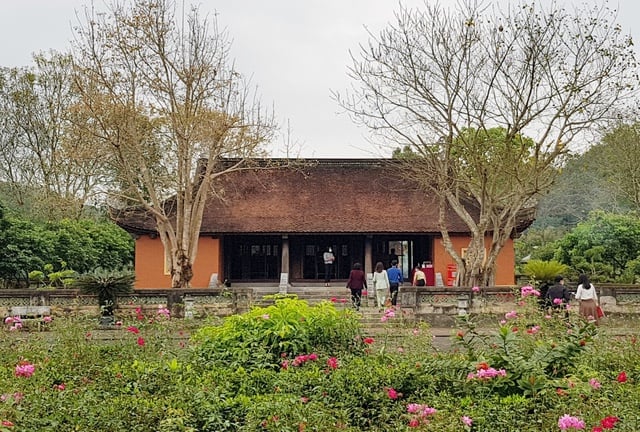
Hai Thuong Lan Ong Le Huu Trac Memorial Area, Son Giang Commune, Ha Tinh Province
PHOTO: DINH BA
According to the imperial decree sent to the governor of Nghe An province, as recorded in Thuong Kinh Ky Su and in Dai Nam Nhat Thong Chi , Le Huu Trac was from a family of scholars, originally from Duong Hao district, Hai Duong province. His given name was Chieu Bay, and he resided in his mother's village, Tinh Diem village, Huong Son district, Ha Tinh province.
In terms of his writings, Hai Thuong Lan Ong left behind many works, including two important ones that are widely known and highly valuable in both medicine and literature. These are Tan Hue Hai Thuong Y Tong Tam Linh Duong An Toan Trach , abbreviated as Lan Ong Y Tap , which is the Hai Thuong Y Tong Tam Linh collection comprising 66 volumes, and Thuong Kinh Ky Su (Record of the Journey to the Capital). The Dai Nam Nhat Thong Chi praised him as a person with "abundant talent and a generous character," and also noted that he was "very skilled in medicine, his works include Lan Ong Y An . Later generations only knew him as a famous physician, not as a highly accomplished scholar." Although living far from the capital, Hai Thuong Lan Ong's reputation for medicine spread as far as Thang Long (Hanoi).
When Prince Cán, son of Lord Trịnh Sâm, fell ill, the Regent, Duke Huy Quận Hoàng Đình Bảo, who had served in Nghệ An and already knew of his talent, recommended him to the Lord, inviting him to the capital to treat the illness. This Regent once told his son, "The master's medical skills are unmatched today"; and on another occasion, he told Lord Trịnh Sâm about Hải Thượng: "Although his language is crude, his medical knowledge is profound; perhaps no other doctor in the world today can surpass him." In the royal palace, there was no shortage of skilled medical professionals caring for the health of the emperor and the royal family, yet they had to call upon a doctor from a remote mountain village, further demonstrating the authority's high regard for Hải Thượng Lãn Ông's expertise.
Fame and fortune cannot bind us.
Born into a prestigious family, Lê Hữu Trác was not burdened by fame and fortune. He called himself the lazy old man of Hải Thượng, showing his desire to escape the hustle and bustle of life and live peacefully in the countryside, "indulging in pleasures, either fishing at Nghinh Phong pavilion, playing the zither under Tịch Huyên roof, reading at Tối Quảng pavilion, or playing chess at Di Chân's house before sleeping. Finding joy at will," as recorded in Thượng Kinh Ký Sự . The Thượng Kinh Ký Sự, published in 1945 and translated by Thiên Lý Nguyễn Di Luân, is considered to partly reflect the character of Hải Thượng Lãn Ông: "It vaguely recalls the image of a patriotic scholar eagerly abandoning his studies, taking up sword and bow for a great cause, traveling far and wide, hoping to reverse the chaotic world, and then one day, having cast aside fame and fortune, returning to enjoy the mountains and rivers, transforming himself from a scholarly general into an old physician, saving people and establishing a medical system whose fame will be passed down to future generations."
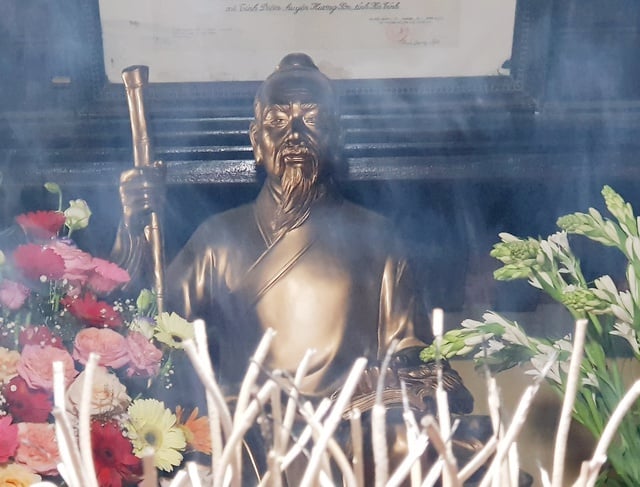
Statue of Hai Thuong Lan Ong at the Hai Thuong Lan Ong Le Huu Trac Memorial Area, Son Giang commune, Ha Tinh province.
PHOTO: DINH BA
In a Confucian society that demanded men to "cultivate themselves, manage their families, govern the country, and bring peace to the world," establishing oneself and one's career was the measure of a scholar's success. Moreover, Le Huu Trac was a man of letters and talent, the son of a high-ranking official. Yet, he chose to shun the corrupt and turbulent world of the Le Dynasty and Trinh Lords, seeking refuge in the countryside to practice medicine, as he himself confided in his " Record of the Journey to the Capital" : "Building a thatched hut at the foot of Huong Son mountain, caring for my mother, reading books, finding joy in the teachings of Hien and Ky, first protecting myself, then helping others, considering myself to have achieved enlightenment." The following verses of his partly reflect the character of Hai Thuong Lan Ong: "I am too lazy to do good, why bother with evil? I do not care about wealth, why worry about poverty?"
Just look at how he devoted himself to treating Lord Trinh's illness, was granted 20 servant soldiers, and enjoyed the same privileges as a high-ranking official in the military. It's frightening to see how he became entangled in the pursuit of fame and fortune. Even officials of that time, upon hearing the story, were surprised, saying: "People rejoice at 'gaining an official position,' but this man considers 'losing an official position' fortunate. Truly, he's different. The ancients said: 'A mountain cave is not the same as a high-ranking official's dwelling, meaning the elegance of a mountain cave is no less than the wealth and prestige of a high-ranking official.' This shows that fame and fortune cannot bind people, and money cannot blind them.
Therefore, the affirmation and praise of the lay Buddhist monk Tieu Son in the "Preface" to the book " Records of the Journey to the Capital" is not an exaggeration at all: "In life, many people, as soon as they have the slightest talent or honor, are quick to boast and record it to pass on the honor to their family. Moreover, Mr. Lan had the opportunity to participate in the royal family's medical work, was close to the emperor, and was treated very well by the king. He refused rewards of gold and silver, and did not accept official titles. Many times, citing old age and weakness, he asked permission to return to his hometown." (to be continued)
Source: https://thanhnien.vn/tinh-tu-dat-viet-nghe-y-cuu-nguoi-tren-het-185251212223602033.htm




















![[Image] Close-up of the newly discovered "sacred road" at My Son Sanctuary](/_next/image?url=https%3A%2F%2Fvphoto.vietnam.vn%2Fthumb%2F1200x675%2Fvietnam%2Fresource%2FIMAGE%2F2025%2F12%2F13%2F1765587881240_ndo_br_ms5-jpg.webp&w=3840&q=75)

















































Comment (0)