

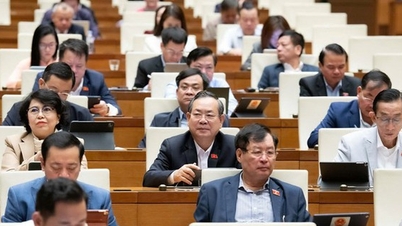
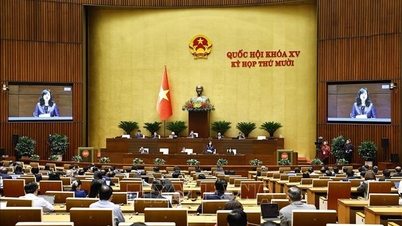
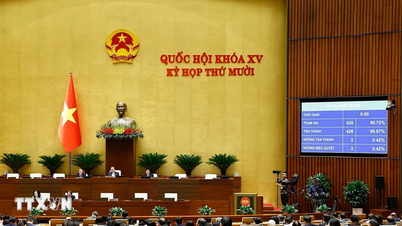
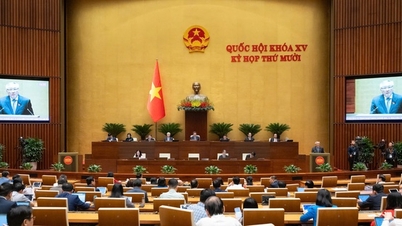
On the afternoon of December 2, the National Assembly discussed the national target program on modernizing and improving the quality of education and training for the 2026-2035 period.
Inequality of educational opportunities in the heart of urban areas
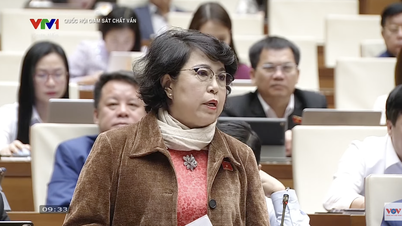
Delegate Nguyen Hoang Bao Tran, Deputy Director of the Department of Science and Technology of Ho Chi Minh City, said that inequality in educational opportunities exists not only in mountainous areas but also in the heart of urban areas.
According to the female delegate, for many years, when talking about difficulties in education, we often mention remote areas, islands, but there is also a group of people who are equally difficult, which is the children of workers in industrial parks and export processing zones.
"Children living in urban areas, near the center, seem to have more favorable conditions, but in reality, workers' lives are still difficult: boarding houses are cramped, most families only live in 10-12 m² boarding rooms, the living environment is not guaranteed, parents work overtime continuously, income is unstable, children do not have space to study, lack social connections, do not have access to extracurricular activities...", the female delegate cited.
According to delegate Nguyen Hoang Bao Tran, if compared to children in mountainous areas, the difficulties of the two groups are different in form, but the common point is that they are both disadvantaged: Lack of quality learning environment, lack of support from family, and lack of opportunities for comprehensive development. In some places, more than 70% of children in industrial zones do not have the opportunity to study gifted subjects, foreign languages or extracurricular activities because their family's economic conditions do not allow it.
Therefore, the female delegate suggested that the National Target Program must clearly identify children of workers as a group that needs priority support, not just a general group. Not only should they be prioritized in scholarship policies, but they should also be supported in building public schools near industrial parks, with flexible boarding school models; creating community learning spaces in boarding houses...
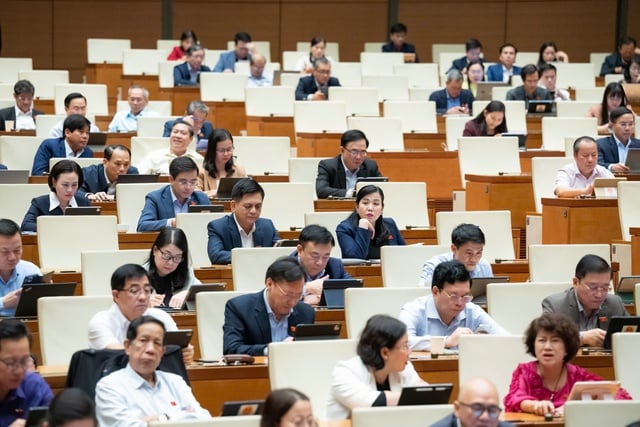
On the afternoon of December 2, the National Assembly discussed the national target program on modernizing and improving the quality of education and training for the 2026-2035 period.
"Teachers need not only allowances, but also a clear path for development"
Regarding the development of the teaching staff, over the past 20 years, according to Ms. Nguyen Hoang Bao Tran, we have applied many models of rotating teachers to difficult areas, but the number of teachers willing to stay long-term is not much, and the effectiveness of the traditional rotation policy shows signs of decreasing.
"Teachers not only need allowances, but also need a clear career development path and be properly recognized," said the female delegate.
From there, the female delegate of Ho Chi Minh City proposed a "Learning - Experience - Contribution" mechanism for young teachers. Instead of requiring rigid rotation as an obligation, it is necessary to design a career path for in-depth professional learning, trained to international standards; then, experience in difficult areas for 1-2 years, but with benefits: Priority for excellent teacher exams, priority for upgrading...
Ms. Nguyen Hoang Bao Tran proposed supporting teachers' housing according to minimum standards, because in reality, in mountainous and island areas, many teachers still have to live temporarily, lacking electricity and water. "It is necessary to invest in standard public housing with basic amenities," Ms. Tran said.
Next, there should be a policy to support scholarships for teachers' children. This is a humane policy, creating peace of mind, reducing the burden on families, and encouraging teachers to stay. In particular, there should be scholarships for professional development for teachers in disadvantaged areas. Support good teachers to study further, attend high-quality training courses at home and abroad.
The number of subjects we have is twice as many as other countries.
Meanwhile, delegate Tran Anh Tuan (HCMC delegation) expressed his opinion on the need to reduce the number of subjects for students.
The delegates recognized that the quality of students is also affected by the content of the program. In fact, the number of subjects at all levels in our country is very large. Compared to developing countries, the number of subjects in a semester is very high, almost double. The ability of students to absorb the amount of knowledge and subjects is very large.
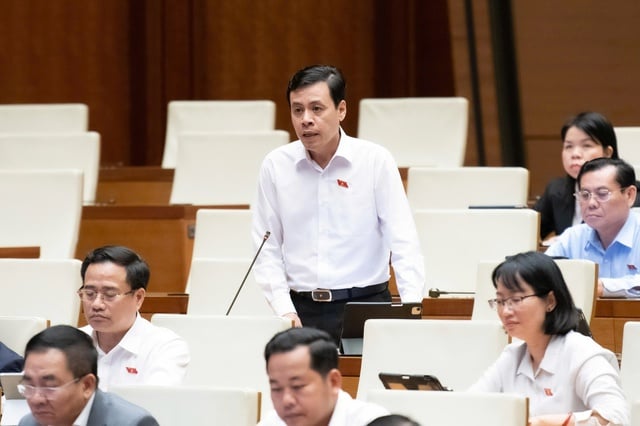
Delegate Tran Anh Tuan (HCMC delegation)
Therefore, Mr. Tran Anh Tuan suggested reviewing and re-evaluating the number of subjects, teaching methods and the number of subjects per semester at all levels. From there, design a program suitable to the absorption capacity of students, in order to improve the quality of students after graduation.
Source: https://phunuvietnam.vn/de-nghi-co-chinh-sach-ho-tro-giao-duc-cho-con-em-cong-nhan-238251202194240572.htm
![[Photo] Worshiping the Tuyet Son statue - a nearly 400-year-old treasure at Keo Pagoda](/_next/image?url=https%3A%2F%2Fvphoto.vietnam.vn%2Fthumb%2F1200x675%2Fvietnam%2Fresource%2FIMAGE%2F2025%2F12%2F02%2F1764679323086_ndo_br_tempimageomw0hi-4884-jpg.webp&w=3840&q=75)
![[Photo] Parade to celebrate the 50th anniversary of Laos' National Day](/_next/image?url=https%3A%2F%2Fvphoto.vietnam.vn%2Fthumb%2F1200x675%2Fvietnam%2Fresource%2FIMAGE%2F2025%2F12%2F02%2F1764691918289_ndo_br_0-jpg.webp&w=3840&q=75)




























![[Video] Protecting World Heritage from Extreme Climate Change](https://vphoto.vietnam.vn/thumb/402x226/vietnam/resource/IMAGE/2025/12/03/1764721929017_dung00-57-35-42982still012-jpg.webp)




















































Comment (0)