

Create dynamics and standardize assessment
The Ministry of Education and Training is widely soliciting public opinion for the draft Circular on Promulgating the Foreign Language Competency Framework for Vietnam. The draft Circular on Promulgating the Foreign Language Competency Framework for Vietnam was developed to replace Circular No. 01/2014/TT-BGDDT dated January 24, 2014, to meet the requirements of innovation in foreign language teaching and learning in the current period. This draft Circular has many important adjustments, updating modern language education trends.
Speaking with reporters of the Vietnam Women's Newspaper, Associate Professor Dr. Vo Thi Hong Le, Faculty of Foreign Languages, Ho Chi Minh City University of Economics, commented that the Draft Circular on Promulgating the Foreign Language Competency Framework for Vietnam has become closer to practical needs and modern assessment trends, with changes suitable to new requirements in teaching, learning and assessing foreign language proficiency.
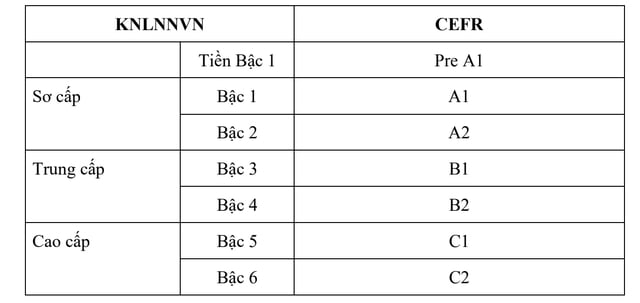
Expected foreign language proficiency framework
In particular, the foreign language competency framework for Vietnam is expected to include a total of 7 levels (for Reading Comprehension, Listening Comprehension, Speaking, Writing, Intermediate Skills) instead of only 6 levels as at present. Associate Professor, Dr. Vo Thi Hong Le commented: "Firstly, in the situation where parents let their children learn foreign languages early, expanding the framework to 7 levels, adding the Pre-A1 level will help to have a clearer assessment level, more suitable for the abilities of children and new learners, creating motivation to learn.
Second, at foreign language schools and centers, having such a clear and detailed competency framework will create consistency in the assessment of each skill (listening, speaking, reading, writing, etc.), helping to standardize the quality of teaching and assessment.
Third, when the Vietnamese foreign language framework is linked to the CEFR (the 7-level framework is expected to be based on CEFR 2020), it will help learners/teachers/schools easily link with international certificates and standards, making it convenient for studying, studying abroad, and working," Associate Professor, Dr. Vo Thi Hong Le shared.
Vietnam's foreign language proficiency framework is updated according to the criteria and content of the Common European Framework of Reference for Languages (CEFR) in 2020, contributing to ensuring compatibility with language education standards that are widely used globally, experts said.

Associate Professor, Dr. Vo Thi Hong Le, Faculty of Foreign Languages, University of Economics Ho Chi Minh City
Build clear criteria for each level
In addition, Associate Professor Dr. Vo Thi Hong Le said that when changing the Foreign Language Competency Framework, the competency descriptions for each skill need to be supplemented and specified, thereby providing an accurate and useful reference basis for managers, program development experts, document editors, teachers and learners in approaching advanced standards. "First of all, the criteria for Pre-A1 need to be clear, specifically how they differ from the A1 criteria to avoid ambiguous assessments, which can easily cause difficulties in the implementation process."
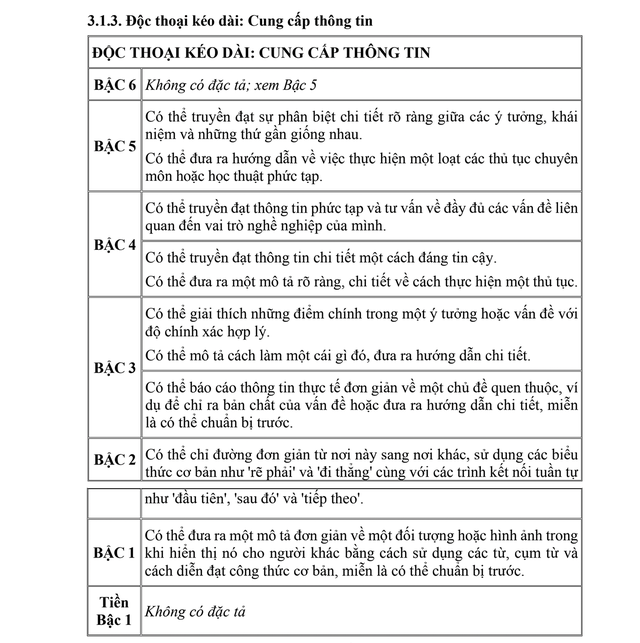
In the Draft, the description of the competencies of Pre-Level 1 and the Extended Monologue skill level of the speaking skill section is not specified.
At the same time, teachers and examiners need to be fully informed about the purpose and positive points of the change and trained to differentiate and evaluate the levels correctly, especially at the elementary level, the female expert emphasized.
In particular, the implementation issue related to the change of curriculum requires the addition of a pre-primary level and the allocation of more time and teachers and administrators, which also needs to be planned and supported by school leaders at all levels.
In addition, it is necessary to consider to limit the inconvenience when the competency framework changes, what will happen to the certificates according to the old framework?
Associate Professor, Dr. Vo Thi Hong Le said that international certificates under the old framework need to have clear instructions and announcements about the time to change to certificates under the new framework. At the same time, this change time needs to be appropriate to have time to prepare necessary steps related to schools, lecturers and learners.
In addition, in cases where equivalent conversion is possible, there should be clear instructions on conversion and equivalence criteria.
Finally, the Draft adds a table of contents on the adjusted contents and objectives of the new framework, helping learners and teachers to easily follow and apply in the teaching and assessment process, grasp faster, increase transparency and convenience in implementation.
The draft Circular is developed in accordance with the spirit of Decision 2371/QD-TTg dated October 27, 2025 of the Prime Minister on making English the second language in schools for the period 2025-2035, with a vision to 2045.
The new Circular is expected to take effect from January 1, 2027 and replaces Circular 01/2014/TT-BGDDT promulgating the 6-level Foreign Language Competency Framework for Vietnam previously. The Foreign Language Competency Framework for Vietnam issued with this Circular is the basis for implementing teaching, evaluating and developing foreign language programs in the entire education system.
Source: https://phunuvietnam.vn/can-cu-the-hoa-tieu-chi-danh-gia-khung-nang-luc-ngoai-ngu-moi-dung-cho-viet-nam-20250930134621256.htm































![[Photo] Parade to celebrate the 50th anniversary of Laos' National Day](/_next/image?url=https%3A%2F%2Fvphoto.vietnam.vn%2Fthumb%2F1200x675%2Fvietnam%2Fresource%2FIMAGE%2F2025%2F12%2F02%2F1764691918289_ndo_br_0-jpg.webp&w=3840&q=75)
![[Photo] Worshiping the Tuyet Son statue - a nearly 400-year-old treasure at Keo Pagoda](/_next/image?url=https%3A%2F%2Fvphoto.vietnam.vn%2Fthumb%2F1200x675%2Fvietnam%2Fresource%2FIMAGE%2F2025%2F12%2F02%2F1764679323086_ndo_br_tempimageomw0hi-4884-jpg.webp&w=3840&q=75)









































![[Infographic] 3 timelines of the "Quang Trung Campaign"](https://vphoto.vietnam.vn/thumb/402x226/vietnam/resource/IMAGE/2025/12/04/1764800248456_fb_ava-2.jpeg)













Comment (0)