

It is important to understand exactly what is meant by "second language" in school.
First of all, it is necessary to clarify the basic concept of "second language". In linguistics, this concept is understood as a language that is not the mother tongue, but is widely used in the society where the learner lives, not only in school but also in work and daily communication. That language must be used for real communication, not just learned in the classroom. For example, in India, Singapore, and the Philippines, English is the second language.
In Vietnam, in the future, English will still be just a foreign language, even though it is an important foreign language and at some point, many Vietnamese people may use it fluently.
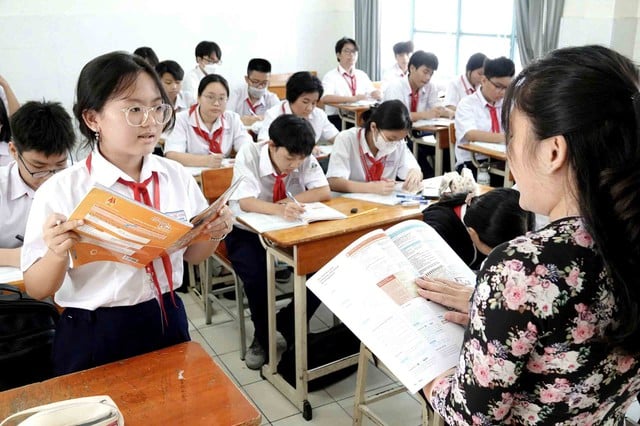
Teachers are the key factor in implementing the project of making English the second language in schools.
PHOTO: DAO NGOC THACH
The concept of "second language" in the Government's project is used in a different way: with the addition of the qualifier "in school", which narrows the scope of the concept. This can be considered a metaphorical use, expressing the state's policy orientation: In school, English is not only the subject of a subject but also a means of teaching and communication. Thus, the expression "second language in school" is not academically accurate (it can cause misunderstanding when communicating to the world ) but is acceptable to interpret a policy: to upgrade English to a special position, more important than a normal foreign language. This special position is only shown in that English is not only taught as a foreign language but also used to teach a number of other subjects.
As for "forming an ecosystem of English use in schools", it only stops at using English in club activities and group activities of students. If English is used during flag salutes, class activities, professional activities of teachers, in communication between the board of directors, medical staff, security guards and students... then it seems unnatural.
The policy of teaching English as a compulsory subject from grade 1 from 2030 is part of the strategy to make English a second language in schools as mentioned above. This is a step forward compared to the regulations in the 2018 General Education Program when it stipulates that in grades 1 and 2, students can study English as an elective subject, with study time not exceeding 70 periods/year, or 2 periods/week. In recent years, students in many schools, especially private schools and public schools in large cities, have chosen to study English from grade 1. Therefore, making this subject a compulsory subject can be seen in a positive way as creating equal opportunities for all students, even students in disadvantaged areas can access English early, not being at a disadvantage compared to their peers in the city.

An English lesson for students in Ho Chi Minh City
Photo: Dao Ngoc Thach
Need to fix English program, textbooks?
However, this policy poses many challenges. Firstly, the teaching staff will be seriously lacking, so the need for training and development is extremely large.
Second, without a suitable teaching method, it will create a great learning burden for students. From grade 1, students have to spend a lot of time getting used to Vietnamese writing, and have to practice a lot to form and develop skills, especially reading and writing. For students from ethnic minority groups, in addition to Vietnamese, they can also learn a minority language. Now, with English added, they have to learn 3 languages at the same time.
Third, the current English textbooks are compiled according to the output standards of the 2018 General Education Program, the study time in primary school is only 3 years. If teaching is compulsory from grade 1, will the output standards for grade 5, and then grade 9 and grade 12, be raised? If raised, will the program and all English textbooks have to be re-compiled?
Speaking of methods, if teachers do not have good English skills and do not know how to take advantage of the support of machines and technology, students may mispronounce right from the start, which will be very difficult to correct later. Learning early then becomes more harmful than beneficial.
The curriculum and textbooks can remain the same if English is taught in grades 1 and 2 in the same way as in the past few years, only changing from optional to compulsory. In the first two years of primary school, students mainly get acquainted and practice English communication through learning activities organized by teachers with the effective support of machines and technology. Study time should also be limited to about 70 periods/year as it has been for a long time.
If the Government ’s project is considered a long-term strategy, the current shortage of teachers is a reality that we must accept. However, this reality cannot last long. The 5-year preparation roadmap is not long, just enough to train a few university courses in English pedagogy.
Teachers for English are similar to teachers for IT in the 2018 Program. Making IT a compulsory subject from grade 3 is a difficult decision after much debate. Making IT a compulsory subject from grade 3 means we are ahead of many developed countries, but we are also facing the reality that many public schools lack teachers, facilities, and equipment. The results of teaching this subject have not been as expected. The preparation of teacher resources, facilities, and equipment for English can also be learned from that experience.
Teaching English as a "second language in schools" needs to be interpreted in the context of Vietnam's project implementation with specific and achievable goals. This should be considered a long-term strategy, the result of thorough scientific research; steps should be taken in accordance with the practical conditions of the country, while implementing, surveying and evaluating so that educational innovation is in the right direction and investment resources are used effectively.
Source: https://thanhnien.vn/tieng-anh-la-ngon-ngu-thu-hai-de-xuat-giai-phap-phu-hop-voi-dieu-kien-vn-185251201194237553.htm
























![[Photo] Parade to celebrate the 50th anniversary of Laos' National Day](/_next/image?url=https%3A%2F%2Fvphoto.vietnam.vn%2Fthumb%2F1200x675%2Fvietnam%2Fresource%2FIMAGE%2F2025%2F12%2F02%2F1764691918289_ndo_br_0-jpg.webp&w=3840&q=75)




















































Comment (0)