


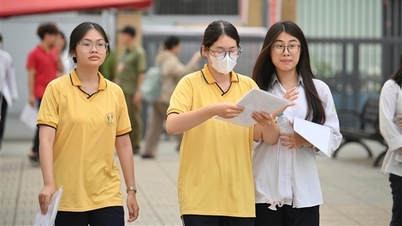
Many universities have stopped considering traditional subjects, mostly C00 (combined literature, history, geography) (Illustration: Huyen Nguyen).
A series of changes in admission combinations
To date, universities have begun to announce their expected enrollment plans for 2026. It is noteworthy that many schools have "eliminated" the traditional exam block.
The University of Social Sciences and Humanities, Vietnam National University, Hanoi has just announced that 15/30 majors of this school will not recruit block C00 (combined literature, history, geography) in 2026. This includes many "hot" majors such as Journalism, Oriental Studies, Korean Studies, Public Relations, Psychology...
The school also stopped considering block D66 (literature, English, economic and legal education), C03 (math, literature, history), C04 (math, literature, geography) for all majors. The main combinations used by the school all have foreign languages such as English, Chinese, Korean, and Japanese.
According to the school's explanation, adding foreign languages to the admission combination is to suit training practices and the goal of making English the second language in schools.
The school's policy of using foreign language combinations and eliminating C00 exam requirements for some majors was introduced in the 2025 admissions season but was met with resistance from students and parents. This year, the school announced it earlier.
Meanwhile, the Political Officer School also said that it will no longer use the A00 (math, physics, chemistry) and C00 (literature, history, geography) combinations for enrollment in 2026. Instead, the school added the C01 (literature, math, physics) group, in addition to the old combinations, including C03 (literature, math, history), C04 (literature, math, geography) and D01 (literature, math, English).
Similarly, in 2026, the Border Guard Academy will only use three admission combinations, including C03, C04, and D01, for both Border Guard and Law majors. Compared to this year, the school has eliminated two traditional combinations, C00 and A01 (math, physics, English).
Explaining this adjustment, the school said that the change in the combination is to comply with current admission regulations. The Ministry of Education and Training requires that the combination of subjects for admission must include at least 3 subjects, including math or literature, with a weighting of no less than 25%; from 2026, the total number of subjects in the combination must contribute at least 50% of the weighting.
Therefore, the four combinations that the school plans all take math and literature as the basis, meeting this criterion. These are two compulsory subjects in the high school graduation exam, so 100% of candidates will take the exam. The third subject is physics, history, geography or English.

The C00 university entrance exam combination with subjects of literature, history, and geography is gradually "disappearing" (Photo: Huyen Nguyen).
Meanwhile, the University of Technology, Vietnam National University, Hanoi, plans to stop considering admission to groups D01 and B00 (math, chemistry, biology) when considering graduation exam scores.
In most majors, this school uses 3 combinations including A00, A01, X06 (math, physics, IT). In particular, the two majors of Biotechnology and Agricultural Technology recruit additional combination A02 (math, physics, biology).
Previously, in June, a series of universities also suddenly announced that they would not enroll students in block C00, causing a strong reaction when the announcement was made too late compared to the time candidates registered for the exam, causing students to fall into the situation of "failing before taking the exam".
In addition to Hanoi University of Humanities, this trend also appears at the Academy of Journalism and Communication, the University of Law - Vietnam National University, Hanoi, Hanoi Open University...
Another reason why the C00 block is gradually being eliminated is because according to the current university admission regulations, the admission score is not considered according to each combination or method. Meanwhile, in recent years, the C00 block exam scores have tended to be more prominent, so the new adjustment is to ensure fairness in admission, avoiding the situation of too large a difference between the combinations, making the conversion complicated.
Students rush to change "tactics"
The fact that schools adjust their admission combinations when the high school graduation exam is only in June of the following year makes many students lose their rhythm because if they want to get into a top school or a hot major, the learning process of the core subject has already started from grades 10-11.
For the past half month, Mai*'s family dinner (12th grade student, Nguyen Khuyen High School, Ninh Binh) has only revolved around the story of admission combinations.
Having spent most of her time in block C00, but now a series of universities have "turned their backs" on her, making Mai quite confused.
“I am wondering whether to choose math or English instead. Both of these subjects require a lot of time to learn well, and it is difficult to improve in a few months,” Mai shared.
Mai's friend Nam is also confused, waiting for the official admission regulations.
“With the trend of constantly changing admission methods and combinations like this, I am very worried. I hope that if schools make any changes, they will notify us early, at least 1-2 years so that students can adjust,” Nam confided.

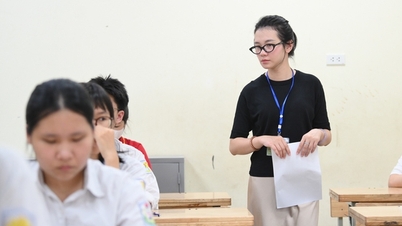
12th grade students in Ho Chi Minh City during a class (Photo: Huyen Nguyen).
Dr. Sai Cong Hong, former Deputy Director of the Department of Secondary Education, Ministry of Education and Training, commented: Over the past few decades, the university admission method in Vietnam has undergone many changes: from the "three-in-one" exam, to the "two-in-one" exam, and then the stage when schools were given autonomy to consider admission based on academic records, competency exams, interviews combined with records...
Each stage is aimed at improvement, but the change is so rapid that it has left many students and teachers confused.
Every year there are a few small changes, each school has a few different methods, forcing students to "follow" the exam, studying according to trends, and not being able to have a long-term orientation.
From there, he believes that it is necessary to regulate the university admission method to be stable for at least 3 years. The 3-year cycle allows students from grade 10 to grade 12 to clearly understand the admission criteria, choose the subject combination and practice appropriate skills.
The need to maintain stability in university admission methods not only helps reduce "shock" for students and schools, but also creates a solid foundation for career orientation and development of students' capacity in accordance with the spirit of innovation.
Sharing the same view, Dr. Le Viet Khuyen, former Deputy Director of the Department of Higher Education, analyzed that the problem does not lie in whether the exam subject combinations are still suitable or not, but in the learning process and orientation of students.
According to the old program, students were required to study all subjects, take exams in 3 compulsory subjects and 3 combined natural science/social science subjects, so announcing the combination close to the exam date would not be too serious.
"But with the 2018 Program, students have to choose elective subjects from grade 10, which is 3 years ago," Mr. Khuyen analyzed.
Therefore, Dr. Le Viet Khuyen emphasized that the announcement of the admission combination should have been done 3 years in advance, right when students were preparing for the 10th grade entrance exam so that they could choose the appropriate combination of elective subjects for both high school and university orientation.
Speaking at the National Assembly about the draft Law on Higher Education (amended) on the afternoon of November 20, delegate Nguyen Thi Thuy (Thai Nguyen delegation) also mentioned the situation where many schools suddenly stopped considering admission for block C00.
Ms. Thuy highly appreciated the reform spirit of the draft Law on Higher Education, but from a specific incident above, she suggested that it is necessary to add many regulations to ensure that university autonomy does not harm the rights of learners.
"We promote university autonomy, but autonomy must be implemented within a time limit and with a reasonable roadmap, avoiding affecting the legitimate rights of learners. We cannot go against the philosophy of putting learners at the center," Ms. Thuy stated her opinion.
* Student names have been changed.
Source: https://dantri.com.vn/giao-duc/tuyen-sinh-2026-nhieu-dh-doi-moi-to-hop-xoa-so-khoi-thi-truyen-thong-20251204012235273.htm


























![[Photo] Parade to celebrate the 50th anniversary of Laos' National Day](/_next/image?url=https%3A%2F%2Fvphoto.vietnam.vn%2Fthumb%2F1200x675%2Fvietnam%2Fresource%2FIMAGE%2F2025%2F12%2F02%2F1764691918289_ndo_br_0-jpg.webp&w=3840&q=75)































































Comment (0)