

The Ministry of Health has proposed a plan to include employees' dependents in the mandatory health insurance scheme, with the state subsidizing 30% of the premium and the remaining 70% shared between the employer and the employee.
In the upcoming report on the impact assessment of the draft Law amending and supplementing several articles of the Health Insurance Law , the Ministry of Health proposes expanding coverage, given that only 92% of the population participates in health insurance, while Vietnam aims to increase this to at least 95% by 2025.
Approximately 8% of the remaining population is not yet covered by health insurance, primarily in the informal sector such as employees in businesses, students, and those participating under household schemes. The main reason is that many people are unaware of the importance of health insurance, only purchasing it when they are sick, especially within households.
The coverage rate for students, especially those in their second year and beyond, remains low due to high fees; although the state subsidizes 30%, the amount paid for health insurance is still substantial for large families.
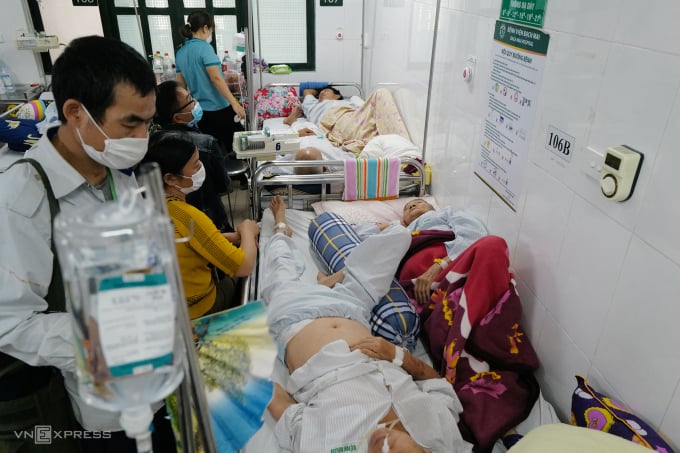
Family members care for a patient at the Neurology Department, Stroke Unit, Bach Mai Hospital (Hanoi), November 2022. Photo: Ngoc Thanh
In order to increase coverage and move towards universal health insurance, the Ministry of Health has proposed three options for expanding the scope of contributions.
Option one involves amending and supplementing some regulations regarding mandatory participation groups to better suit practical realities, such as clarifying the definition of groups like police academy students (including Vietnamese and foreign nationals); children of martyrs (including biological and legally adopted children); and separating retired police officers into a separate group to adjust benefit levels. For self-paying health insurance groups, it includes Vietnamese nationals without identification documents, foreigners residing in Vietnam, and workers on unpaid leave or with temporarily suspended contracts.
Information on several groups, such as people infected with HIV and residents of revolutionary safe zones during the resistance against the French and Americans (bases of the revolution during the resistance), who are currently residing in the locality, has been updated in the National Database on Population and Residence.
The list of groups whose contributions are synchronized with the amended Social Insurance Law is being expanded, including registered business households, workers with contracts of one month or more, and part-time workers.
Assessing the impact of this plan, the Ministry of Health stated that it helps increase revenue for the Health Insurance Fund, providing additional funding for health insurance-covered medical examinations and treatments for healthcare facilities; and improving the quality of people's health. For example, the Health Insurance Fund currently covers 4.3 million dialysis treatments annually, costing 2,400 billion VND. If these patients were not covered by health insurance, they would incur significant medical expenses.
Option two , in addition to the supplementary groups as in option one, proposes that the Ministry of Health include dependents of employees in the mandatory contribution scheme. This group would receive a 30% subsidy from the state, with the remaining 70% contributed by the employee (1/3) and the employer (2/3).
For example, according to current regulations, the health insurance contribution is 4.5% of the basic salary, so the participant pays a total of 972,000 VND. For each dependent, the State subsidizes 30% of the contribution, or 291,600 VND; the remaining 680,400 VND is paid by the employee and the employer. Assuming the employee has four dependents, including parents and two children over 6 years old, current law stipulates that the employee pays 1/3, meaning they will spend an additional 907,200 VND annually; the employer pays the remaining 2/3, or 1,814,400 VND.
The government also has mechanisms to encourage people to pay for health insurance in a lump sum for three years to maintain long-term participation in the Fund.
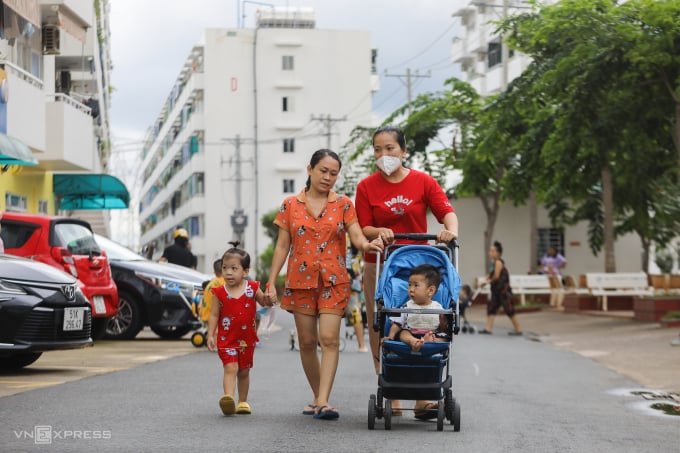
A working-class family in a social housing complex in Binh Tan District, Ho Chi Minh City, August 2022. Photo: Nhu Quynh
The Ministry of Health assesses this plan as expanding coverage, improving people's health, and contributing to an increased supply of human resources for the labor market. The Health Insurance Fund also gains additional revenue; the regulation specifically including dependents of workers in the mandatory contribution scheme increases revenue from 1,159 billion to 3,819 billion VND. The government reduces the financial burden, freeing it up to address future social issues.
However, the above option has a significant impact on social costs. According to preliminary calculations, the state budget would spend an additional 348 billion to 1,146 billion VND annually if it subsidizes 30% of the contribution for dependents of workers.
Businesses increase their spending by 541 billion to 1,782 billion VND annually, offsetting the burden of dealing with employee issues such as sick leave for family members. When family members are covered by health insurance, employees can feel secure in their work and dedicate themselves to the company. In fact, many companies include health insurance coverage as a criterion in their recruitment process to attract candidates.
Creating a mechanism for citizens to pay for health insurance in a lump sum for three years would also impact businesses, as employers would be required to make contributions according to regulations. In that case, businesses would have to pay upfront the periodic expenses that would otherwise be used for production investment. However, the Ministry of Health believes that the amended law could include provisions for partial tax exemption for these expenses.
Each year, workers also allocate an additional amount for health insurance for their relatives, but the drafting agency considers this a necessary expense. The Ministry estimates the total preliminary cost to be approximately 270 billion to 891 billion VND per year. However, with coverage from the Health Insurance Fund, people's financial burden when seeking medical treatment will be reduced, from 43% to 23% by 2025.
The Ministry of Health also clarified that this plan needs to take into account the income capacity of workers, classifying family members according to income groups to provide appropriate and effective contribution support, rather than applying a uniform rate.
Option three involves maintaining the current contribution groups and not adding any new participants. The government would not have to increase budget spending, but would face the burden of addressing social issues related to those without health insurance cards. The goal of universal health insurance coverage would be difficult to achieve.
After weighing the pros and cons, the Ministry of Health chose option three, which is to maintain the current regulations. This is practical given the limited budget and ensures that the law can be amended in time to take effect in 2025.
Option two, which includes adding dependents of employees to the health insurance coverage, will be considered for implementation in the upcoming comprehensive revision of the Health Insurance Law.
The Law amending and supplementing a number of articles of the Health Insurance Law is expected to be submitted to the National Assembly at the May 2024 session and will take effect from January 1, 2025. In addition to expanding the coverage, the Ministry of Health is proposing a roadmap to increase health insurance contributions starting in 2025...
By the end of 2023, nearly 93.7 million people nationwide were covered by health insurance, representing a coverage rate of over 93% of the population. Vietnam aims to achieve health insurance coverage of over 95% of the population by 2025.
Phuong Ha
Source link


![[Photo] Prime Minister Pham Minh Chinh holds a phone call with the CEO of Russia's Rosatom Corporation.](/_next/image?url=https%3A%2F%2Fvphoto.vietnam.vn%2Fthumb%2F1200x675%2Fvietnam%2Fresource%2FIMAGE%2F2025%2F12%2F11%2F1765464552365_dsc-5295-jpg.webp&w=3840&q=75)









































































Comment (0)