

Circular 68, once effective, will provide opportunities for securities companies with solid capital buffers and large market shares, while also increasing competition among securities companies, especially in terms of capital.
Circular 68, once effective, will provide opportunities for securities companies with solid capital buffers and large market shares, while also increasing competition among securities companies, especially in terms of capital.
Opportunities with securities companies that have strong capital and market share.
From November 2nd, 2024, Circular No. 68/2024/TT-BTC dated September 18th, 2024, amending and supplementing a number of articles of the Circulars regulating securities transactions on the securities trading system; clearing and settlement of securities transactions; operations of securities companies and information disclosure on the securities market, officially comes into effect.
The circular amends and supplements the requirement that investors must have sufficient funds when placing a securities purchase order, except in the following cases: Investors trading on margin as prescribed; Organizations established under foreign law participating in investment in the Vietnamese securities market to purchase shares are not required to have sufficient funds when placing an order as prescribed.
Thus, starting from the beginning of November, foreign institutional investors participating in the Vietnamese stock market have been able to buy shares without requiring sufficient funds to place orders as per regulations. This will open up new business opportunities for securities companies; however, not all companies have the advantage to provide this service effectively. The key issue is that securities companies will be responsible for settling transactions for foreign investors when the investor does not have sufficient funds to pay for the executed transaction.
In the initial phase, the advantage will lie with securities companies that have strong capital buffers and large market shares, especially among institutional clients.
Statistics from Investment Online Newspaper on 27 large-scale securities companies show that most companies increased their assets in the first nine months of the year. Among them, five securities companies increased their total assets by more than 50% compared to the beginning of the year, including VIX (+100.5%), KAFI (+96%), ACBS (+92.2%), HSC (+82.7%), and ORS (+64.5%).
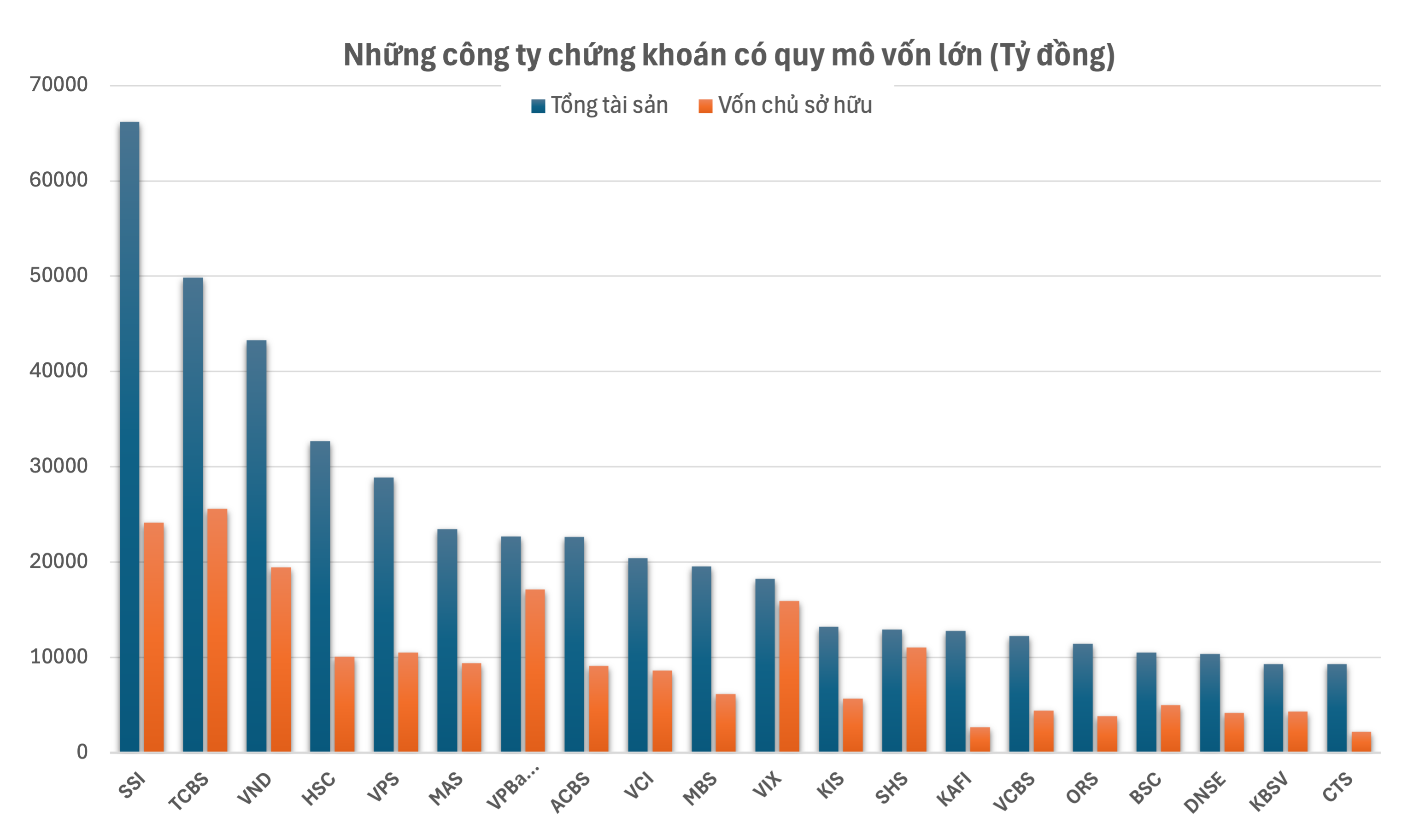 |
Nevertheless, the securities companies with the highest total assets remain familiar names, holding the main market share. Currently, SSI is the company with the highest total assets at VND 66,181 billion as of the end of Q3/2024. This is followed by TCBS and VND with total assets exceeding VND 40,000 billion.
The number of securities companies with total assets exceeding 10 trillion VND has also increased significantly compared to the beginning of this year. The list of companies with capital exceeding 10 trillion VND now includes several new names such as VIX, KIS, KAFI, ORS, BSC, and DNSE.
In terms of equity capital, TCBS currently has the largest equity capital with VND 25,589 billion at the end of Q3/2024. Only 8 companies have equity capital exceeding VND 10,000 billion, followed by TCBS, SSI, VND, VPBS, VIX, SHS, VPS, and HSC. Notably, VIX's equity capital increased by 80% compared to the beginning of the year after a successful share offering to existing shareholders in September 2024.
Competitive pressure will increase.
However, having high capital reserves does not necessarily mean a securities company will have an advantage.
Circular 68 stipulates that the limit for accepting buy orders for shares is equal to the total amount convertible into cash, but not exceeding the difference between twice the equity of the securities company and the outstanding balance of margin trading loans. This means that securities companies with a higher ratio of margin loans to equity will have a lower limit for accepting buy orders for shares.
According to regulations, securities companies are not allowed to lend margin more than twice their equity capital. To date, after a period of rapid margin growth, some securities companies have nearly reached this limit, leaving little room for margin lending.
Statistics from 27 securities companies show that 5 securities companies have nearly reached this threshold. In particular, HSC has the highest margin loan/equity ratio. HSC's outstanding margin loan balance at the end of Q3 2024 was VND 19,286 billion, an increase of nearly 60% compared to the beginning of the year and 1.92 times its equity, meaning HSC only has just over VND 800 billion left for margin lending.
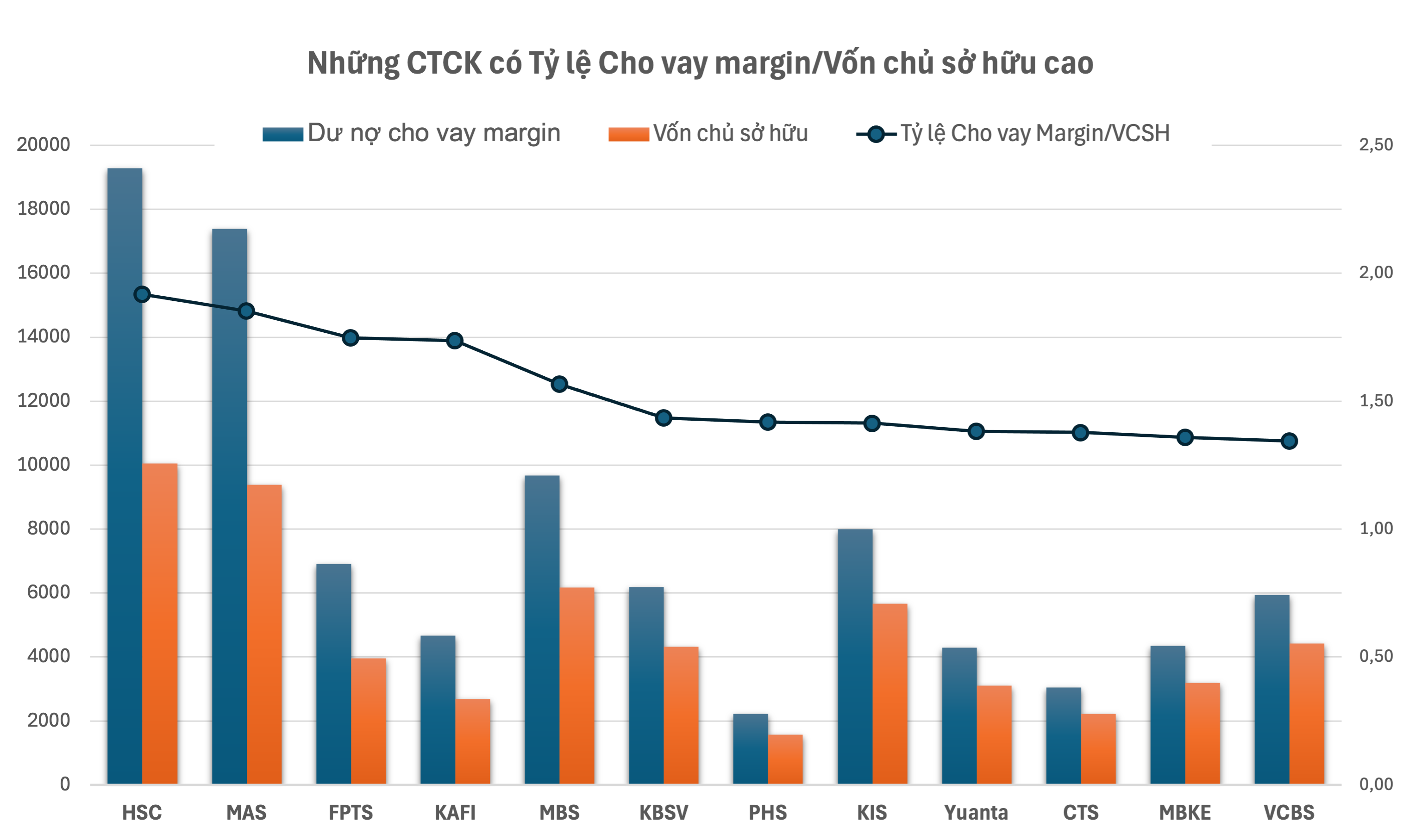 |
At Mirae Asset, margin lending balances have also increased continuously. At the end of the third quarter, this figure was VND 17,385 billion, a 30% increase compared to the beginning of the year. MAS's margin lending balance is currently at 1.85 times its equity. Other securities companies with high margin lending/equity ratios above 1.5 times include FPTS, KAFI, and MBS.
With tight margin lending ratios, securities companies will have to increase their capital, not only to support non-prefunding activities but also to meet margin lending ratio requirements – a segment that is gradually becoming a major contributor to revenue.
VNDirect's analysis suggests that the securities industry will benefit from serving more foreign institutional investors due to increased brokerage income as liquidity rises. However, alongside these benefits, there are potential risks, such as payment risks arising from foreign institutional funds making late payments after T+2 following purchases. Therefore, securities companies need to strengthen risk management related to clients, margin ratios, market conditions, and appropriate lending ratios.
To attract foreign institutional investors, securities companies will compete based on: 1) transaction fees; 2) upfront funding ratio (equity/total purchase value); 3) total value of capital advanced; and 4) quality of service (information and reporting).
Regarding the first factor, although securities firms can provide funding to foreign institutional clients, these clients will still only be charged transaction fees. For the second factor, the ability to offer lower upfront funding rates will provide a competitive advantage. The third factor will depend on the company's equity capital, as securities firms with a larger equity structure will have a distinct advantage.
VNDirect believes that the third factor will increase pressure on securities companies to increase their equity capital, due to regulations limiting the debt-to-equity ratio to no more than five times. In short, large-scale securities companies with low transaction fees and competitive pre-funding ratios will benefit from attracting foreign institutional investors.
Source: https://baodautu.vn/don-non-prefunding-cong-ty-chung-khoan-nao-co-loi-the-d229089.html
![[Photo] Prime Minister Pham Minh Chinh holds a phone call with the CEO of Russia's Rosatom Corporation.](/_next/image?url=https%3A%2F%2Fvphoto.vietnam.vn%2Fthumb%2F1200x675%2Fvietnam%2Fresource%2FIMAGE%2F2025%2F12%2F11%2F1765464552365_dsc-5295-jpg.webp&w=3840&q=75)























































































Comment (0)