


As a framework law connecting various specialized laws, this law shapes the overall picture of Vietnam's digital transformation, ensuring interconnectedness, modernity, and security throughout the entire legal system. The law also provides an important legal basis for concretizing Resolution 57-NQ/TW of the Politburo on breakthroughs in the development of science, technology, innovation, and national digital transformation. Based on this foundation, digital transformation is being implemented synchronously from the central to local levels, contributing to the integration of digital technology into all sectors and directly serving citizens and businesses.
Facilitating access for citizens and businesses.
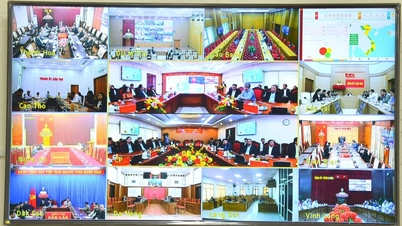
On December 12th, in Hanoi, within the framework of the Conference on Implementing the Targets and Tasks of Civil and Administrative Enforcement in 2026, the Ministry of Justice officially activated the Digital Platform for Civil Enforcement and the Intelligent Monitoring and Operating Center for the Civil Enforcement System.
In the context of implementing a new organizational model towards streamlining and reducing administrative layers while the number of cases continues to increase and their nature becomes more complex, the Ministry of Justice is focusing on implementing digital transformation in civil enforcement work through the deployment of the Civil Enforcement Digital Platform and the Smart Monitoring and Operating Center as stipulated in Resolution 71/NQ-CP 2025 amending the Action Program for implementing Resolution 57-NQ/TW.
With its digital platform and fully digital, modern, and transparent operational processes, this is considered the largest digital transformation platform ever implemented by the Ministry of Justice, with nationwide deployment at the Civil Enforcement Management Department, 34 provincial and city Civil Enforcement Offices, and 355 regional Civil Enforcement Offices, serving over 6,800 users, including civil enforcement officials from leadership and enforcement officers to various operational departments.
The digital platform in the field of civil enforcement is built as a comprehensive solution, seamlessly digitizing the entire civil enforcement process, integrating and linking all business processes, databases, and digital services with groundbreaking benefits. The digital platform allows for the resolution of procedures across administrative boundaries, regardless of geographical distance, helping to reduce the workload of statistical reporting and effectively supporting management and decision-making.
Digital technology, particularly AI, plays a prominent role in automating data extraction, task assignment, and progress monitoring. Citizens can easily interact, search for records, and receive notifications via QR code and VNeID across digital environments. The creation of an accurate, complete, clean, active, unified, and shared database connects civil enforcement agencies with courts, police, the national population database, banks, postal services, and many related ministries and sectors. This helps digitize, automate, and streamline the process of handling and enforcing judgments, resulting in a unified and convenient process for citizens and businesses.
The digital platform comprises four core business subsystems, operating uniformly and seamlessly throughout the entire civil enforcement process and connecting with the Intelligent Monitoring and Operation Center for the Civil Enforcement System (IOC THADS). Civil enforcement officials access the digital platform through a shared portal. After authentication and authorization, users are centrally directed to use specialized business subsystems, serving the entire civil enforcement process, from receiving files, processing, organizing enforcement, to warehousing, funds, and operational monitoring.
On the Digital Platform and Intelligent Monitoring and Control Center, AI is being strongly applied and promoted to shorten processing time, reduce manual work, and enhance accuracy and transparency. The completion of all functions and the implementation of the digital platform in the field of civil enforcement have created and will continue to create a unified, efficient, transparent, and more convenient process for citizens and businesses. Citizens can submit applications quickly online or at the nearest one-stop service center of the civil enforcement agency, regardless of administrative boundaries.
To equip people with the basic skills to use digital platforms.
At the grassroots level, many localities have strongly embraced the digital transformation movement. In Dak Lak, the atmosphere of implementing the digital transformation movement has spread widely from wards and communes to every village, hamlet, and neighborhood, with a focus on concrete actions instead of just slogans.
According to Ms. H'Ler Êban, Deputy Secretary of the Party Committee of Ea Kao Kao ward (Dak Lak province), the ward has established three working groups and strengthened 25 community digital technology teams. These teams coordinate with the Vietnam Fatherland Front Committee of the ward and other organizations and associations to directly visit each household to guide residents on using online public services, installing digital applications, carrying out procedures related to land, civil registration, social security, installing VNeID, and using digital transaction applications; while also continuing to overcome the difficulties faced by many residents who do not yet have smartphones.
According to Mr. Y Vui Ayun, Deputy Secretary of the Party Branch of Hwie hamlet, Ea Kao ward, the hamlet has a community digital technology team. Team members regularly visit residents' homes to guide them on public services, land registration, birth and death registration, etc. However, the local area has many illiterate people who rarely use information technology, and young people are not yet enthusiastic about it, making it very difficult. To overcome this, the digital technology team has to go to people's homes to help them access technology. Through this outreach, most residents have changed their mindset and gained a better understanding of digital technology.
Ms. H'Len Buôn Krông (Hwie village) happily shared that she didn't know how to use a phone before, but with the support of the digital technology team, she now knows how to complete online public service procedures.
According to the Department of Science and Technology of Dak Lak province, the "Digital Literacy Movement" identifies five basic digital skills that need to be popularized: using online public services; online shopping; cashless payments; information security; and applying digital platforms in public administration. The goal of the movement is to change perceptions and form digital habits in the community. Over time, the movement has yielded positive results, with many targets exceeding the assigned plan. The percentage of adults whose digital literacy skills have been enhanced reached 66.3% (target was 60%); the percentage of people guided to use important applications on the VNeID platform reached 66.4% (target was 40%)...
According to Mr. Bui Thanh Toan, Director of the Department of Science and Technology of Dak Lak province, to serve the digital transformation process while ensuring the specific characteristics of the locality, the Department has categorized target groups. The aim is to equip people with basic skills and knowledge about digital transformation not only in central areas but also in remote and rural areas. People will become familiar with and have the basic skills to apply digital platforms and applications to serve production, business, and public administrative procedures.
According to the People's Committee of Dak Lak province, after the implementation of the two-tiered local government system from July 1st, the province has 100% broadband coverage (high-speed internet connection) in villages and hamlets; 99.9% of the population has 4G coverage, 26% has 5G coverage; and the rate of online applications has reached over 35%...
Recently, the People's Committee of Dak Lak province also approved the Digital Transformation Strategy of Dak Lak province - focusing on the development of digital data for the period 2025-2030. The province strives to achieve synchronous and comprehensive digital transformation throughout the province by 2030, basically completing the government's goals; Dak Lak will become a province with a relatively high average level in the country in terms of digital transformation, with a digital data infrastructure formed and developed to create a safe and convenient digital environment, maximizing the needs of production, business, and community life of the people...
Permanent Vice Chairwoman of the Provincial People's Committee Ho Thi Nguyen Thao affirmed that digital transformation is an opportunity for Dak Lak to make breakthroughs and integrate science and technology into all aspects of social life. Launching the intensive campaign "Improving the effectiveness of digital transformation at the commune level," the province aims to complete 94 criteria of the Central Steering Committee before December 19, 2025.
Source: https://baotintuc.vn/thoi-su/dot-pha-theo-nghi-quyet-57-chuyen-doi-so-lan-toa-den-tung-nguoi-dan-20251214120441396.htm


























































































Comment (0)