

Margin pressure and market euphoria
At the end of the third quarter of 2025, the Vietnamese stock market concluded a spectacular growth quarter with the VN-Index reaching 1,661.7 points, a 31% increase compared to the beginning of the year. Accompanying this was a new record high in margin lending, approximately 384,000 billion VND, an increase of over 54% compared to the beginning of the year – an unprecedented level in history.
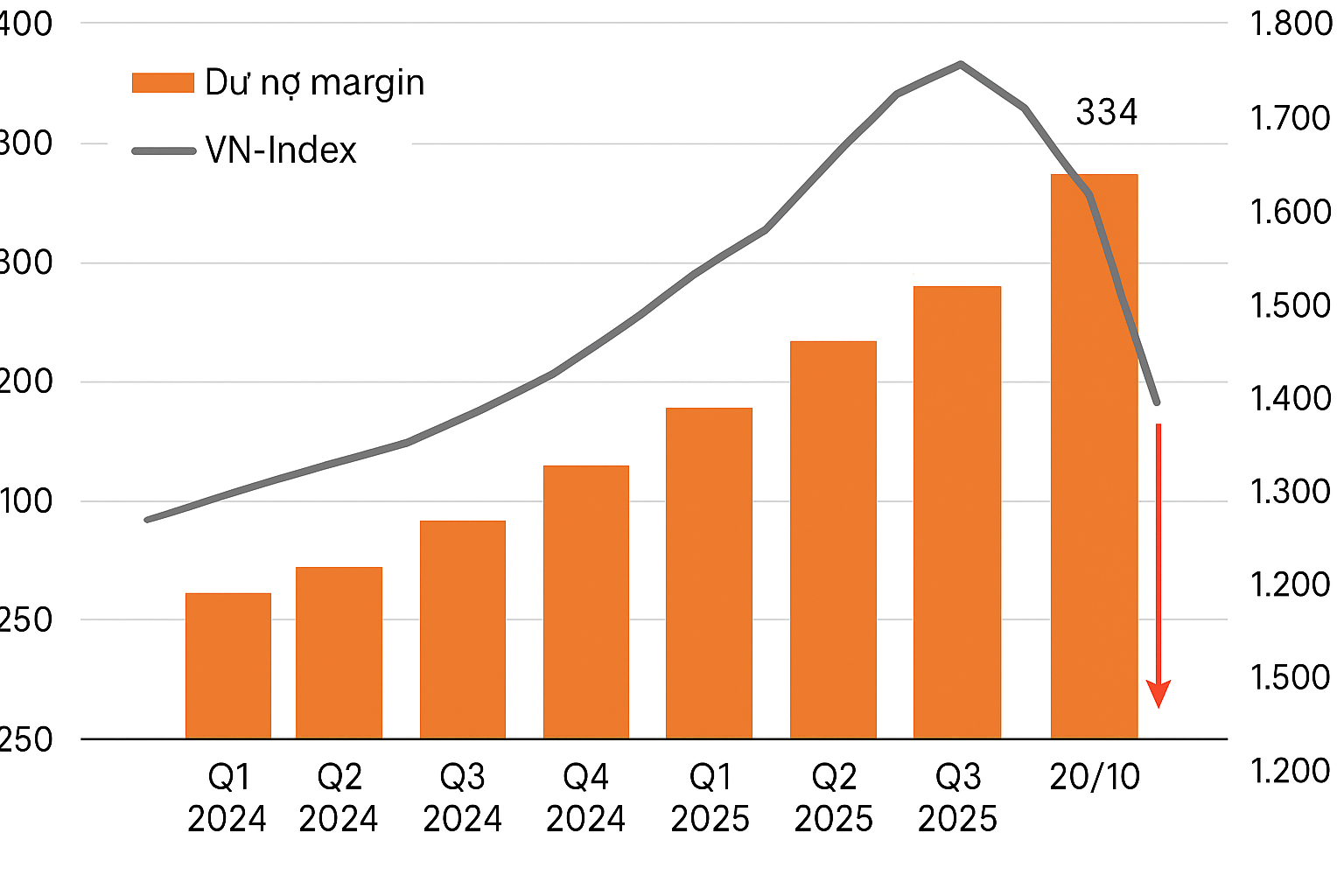
According to VietstockFinance statistics, the top 10 securities companies hold up to 61% of the total outstanding loans in the industry, equivalent to VND 233,000 billion. The two "giants," TCBS and SSI, lead with outstanding loans of VND 41,700 and VND 39,200 billion respectively; followed by VPBankS, VPS, and HSC. Notably, VPBankS and VIX both recorded loan growth of over 180% in just 9 months, demonstrating the strong demand for leveraged capital in the market.
Many believe that margin lending is becoming the main profit driver for the securities industry. However, the current growth rate far exceeds the system's capital absorption capacity. Revenue from margin lending in the third quarter reached nearly VND 9,400 billion, an increase of over 50% compared to the same period last year. With common margin interest rates ranging from 10-13% per year, this is currently the highest-profit source of revenue for securities companies.
Meanwhile, a report by Vietdata Research shows that the total outstanding loan balance across the entire system (including margin loans and advances against sales) has reached approximately VND 383,000 billion, of which margin loans alone account for VND 370,000 billion, equivalent to 120% of the industry's equity, the highest level since 2022. This indicates that the financial leverage of the securities system is at its "hottest" phase in the last three years.
However, according to current regulations, total margin lending cannot exceed twice equity. With the above figure, the market has used more than 60% of its legal lending capacity. In the context of a sharp increase in new investor capital and widespread optimistic investment sentiment, this indicates that leverage is approaching a risk threshold, potentially leading to "capital overload" if the market experiences an unexpected shock.

Commenting on this issue, Mr. Truong Hien Phuong, Senior Director of KIS Vietnam Securities, expressed concern: “Margin leverage is like a double-edged sword. It amplifies profits when the market rises, but it can also cause investors to lose capital twice as fast when stock prices fall by only 5-7%.”
In fact, the nearly 95-point drop in the VN-Index on October 20, 2025, is considered a prime example of the "domino margin call" effect, where numerous accounts using high leverage were forced to sell due to falling stock prices and insufficient collateral. Experts believe this serves as a warning for a market operating in a state of euphoria but with high potential for technical risks.
Financial reports from securities companies also indicate that systemic risk stems not only from margin trading but also from the link between margin trading and corporate bond investments. This has created a cross-credit chain between securities, banks, and bonds. When the bond market fluctuates, the asset value of securities companies decreases, leading to a reduction in margin limits, easily resulting in a chain reaction of forced selling—a risk that experts warn could spread if not controlled promptly.
The race to raise capital and the "margin bottleneck"
To maintain lending capacity, many securities companies are rushing to increase their charter capital. Notably, VPBank has announced plans to IPO 375 million shares to raise capital to VND 18,750 billion; while SSI, TCBS, and VPS are also expanding their scale to maintain their leading position in margin lending.
Assuming the entire industry reaches a total equity capital of approximately VND 331,000 billion, the maximum margin lending capacity under regulations is VND 663,000 billion, meaning there is still room for growth 1.7 times the current level. However, with an average growth rate of VND 80,000 billion per quarter, this capital could quickly be depleted if not replenished.
"The market isn't currently experiencing a margin call, but this growth momentum is difficult to sustain in the long term without a corresponding increase in capital. When borrowing demand exceeds limits, selling pressure from companies tightening margin requirements is unavoidable," warned an expert from SSI Research.

Given the rapid increase, experts believe that regulatory authorities need to tightly control leverage risks through "softening" measures. The amendment to Circular 91/2020/TT-BTC, raising the risk weighting for "non-standard" loans and large advances, is an important step to prevent the phenomenon of "hidden margin," which caused instability during the 2021-2022 period.
From an investor's perspective, experts recommend avoiding leverage exceeding 1:1, maintaining a minimum margin of 40-50%, and focusing on blue-chip stocks, banks, securities, and public investment projects—groups with strong fundamentals and liquidity. Abusing leverage in a volatile market can easily lead retail investors into a "forced liquidation spiral."
The Vietdata Research report also emphasizes that the biggest risk to the Vietnamese market currently lies not in macroeconomic factors but in the potential for excessive self-correction due to forced selling pressure.
However, positive signs remain: Vietnam's economy is projected to grow by 8% in 2025, while FTSE Russell has officially included Vietnam in its list of countries slated for upgrade to secondary emerging market status from September 2026, promising to attract billions of USD in foreign capital. But to turn this opportunity into a sustainable advantage, the market needs a robust risk control system to ensure that margin lending does not become a "technical time bomb" threatening overall stability.
Nevertheless, the recent pressure from margin calls shows that the record level of margin debt reflects investors' confidence in the Vietnamese stock market, but also tests the risk management capabilities of the entire financial system. Between "golden opportunities" and "bubble risks," balancing leverage is the key to determining the sustainability of the new growth cycle.
Source: https://baotintuc.vn/thi-truong-tien-te/du-no-margin-lap-dinh-ky-luc-co-hoi-but-pha-hay-qua-bom-no-cham-20251023163407482.htm
![[Image] Close-up view of the interchange connecting the two expressways and Long Thanh Airport.](https://vphoto.vietnam.vn/thumb/1200x675/vietnam/resource/IMAGE/2026/05/25/1779703378210_ndo_br_z7863716673926-224453a31600126cce10622af6290afd-4549-jpg.webp)




![[Image] Hanoi's urban life under the challenge of a "scorching hot" environment](https://vphoto.vietnam.vn/thumb/1200x675/vietnam/resource/IMAGE/2026/05/25/1779706979265_nang-nong-t5-2026-minh-duy-7-4636-jpg.webp)


























































































Comment (0)