

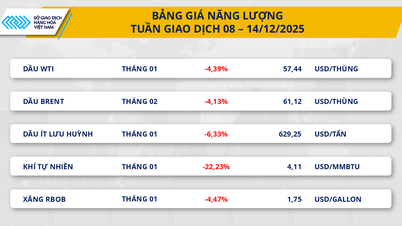
Specifically, WTI crude oil prices fell by nearly 4.4% compared to the previous week, to $57.4 per barrel; Brent crude oil prices also retreated to $61.1 per barrel, a decrease of more than 4.1%.
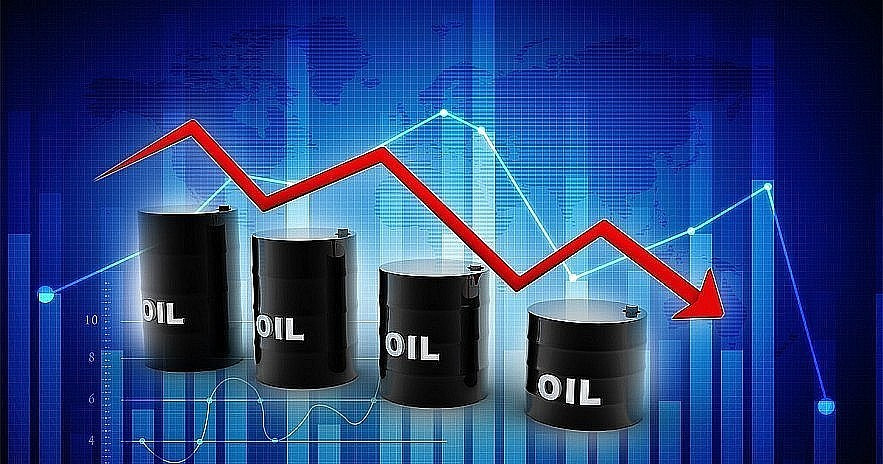
The latest reports from the International Energy Agency (IEA), the Organization of Petroleum Exporting Countries (OPEC), and the U.S. Energy Information Agency (EIA) all highlight the increasingly clear imbalance between supply and demand.
In its December report, the International Energy Agency (IEA) slightly lowered its forecast for the oil surplus in 2026 to 3.84 million barrels per day, but this level is still equivalent to nearly 4% of global demand, which is considered very high compared to previous periods.
The IEA also emphasized that supply from outside OPEC+, particularly from the US and the Americas, continues to grow faster than demand.
In Asia, the downward price trend is even more pronounced as buyers demand increasingly deeper discounts compared to the Brent benchmark price. Intense competition from oil sources such as Russia, Iran, Venezuela, and the Middle East has forced Saudi Arabia to lower its official selling price to the Asian market to its lowest level in years.
With the oversupply picture still prevailing, the Vietnam Commodity Exchange (MXV) believes that world oil prices this week are likely to continue to face downward pressure or fluctuate in low ranges, while the supply-demand imbalance remains the dominant factor influencing market sentiment.
Source: https://baogialai.com.vn/gia-dau-the-gioi-giam-hon-4-trong-tuan-qua-post574998.html

![[Photo] Two flights successfully landed and took off at Long Thanh Airport.](/_next/image?url=https%3A%2F%2Fvphoto.vietnam.vn%2Fthumb%2F1200x675%2Fvietnam%2Fresource%2FIMAGE%2F2025%2F12%2F15%2F1765808718882_ndo_br_img-8897-resize-5807-jpg.webp&w=3840&q=75)



































































































Comment (0)