

In Hanoi, Anh Kieu Van Thanh, 46 years old, is the third generation of the Kieu family in Dong Ha village, Dong Yen commune, Quoc Oai district, to work as a professional mourner at funerals.
His two sons, aged 18 and 22, also followed in their father's footsteps, becoming the fourth generation to do this job.
The Kieu family's involvement in the performing arts in Dong Ha village began in the 1950s, when Thanh's great-grandfather passed away. They had to hire a brass band (bat am) from Chuong My district, nearly 20 km away. Unfortunately, the funeral caused offense to the band, and the family suffered from negative publicity for several years afterward. Seeing that many members of the family had a talent for performing arts, Thanh's grandfather came up with the idea of establishing a bat am band to serve the family and the surrounding village.
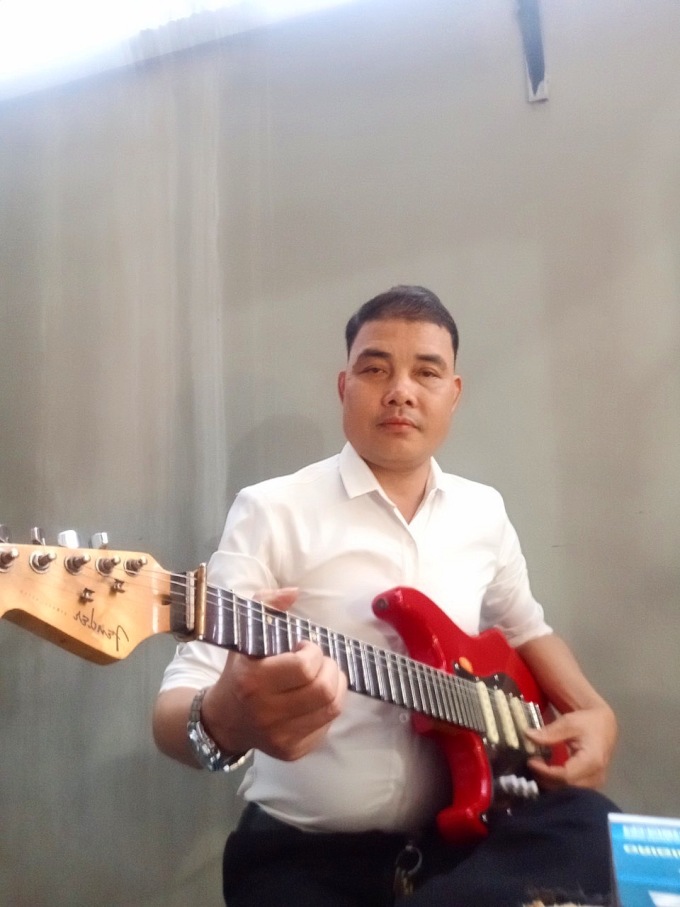
Kieu Van Thanh played an electric guitar while performing with a traditional Vietnamese string instrument at a funeral in Hanoi in 2024. Photo: Provided by the subject.
Mr. Kieu Van Bay, Thanh's uncle, who has been in the profession for nearly 20 years, recounted the heyday when the Kieu family's traditional music troupe was famous throughout the region. Besides performing within the village, they traveled to various districts and communes of the former Ha Tay province, and even as far as Thai Nguyen, Hung Yen, Hai Phong , and Thai Binh. "Many people, before their death, would instruct their children and grandchildren to wait for the Kieu family's troupe to arrive before their funeral could take place," Mr. Bay said.
In those days, the work of the traditional music troupe revolved around playing horns and drums, and expressing grief on behalf of the deceased's relatives. At night, they would change into costumes and perform ancient stories such as Mục Kiền Liên's search for his mother (a Buddhist tale praising filial piety).
Today, the performance of this traditional story at funerals is still preserved, but mainly in rural areas. In the city, if the traditional music troupe of the Kieu family is invited, the performance is shortened to 45 minutes or omitted entirely. However, the request for mourners to cry on behalf of others remains very common because almost every family has children or grandchildren working far away who cannot return in time for the funeral.
According to Thanh, the act of mourning on behalf of others (hiring mourners) is essentially using singing to express the feelings of those left behind, rather than dressing in mourning clothes like family members and wailing in front of the coffin as some other groups do.
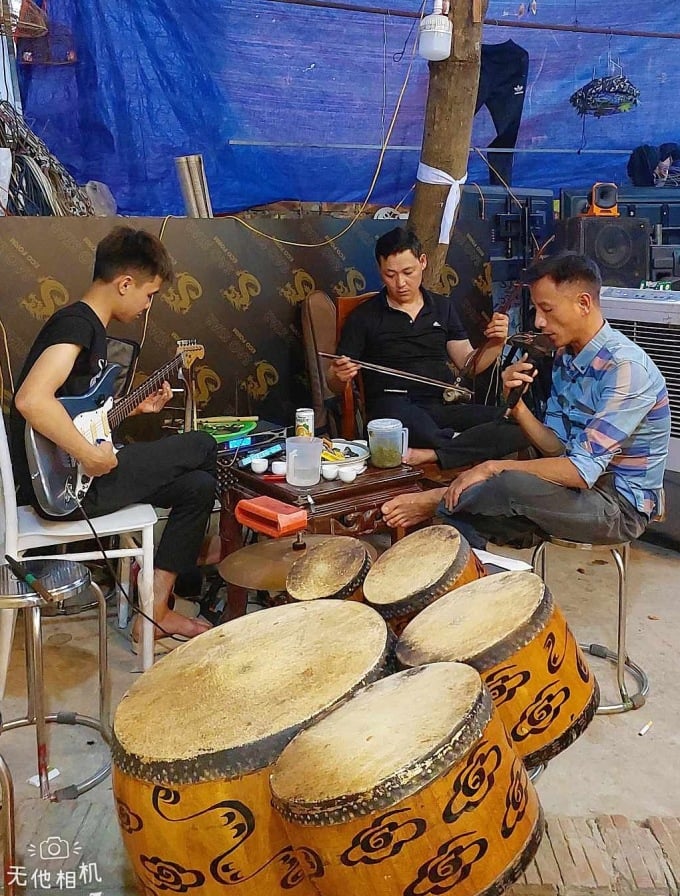
Mr. Thanh's eldest son (far left) and two relatives weep at his funeral in Quoc Oai district, Hanoi, on April 26. Photo: Provided by the subject .
The lamentations performed by the Kiều family's traditional music ensemble had to meet two criteria: firstly, to commemorate the contributions of the deceased; and secondly, to express the grief and regret of those left behind. Typically, each "role" would have its own lament, such as children mourning their parents, wives mourning their husbands, husbands mourning their wives, grandchildren mourning their grandparents, or siblings mourning each other...
Many funerals nowadays, even with numerous family members, still hire mourners to express their grief through song. For families with few members, the bereaved may request a traditional music ensemble to sing, hoping to alleviate the loneliness of the deceased. There are also many cases where the deceased died in tragic circumstances, causing the mourners, like Thanh, to spontaneously improvise their songs instead of using pre-written lyrics.
Traditional mourners used to perform classical Vietnamese opera melodies such as mournful songs, tragic ballads, or poignant tunes, which were both sorrowful and sentimental. Nowadays, to suit modern needs, they also play contemporary pieces like "Mother's Love," "Father's Love," "A Realm to Return To," or "The Soul of a Fallen Soldier ." The troupe's instruments include drums, trumpets, flutes, two-stringed fiddles, cymbals, three-stringed lutes, moon-shaped lutes, and electric guitars.
According to Thanh, besides mastering musical instrument skills, one must also have a good singing voice to succeed in this profession. When he was younger, he went to Hanoi to attend a basic vocal training class to understand fundamental theory, and later he taught himself and learned from his elders.
To preserve his singing voice, the 46-year-old man completely abstains from alcohol and iced drinks, always sings in the correct pitch to avoid hitting wrong notes that could damage his vocal cords. In his younger years, Thanh worked almost every day of the year, but now he works one day and rests the next to maintain his health.
Currently, the cost for playing music and crying at each two-day funeral is 5 million VND. Wealthier families or those pleased with the singing can contribute more as they see fit. However, there have been many times when Thanh has seen families in difficult circumstances, and he has either not charged any money or only charged a small amount, just enough to cover travel expenses.
"A few years ago, there was a funeral for a poor, elderly person, and we donated all of our earnings," Thanh said. "Whatever you do, you should put your heart first; a few extra dollars won't make you rich."
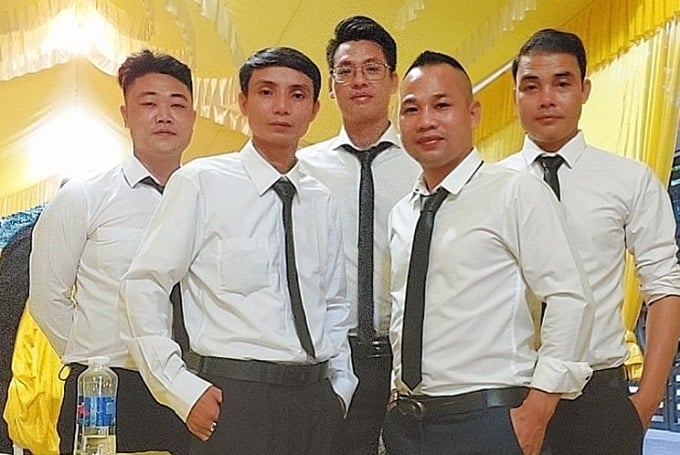
Mr. Thanh (far right) and members of the Kieu family's traditional music troupe performing at a funeral for a family in Hanoi in 2023. Photo: Provided by the subject.
Nevertheless, Thanh often felt hurt by the contempt and discrimination he faced from others, as people believed anything associated with funerals brought bad luck. Furthermore, the long hours spent performing, often leaving early in the morning and late at night, meant that the Kiều family's traditional music troupe, which once had dozens of members, now only had a few left. On days with many funerals, Thanh would mobilize more villagers to help out.
Mr. Kieu Van Thinh, head of Dong Ha village, said that the Kieu family in the village has been practicing this profession for four generations. Compared to other funeral processions that only play trumpets and drums, Mr. Thanh's traditional music troupe also composes their own songs for the deceased's descendants, deeply moving the listeners. In particular, the theatrical performances of historical stories performed the night before the deceased are laid to rest have been passed down through generations, becoming a unique cultural feature of the commune.
"Besides weeping and offering condolences, villagers often gather at funerals to listen to the funeral procession reenact stories that remind people of filial piety and gratitude towards their ancestors and parents," Mr. Thinh said.
Ms. Ngoc Hoa from Dong Ha village recounts that since childhood she has attended funeral performances by the Kieu family. According to the 62-year-old woman, the songs not only express sorrow and grief but also remind the living of the nurturing efforts of their grandparents and parents, always touching the emotions of the listeners.
As a third-generation practitioner of the craft, Mr. Thanh says he is fortunate that two of his four sons are still carrying on the family tradition. Instead of self-learning, his sons are now receiving formal vocal training, know how to play musical instruments properly, and are dedicated to their profession.
"As long as I and my children are alive, the Kieu family's funeral music band will continue to operate. This also means that the traditional cultural aspects of funerals passed down from previous generations will continue to be preserved," Thanh said.
Quynh Nguyen - Hai Hien
Source



![[Image] National Assembly discusses the implementation of the socio-economic development plan.](https://vphoto.vietnam.vn/thumb/1200x675/vietnam/resource/IMAGE/2026/04/20/1776696707422_ndo_br_img-20260420-185419-jpg.webp)

![[Photo] General Secretary and President To Lam meets with National Assembly delegates from ethnic minorities.](https://vphoto.vietnam.vn/thumb/1200x675/vietnam/resource/IMAGE/2026/04/20/1776696701056_a1-bnd-8331-3342-jpg.webp)
















































































Comment (0)