

Nvidia was once known as a manufacturer of chips used in the video game industry, but has shifted its focus to the data center market in recent years.
The American chip company quickly thrived during the pandemic as demand for gaming and cloud applications surged, along with the global cryptocurrency mining craze. By the end of the fiscal year ending January 29th, the data center chip business accounted for more than 50% of the company's revenue.
Meanwhile, the hugely popular chatbot ChatGPT has taken artificial intelligence (AI) generation to a new level this year. This technology uses vast amounts of available data to create new content on a range of topics, from poetry to computer programming.
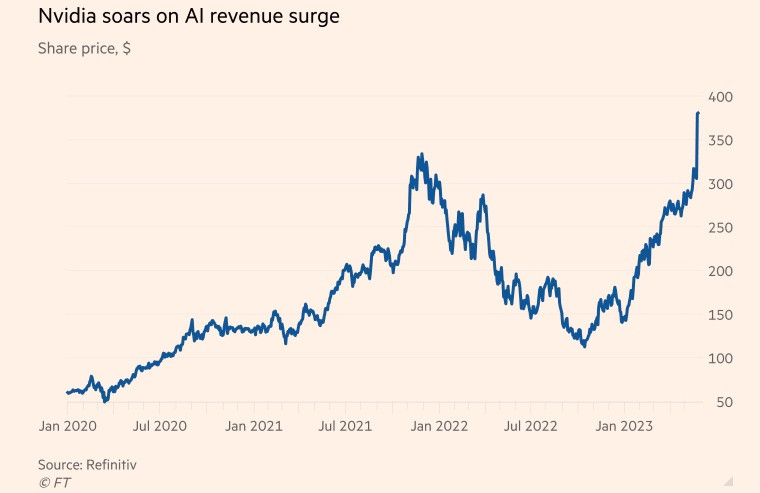
Microsoft and Alphabet, two tech giants and major players in the AI space, believe that generative technology can change the way people work. Both have launched a race to integrate AI into search engines and office software with the ambition of dominating the industry.
Goldman Sachs estimates that US investment in AI could amount to approximately 1% of the country's economic output by 2030.
Supercomputers used for data processing and AI generation rely on graphics processing units (GPUs). GPUs are designed to handle the specific computational tasks involved in AI, and are significantly more efficient than central processing units from other chip manufacturers like Intel. For example, OpenAI's ChatGPT is powered by thousands of Nvidia GPUs.
Meanwhile, Nvidia holds approximately 80% of the GPU market share. Nvidia's main competitors include Advanced Micro Devices and internal AI chips from tech companies such as Amazon, Google, and Meta Platforms.
Secrets to achieving transcendence
This company's leap forward was thanks to the H100, a chip based on Nvidia's new "Hopper" architecture – named after the American programming icon Grace Hopper. The AI boom transformed the H100 into the hottest commodity in Silicon Valley.
These massive chips, used in data centers, have 80 billion transistors, five times the number of silicon chips running the latest iPhones. Although twice as expensive as its predecessor, the A100 (released in 2020), H100 users say the chip offers three times the performance.
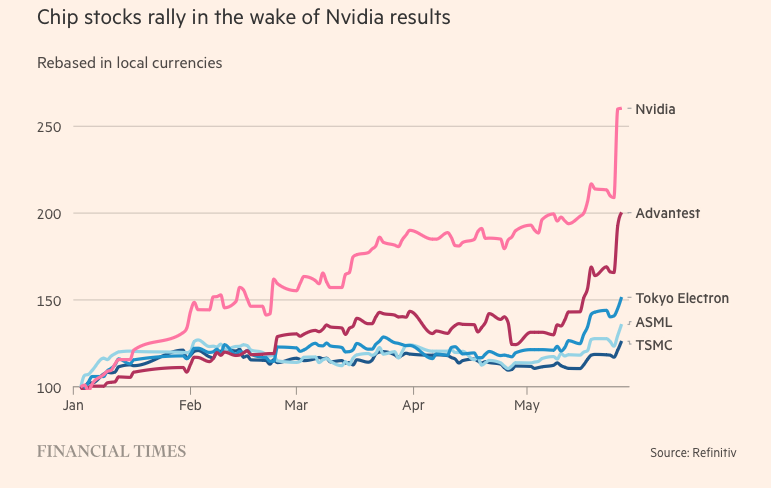
The H100 is proving particularly popular with "Big Tech" companies like Microsoft and Amazon, which are building entire data centers focused on AI workloads, and next-generation AI startups like OpenAI, Anthropic, Stability AI, and Inflection AI, as it promises higher performance, which can accelerate product launches or reduce training costs over time.
“This is one of the most scarce technical resources right now,” said Brannin McBee, chief strategy officer and founder of CoreWeave, an AI-powered cloud startup and one of the first companies to receive a shipment of H100 earlier this year.
Some other customers were not as fortunate as CoreWeave, having to wait up to six months to receive the product to train their massive datasets. Many AI startups are concerned that Nvidia will not be able to meet market demand.
Elon Musk also ordered thousands of Nvidia chips for his AI startup, saying that "GPUs are harder to come by than drugs right now."
“Computer costs have skyrocketed. The minimum amount required for server hardware used in building innovative AI has reached $250 million,” the Tesla CEO shared.
While the H100 arrived at the right time, Nvidia's breakthrough in AI stemmed from two decades prior, driven by software innovation rather than hardware. In 2006, the company launched CUDA software, which leveraged GPUs to accelerate tasks beyond graphics.
“Nvidia saw the future ahead of others and pivoted to developing programmable GPUs. The company spotted the opportunity, bet big, and consistently outperformed its competitors,” said Nathan Benaich, a partner at Air Street Capital and an investor in AI startups.
(According to Reuters, FT)
Source
































![[Video] The craft of making Dong Ho folk paintings has been inscribed by UNESCO on the List of Crafts in Need of Urgent Safeguarding.](https://vphoto.vietnam.vn/thumb/402x226/vietnam/resource/IMAGE/2025/12/10/1765350246533_tranh-dong-ho-734-jpg.webp)






























































Comment (0)