

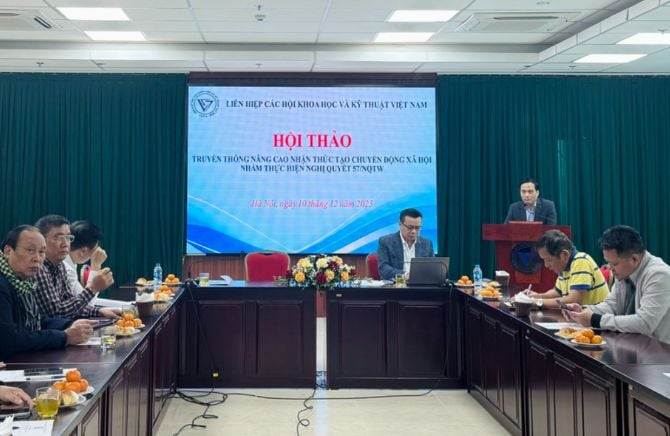
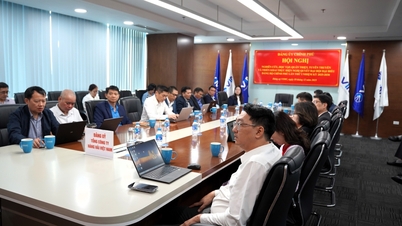
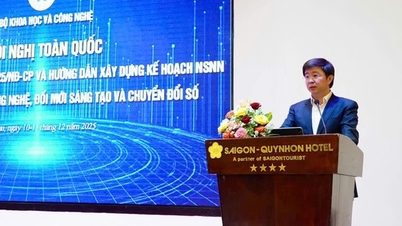
Workshop “Communication to raise awareness and create social movement to implement Resolution 57”. Photo: Thu Giang/ Government Newspaper.
Associate Professor Pham Ngoc Linh, Vice President of VUSTA, emphasized that the most important thing is for the media to create a strong shift in thinking, making the whole society realize that science and technology, innovation, and digital transformation are common tasks of the entire society, not just the Ministry of Science and Technology . From this awareness, the media must lead to action, first and foremost the application of scientific and technological achievements and the fostering of creativity, thereby creating digital capacity for the whole society.
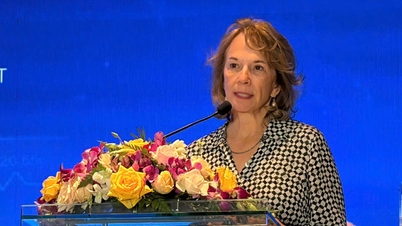
According to Dr. Le Nghiem, Vice President of the Vietnam Digital Communication Association, if policies are formulated without adequate policy communication, they will be difficult to implement in society, will not receive widespread feedback, and will not be able to create the desired impact.
Media plays a crucial role in creating shared awareness, thereby fostering trust and social consensus. In many developed countries, science and technology communication has helped shape a culture that values knowledge and innovation, something Vietnam desperately needs for Resolution 57 to bring about a transformation in thinking and action.
However, Dr. Le Nghiem also pointed out that the lack of professionalism in policy communication by state agencies is the biggest "bottleneck" in implementing Resolution 57. Communication activities in many state agencies are still rudimentary, and the lack of professional communication specialists can lead to low-quality policies and easy influence from vested interests.
To address this, he proposed that the Ministry of Science and Technology develop a national communication strategy on science, technology, and innovation, and issue a code of conduct for communication in this field. He also suggested that the Ministry of Interior should soon assign communication specialists in state agencies to improve the effectiveness of policy communication.
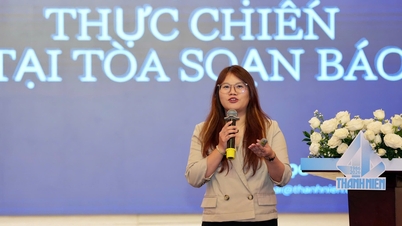
Digital transformation in journalism and the "Smart Newsroom" model support communication in accordance with Resolution 57.
In the context of readers changing their approach in the digital environment, disseminating Resolution 57 requires attractive digital products. Associate Professor Dr. Nguyen Thanh Loi, Editor-in-Chief of the Economic and Urban Newspaper, emphasized that digital transformation and building a smart newsroom are essential requirements for media organizations.
The essence of digital transformation in journalism is the application of modern technology to improve content quality and create a digital journalism ecosystem with new experiences for readers.
Vietnamese media outlets are facing numerous challenges in the digital transformation process, including the risk of cyberattacks, the impact of fake news on social media, the trend towards personalized information consumption, and the shift in the public's role from passive to active participation in the information dissemination process.
Intense competition from social media platforms such as websites and social networks like Facebook, Zalo, Twitter, and YouTube, the trend towards multimedia newsrooms, and readers' demands for quick and accurate information updates require journalism to innovate in technology and organizational structure.
To successfully implement digital transformation, the Economic and Urban Newspaper shares that it must begin with a change in leadership mindset, while simultaneously innovating the style and journalistic skills of its reporters and editors.
In the smart newsroom model, data is considered a valuable intangible asset and a strategic resource. Newspapers have applied advanced technologies such as virtual assistants for content creation, social media data monitoring and analysis systems to capture public reaction, and artificial intelligence (AI) technologies such as text-to-speech conversion for automated broadcasting.
In addition, the newspaper has also developed a comprehensive and synchronized digitalization roadmap for content, infrastructure, and business models, while also providing training in producing digital magazines, digital radio programs, and search engine optimization (SEO)...
Media and digital transformation in journalism are not only essential requirements for adapting to the new environment but also opportunities to enhance competitiveness and maintain a leading role. Opinions at the workshop unanimously agreed that media must take a proactive approach in implementing Resolution 57, promoting innovation as a new cultural value of society, and contributing to the shift towards a knowledge-based growth model. With determination and policy support in line with Resolution 57, media organizations can become pioneers in the national digital transformation.
Source: https://doanhnghiepvn.vn/cong-nghe/day-manh-truyen-thong-dua-nghi-quyet-57-di-sau-vao-cuoc-song/20251210050322877

























![[Video] The craft of making Dong Ho folk paintings has been inscribed by UNESCO on the List of Crafts in Need of Urgent Safeguarding.](https://vphoto.vietnam.vn/thumb/402x226/vietnam/resource/IMAGE/2025/12/10/1765350246533_tranh-dong-ho-734-jpg.webp)























































Comment (0)