


The New York Times reported that the approval of the H200 chip came after months of bargaining between pro-chip proponents and hawkish defense factions in the US. - Photo: Reuters
President Donald Trump's decision to allow Nvidia to export its advanced H200 AI chips to China on the condition that it shares 25% of the revenue marks a turning point in US-China technology policy, reflecting the tug-of-war between economic interests and national security.
President Trump announced on December 8 that Nvidia would be allowed to export the H200 chip to "approved customers" in China and elsewhere, on condition that the US government receives 25% of the revenue.
Chinese President Xi Jinping has "responded positively" to the proposal, Trump wrote on the social media platform Truth Social. He asserted that the policy "will support American jobs, strengthen American manufacturing, and benefit American taxpayers"; and that a similar approach would apply to AMD, Intel, and other great American companies.
The H200 chip and its strategic significance.
The H200 is an advanced AI chip for data centers, introduced in 2024, belonging to the Hopper generation, and is currently being used by many of the largest AI companies in the US.
The chip uses the GH100 logic die, a six-stack, high-bandwidth memory (HBM) die that Nvidia touts as "outstanding AI inference performance."
Prior to Trump's announcement, this chip was subject to strict export controls because its overall processing performance exceeded the regulated limits by nearly 10 times.
According to an analysis published on December 7th by the Institute for the Advancement (IFP) in the US, Chinese AI labs could use H200 to build powerful AI training supercomputers comparable to those currently in US AI labs.
Both Nvidia and rival AMD agreed in August to share 15% of revenue from chip sales to China with the US government.
However, according to CNBC, there were reports at the time that China had warned domestic companies against using the H20 AI chip that Nvidia had specifically designed for the Chinese market. The H200 is a higher-end chip than the H20, but it is not the company's flagship product.
Last month, the Trump administration decided not to export Nvidia's top-of-the-line Blackwell AI chip to China. This new announcement suggests Washington has yet to make a definitive decision on completely severing technological ties with Beijing in AI development.
Internal struggle
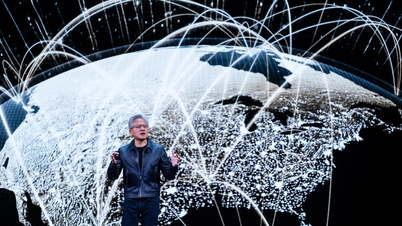
This new move marks a shift in Trump's strategy following a campaign by Nvidia CEO Jensen Huang and David Sacks, Trump's advisor on AI and cryptocurrency.
They dismissed national security concerns related to AI chips, arguing that increased Nvidia sales to China would make Chinese companies dependent on American technology and bring in more money to develop future generations of chips.
Last week, Mr. Huang met Mr. Trump at the White House, and Mr. Trump later praised the CEO.
"We welcome President Trump's decision to allow the U.S. chip industry to compete in order to support high-paying jobs and manufacturing in the U.S.," an Nvidia spokesperson told CNBC on December 9.
The New York Times reported that the approval of the H200 chip came after months of bargaining between proponents of the chip industry and hawkish defense factions. The US administration also spent months battling over the issue.
IFP's analysis points out that the decision to allow the export of significant quantities of advanced Hopper chips to China will have several important implications. First, it deviates significantly from the current export control strategy. This is important because Chinese domestic companies, most notably Huawei, are not expected to be able to produce H200-level AI chips until at least Q4 2027.
Secondly, with the Hopper chip, Chinese AI labs will be able to build AI supercomputers with performance comparable to the US, but at only 50% more cost – negligible compared to Beijing's vast resources and ambitious goals in this key technology sector.
Finally, there's the issue of Huang's "dependence on American technology" argument. Importing chips from the US could indeed slow down China's localization efforts. But Huawei's current peak production is still significantly lower than domestic demand, meaning that US chips would only supplement China's overall computing capacity, not replace domestic production.
Beijing can also maintain artificial demand for domestic chips through procurement orders and restrictions on foreign chips in critical infrastructure, as it has long done, regardless of US export policies.
The technological gap is still wide.
Even if China can produce chips on a large scale, its current chip designs are still less competitive than the H200. According to a recently announced three-year roadmap, Huawei is not expected to produce AI chips that can compete with the H200 until at least Q4 2027. Until then, the H200 will remain superior to any domestically produced Chinese chip.
Compared to China's current best chip – the Huawei Ascend 910C – the H200 offers approximately 32% higher processing power (a key factor in AI training performance) and 50% more memory bandwidth (a key factor in inference performance).
In terms of performance per cost, the H200 offers about a 16% advantage over the 910C for processing and 32% for memory bandwidth, according to IFP.
Source: https://tuoitre.vn/nhung-he-qua-chien-luoc-cua-mot-con-chip-20251210062422804.htm


![[Photo] Explore the US Navy's USS Robert Smalls warship](/_next/image?url=https%3A%2F%2Fvphoto.vietnam.vn%2Fthumb%2F1200x675%2Fvietnam%2Fresource%2FIMAGE%2F2025%2F12%2F10%2F1765341533272_11212121-8303-jpg.webp&w=3840&q=75)

![[Photo] The captivating scenery of the fragrant maple forest in Quang Tri](/_next/image?url=https%3A%2F%2Fvphoto.vietnam.vn%2Fthumb%2F1200x675%2Fvietnam%2Fresource%2FIMAGE%2F2025%2F12%2F10%2F1765353233198_lan09046-jpg.webp&w=3840&q=75)






















![[Video] The craft of making Dong Ho folk paintings has been inscribed by UNESCO on the List of Crafts in Need of Urgent Safeguarding.](https://vphoto.vietnam.vn/thumb/402x226/vietnam/resource/IMAGE/2025/12/10/1765350246533_tranh-dong-ho-734-jpg.webp)






















































Comment (0)