

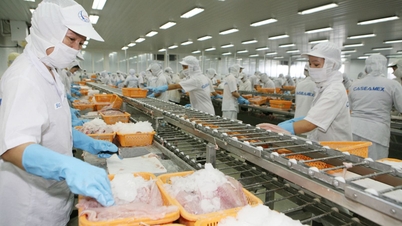
The proposals made by the Vietnamese and Chinese prime ministers at their meeting on October 13, along with the documents exchanged afterward, are expected to help Vietnamese goods, especially agricultural products, penetrate deeper into the Chinese market.
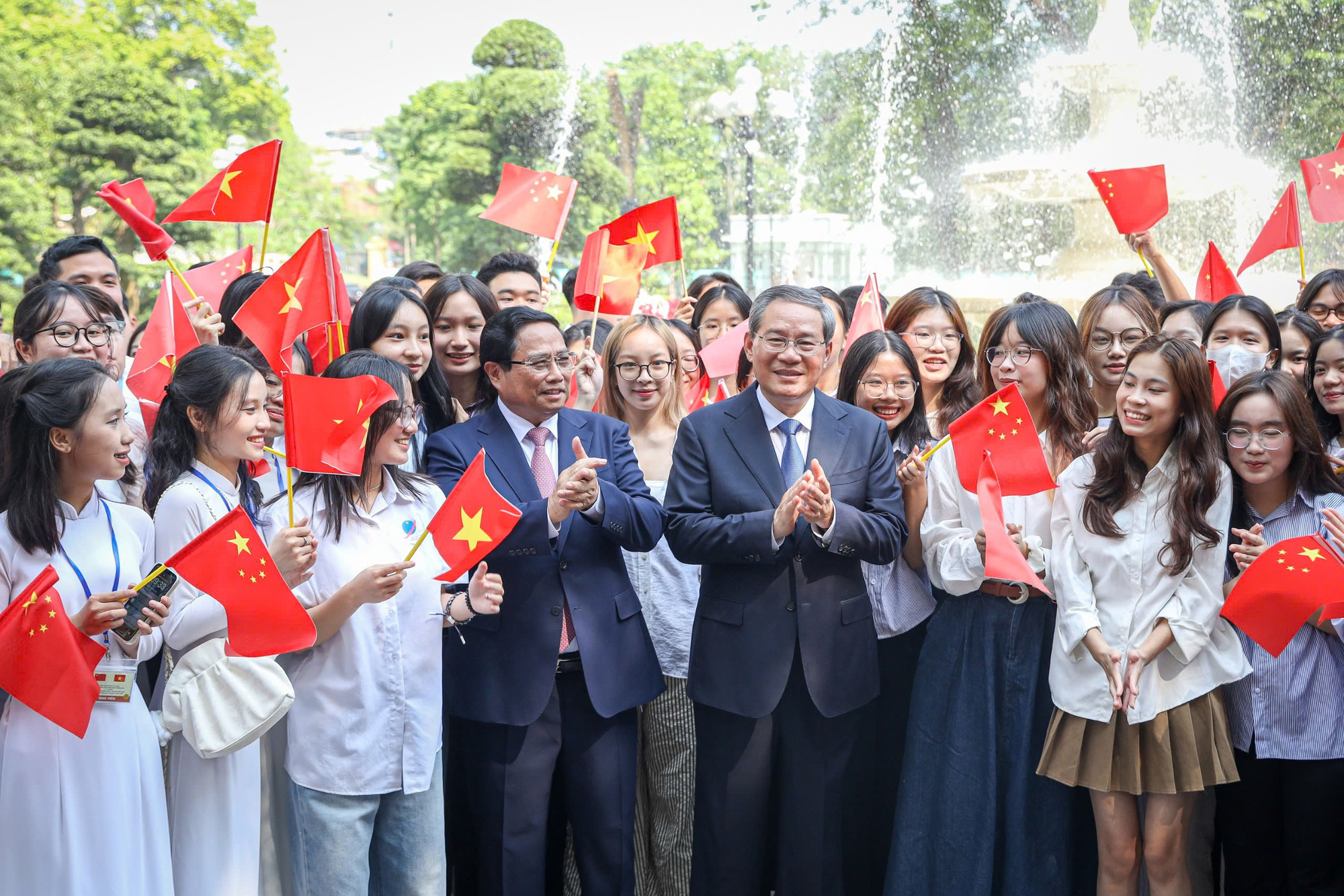
Prime Minister Pham Minh Chinh and Chinese Premier Li Qiang met with students and young Vietnamese people to welcome them on October 13 - Photo: DANH KHANG
Enhancing transportation connectivity
Recently, cooperation in transportation connectivity, including railways, between Vietnam and China has become vibrant again. Notably, three railway projects connecting northern Vietnam with China – Lao Cai - Hanoi - Hai Phong, Lang Son - Hanoi, and Mong Cai - Ha Long - Hai Phong – have been underway. At the meeting on October 13th, Prime Minister Pham Minh Chinh proposed that both sides continue to effectively implement the signed railway cooperation agreements and cooperate in developing a modern railway industry. Specifically, he requested that China provide preferential loans, technology transfer, and support for human resource training to implement the three standard-gauge railway lines. To further facilitate trade between the two countries, Prime Minister Pham Minh Chinh also suggested improving customs clearance efficiency at border crossings and promoting the upgrading of "soft connectivity" through smart customs systems. Furthermore, it is necessary to actively coordinate research and propose new models for implementing cross-border economic cooperation between Vietnam and China. Agreeing with and highly appreciating the cooperation proposals of Prime Minister Pham Minh Chinh, Prime Minister Li Qiang affirmed that China will continue to further open its market to Vietnamese goods, especially high-quality agricultural and aquatic products and fruits, and will cooperate in creating favorable conditions for quarantine, customs clearance, and resolving policy obstacles. Mr. Li also suggested that the two sides strengthen strategic connectivity, especially in transportation infrastructure; promote cooperation in economics, trade, and investment, especially in manufacturing, agriculture , and maintaining supply chains and production chains.Benefits for both countries and the region.
According to The Economist, countries like Vietnam are attractive to Chinese railway companies because their national railway system is almost complete and modern. The majority of the 10 documents exchanged on October 13th, witnessed by the two prime ministers, were in the areas of "hard connectivity" and "soft connectivity" between the two economies. Two notable documents in railway cooperation were the Memorandum of Understanding (MoU) on the technical plan for connecting the railway between Lao Cai station (Vietnam) and Hekou North station (China); and the site survey report on the feasibility study for the aid project to plan standard-gauge railway lines between Dong Dang - Hanoi and Mong Cai - Ha Long - Hai Phong. These two MoUs are concrete evidence supporting the prime ministers' earlier assessment during the talks that strategic connectivity between the two countries, especially transportation connectivity, has been accelerated in recent times. At the same time, these MoUs are expected to promote the removal of obstacles and increase freight transport between the two countries in the coming time. Since the first international railway line began operating in 2017, Vietnam and China now have three international railway lines. However, due to infrastructure difficulties, especially differences in railway gauge, transportation has not yet met demand. The benefits are two-way. For Vietnam, it is an opportunity to upgrade railway infrastructure, paving the way for goods, especially agricultural products, to enter the Chinese market faster and at lower costs. Conversely, according to The Economist, improved freight transport will benefit Chinese companies that are relocating factories to Vietnam and Southeast Asia. For example, electronic components from China can be supplied promptly to electronic assembly plants in Vietnam. Goods from southern Chinese provinces will also be transported to the coastal city of Hai Phong, from where they will be distributed globally at lower costs and in less time, as Hai Phong's ports are located much closer to these provinces than ports in eastern China."Soft connections" to increase transportation efficiency.
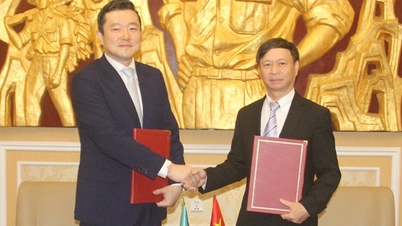
Also in Hanoi on October 13th, Prime Minister Pham Minh Chinh and Chinese Premier Li Qiang witnessed the signing of an Memorandum of Understanding (MoU) establishing a working group to study a model for building a cross-border economic cooperation zone between Vietnam and China; an action plan between the customs authorities of both sides following the agreement on mutual recognition of "priority enterprises"; and an MoU on the implementation of cross-border payment services via QR code between Vietnam and China. These documents contribute to increasing "soft connectivity" between the two economies, and, together with "hard connectivity" in the form of railways, enhance the efficiency of goods transportation between the two countries, especially agricultural products, electronic components, and mechanical equipment for production and consumption in the future.Tuoitre.vn
Source: https://tuoitre.vn/hang-viet-se-tien-sau-hon-vao-trung-quoc-20241013215223256.htm
![[Photo] Prime Minister Pham Minh Chinh attends the Conference summarizing and implementing tasks of the judicial sector.](/_next/image?url=https%3A%2F%2Fvphoto.vietnam.vn%2Fthumb%2F1200x675%2Fvietnam%2Fresource%2FIMAGE%2F2025%2F12%2F13%2F1765616082148_dsc-5565-jpg.webp&w=3840&q=75)















































































Comment (0)