

Tens of thousands of invasive species are causing over $400 billion in losses annually and severely impacting ecosystems worldwide .
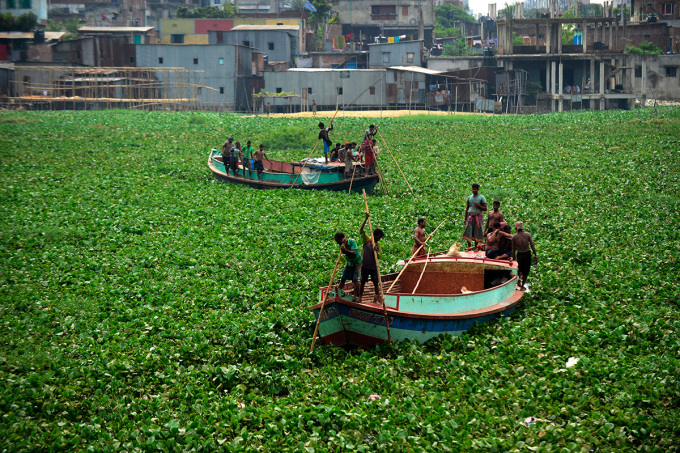
Bangladeshi boatmen navigate through dense patches of water hyacinth on the Buriganga River in 2014. Photo: AFP
Invasive species that destroy crops and forests, spread diseases, and disrupt ecosystems are spreading at an unprecedented rate globally, and humanity has yet to stop this wave, according to a comprehensive scientific assessment by the intergovernmental scientific advisory panel to the United Nations Convention on Biological Diversity (IPBES), released on September 4th. This causes damage and lost income of more than $400 billion annually, equivalent to the GDP of Denmark or Thailand, and that may still be an underestimate, according to AFP .
The assessment lists more than 37,000 invasive species that have appeared in locations far from their native habitats. This number is trending sharply upward, and on average, the damage has quadrupled every decade since 1970.
Economic development, population growth, and climate change will increase the frequency and scale of biological invasions, and amplify the impact of invasive alien species, the assessment states. Currently, only 17% of countries have laws or regulations to manage these invasions. The spread of species is clear evidence that human activity has altered natural systems to such an extent that it has pushed Earth into a new geological era, the Anthropocene.
Many invasive species are intentionally introduced by humans. For example, water hyacinth is believed to have been brought by Belgian officials in Rwanda, East Africa, as an ornamental garden plant. It invaded the Kagera River in the 1980s and at one point covered 90% of Lake Victoria. It obstructs navigation, suffocates aquatic life, hinders the operation of hydroelectric dams, and creates breeding grounds for mosquitoes.
The Everglades wetlands in Florida, USA, are grappling with invasive 5-meter-long Burmese pythons, white catfish, Lygodium microphyllum ferns, and Brazilian pepper plants. These are "descendants" of domesticated animals and ornamental plants that were introduced to the area.
In the 19th century, rabbits were brought to Australia and New Zealand for hunting and food. However, they quickly multiplied, consuming local vegetation, causing habitat degradation, and threatening the survival of many native species.
However, invasive species often arrive in new territories by chance, for example, hitching a ride on cargo ships. The Mediterranean Sea has many non-native fish and plant species such as lionfish and Caulerpa seagrass, which migrate from the Red Sea via the Suez Canal.
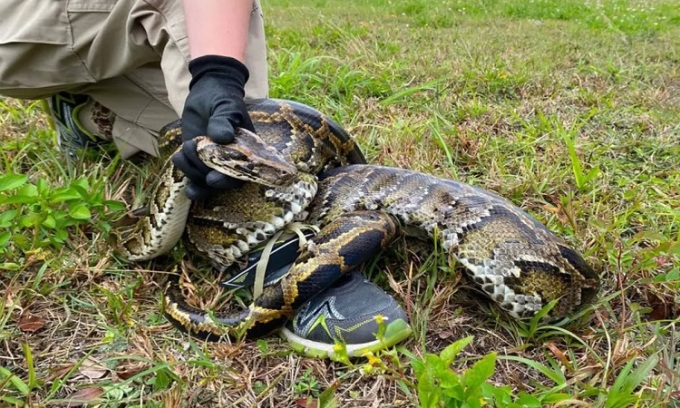
Burmese pythons invaded Florida in the 1980s. Photo: Miami Herald
Europe and North America have the highest densities of invasive species in the world, according to a new report by IPBES. A major reason for this is the enormous volume of trade conducted in these regions.
In Vietnam, in 2019, the Ministry of Natural Resources and Environment also issued a Circular stipulating criteria for identifying and publishing a List of Invasive Alien Species comprising 19 species and a List of Alien Species with the Potential to Invade, comprising 61 species.
Nineteen invasive alien species are divided into six groups: microorganisms (avian influenza virus, etc.), invertebrates (golden apple snail, etc.), fish (mosquito-eating fish, etc.), amphibians and reptiles (red-eared turtle), birds and mammals (South American beaver), and plants (water hyacinth, etc.). The list of potentially invasive alien species includes 61 species belonging to five groups: invertebrates (American white butterfly, blue crab, etc.), fish (whole-bodied white pomfret, tiger fish, etc.), amphibians and reptiles (leopard frog, climbing brown snake, etc.), birds and mammals (ermine, brown squirrel, etc.), and plants (large water hyacinth, climbing daisy, etc.).
An IPBES report released on September 4th revealed that invasive species are a major contributor to 60% of recorded plant and animal extinctions. Other contributing factors include habitat loss, global warming, and pollution.
These factors also interact with each other. Climate change pushes invasive species to new, warmer waters or lands. Native organisms there are often vulnerable to invaders they've never encountered before. Last month, a deadly wildfire struck the town of Lahaina, Maui, Hawaii, partly due to invasive grasses brought in decades ago to feed livestock and now spreading.
An international treaty aimed at protecting biodiversity, signed in Montreal last December, sets a target of halving the spread of invasive alien species by 2030. The IPBES report outlines general strategies to achieve this goal, but does not assess the likelihood of success. Essentially, there are three lines of defense: prevention, eradication, and control/limitation if the first lines fail.
Thu Thao ( Compiled )
Source link
















![[Video] AI application for early detection of common diseases on cassava plants](https://vphoto.vietnam.vn/thumb/402x226/vietnam/resource/IMAGE/2025/12/10/1765328634749_avatar-of-video-1038119-png.webp)















![[Photo] Urgently help people soon have a place to live and stabilize their lives](/_next/image?url=https%3A%2F%2Fvphoto.vietnam.vn%2Fthumb%2F1200x675%2Fvietnam%2Fresource%2FIMAGE%2F2025%2F12%2F09%2F1765248230297_c-jpg.webp&w=3840&q=75)































































Comment (0)