

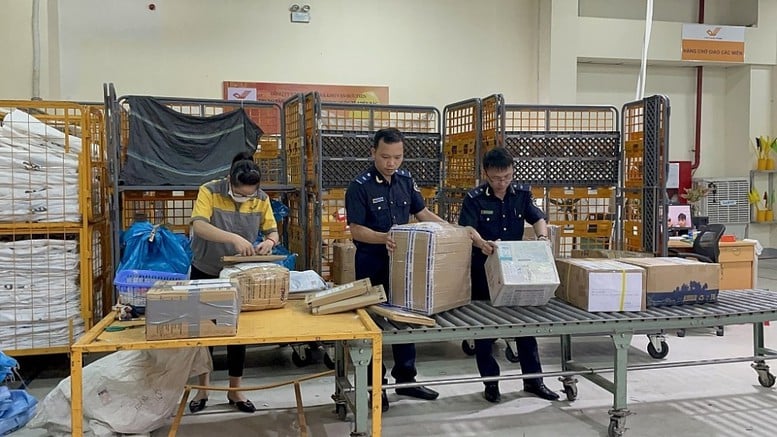
Increase budget revenue, prevent commercial fraud
Ms. Nguyen Thi Khanh Huyen, Head of the Tax Management Team, Customs Tax Department (Customs Department) said that from February 18, 2025, Decision No. 01/2025/QD-TTg officially took effect, ending the exemption of value-added tax (VAT) for small-value goods sent via express delivery service. This is a very important adjustment step of tax policy. The collection of VAT on small-value goods via express delivery has increased budget revenue, ensured fairness, prevented fraud and conformed to international practices.
After 8 months of implementation, the Customs authority has recorded many remarkable results, in particular, the budget revenue has been significantly increased. Statistics show that, as of September 15, 2025, the VAT collected from low-value goods sent via express delivery service is 1,035 billion VND, this is a significant number that initially contributes to ensuring resources for the country, implementing the Party and State's policies and orientations on covering all revenue sources and expanding the revenue base.
In addition, this new policy ensures fair competition. Previously, small-scale imports were exempted from taxes while domestically produced goods were taxed. Now, the collection of taxes helps create a more level playing field for domestic enterprises.
Notably, the tax imposition has limited the situation of dividing orders below the limit to avoid taxes, contributing to preventing trade fraud and tax losses.
In accordance with international practice
The collection of VAT on small-value goods sent via express delivery services is in line with international legal trends and practices. Specifically, in recent years, countries in the European Union (EU) have abolished the VAT exemption for shipments of 22 euros or less. The United Kingdom (England, Scotland and Wales) also abolished the VAT exemption for imported goods with a total value of 135 pounds or less from January 1, 2021.
Or in Australia, the regulation on VAT exemption for goods valued at 666 USD or less is also abolished. Similarly, in Singapore, from January 1, 2023, the regulation on VAT exemption for low-value goods, especially in the field of e-commerce, will also begin to be abolished.
To ensure fair trade practices, Thailand will also collect VAT on all imported goods, regardless of value, from May 1, 2024. In addition, at the seminars, experts from the Trade Facilitation Project (TFP) also recommended that Vietnam consider collecting VAT on low-value imported goods.
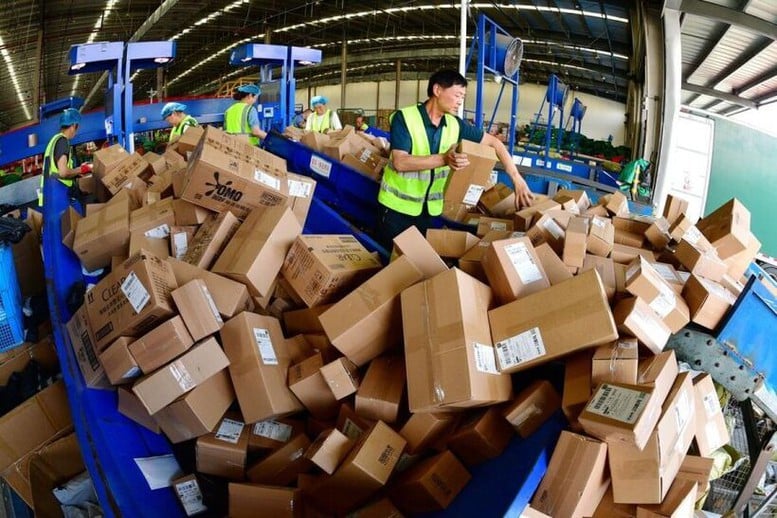
Continue to upgrade the system and improve business processes so that tax declaration and payment are more convenient, transparent and accurate.
Focus on completing information technology infrastructure to facilitate tax declaration and payment
According to Ms. Nguyen Thi Khanh Huyen, in order to facilitate businesses in customs declaration, as well as reduce the burden of manual management for the Customs agency, the Customs Department has been very urgent and made efforts in building and perfecting the information technology system to serve the declaration and tax collection for small-value goods sent via express delivery service.
On July 8, 2025, the Customs Department issued Document No. 13103/CHQ-GSQL on the plan to implement the Customs Procedures System for Group 2 Import and Export Goods sent via Express Delivery Service (AVP-ECOM System). Accordingly, from August 1, 2025, it will be applied to all express delivery businesses (including air, road, and rail).
Emphasizing the effectiveness of this system, a representative of the Customs Department said that the application of AVP-ECOM in the management of small-value goods has helped increase transparency, shorten processing time and prevent VAT losses. Thanks to that, budget collection is guaranteed and trade is facilitated.
The development and improvement of the above mentioned electronic customs declaration system has helped to clear goods quickly and facilitate the management of daily declarations of goods in large quantities without interrupting commercial activities. Because the procedures are carried out through agents and shipping companies, the management and collection of taxes on imported goods sent via express delivery services are carried out in a centralized and much faster manner than before.
In particular, the implementation of AVP-ECOM not only brings immediate efficiency in VAT collection but also contributes to building a modern and sustainable management platform, in line with the digital transformation trend in the customs sector.
In the coming time, the Customs will focus on completing the information technology infrastructure, upgrading the system, and perfecting the business processes so that tax declaration and payment will be more convenient, transparent and accurate. At the same time, the Customs will continue to coordinate with businesses and increase support for people to effectively implement this policy, contributing to building a fair and sustainable business environment.
Source: https://baochinhphu.vn/hieu-qua-trong-trien-khai-thu-thue-gtgt-voi-hang-tri-gia-nho-qua-chuyen-phat-nhanh-102251204173745314.htm
![[Photo] Cat Ba - Green island paradise](/_next/image?url=https%3A%2F%2Fvphoto.vietnam.vn%2Fthumb%2F1200x675%2Fvietnam%2Fresource%2FIMAGE%2F2025%2F12%2F04%2F1764821844074_ndo_br_1-dcbthienduongxanh638-jpg.webp&w=3840&q=75)













































![[VIMC 40 days of lightning speed] Da Nang Port: Unity - Lightning speed - Breakthrough to the finish line](https://vphoto.vietnam.vn/thumb/402x226/vietnam/resource/IMAGE/2025/12/04/1764833540882_cdn_4-12-25.jpeg)









































Comment (0)