

If revenue is 1 billion VND, how much tax will be paid?
According to the recently passed amended Personal Income Tax Law, the tax threshold for personal income tax and value-added tax (VAT) for household businesses is 500 million VND per year, effective from January 1, 2026. Furthermore, according to Resolution 198 of the National Assembly on tax and fee support for the private economy , the business license fee for household businesses will also cease from 2026. Therefore, from next year, household businesses will only pay two types of taxes: personal income tax and VAT, if their revenue exceeds 500 million VND.
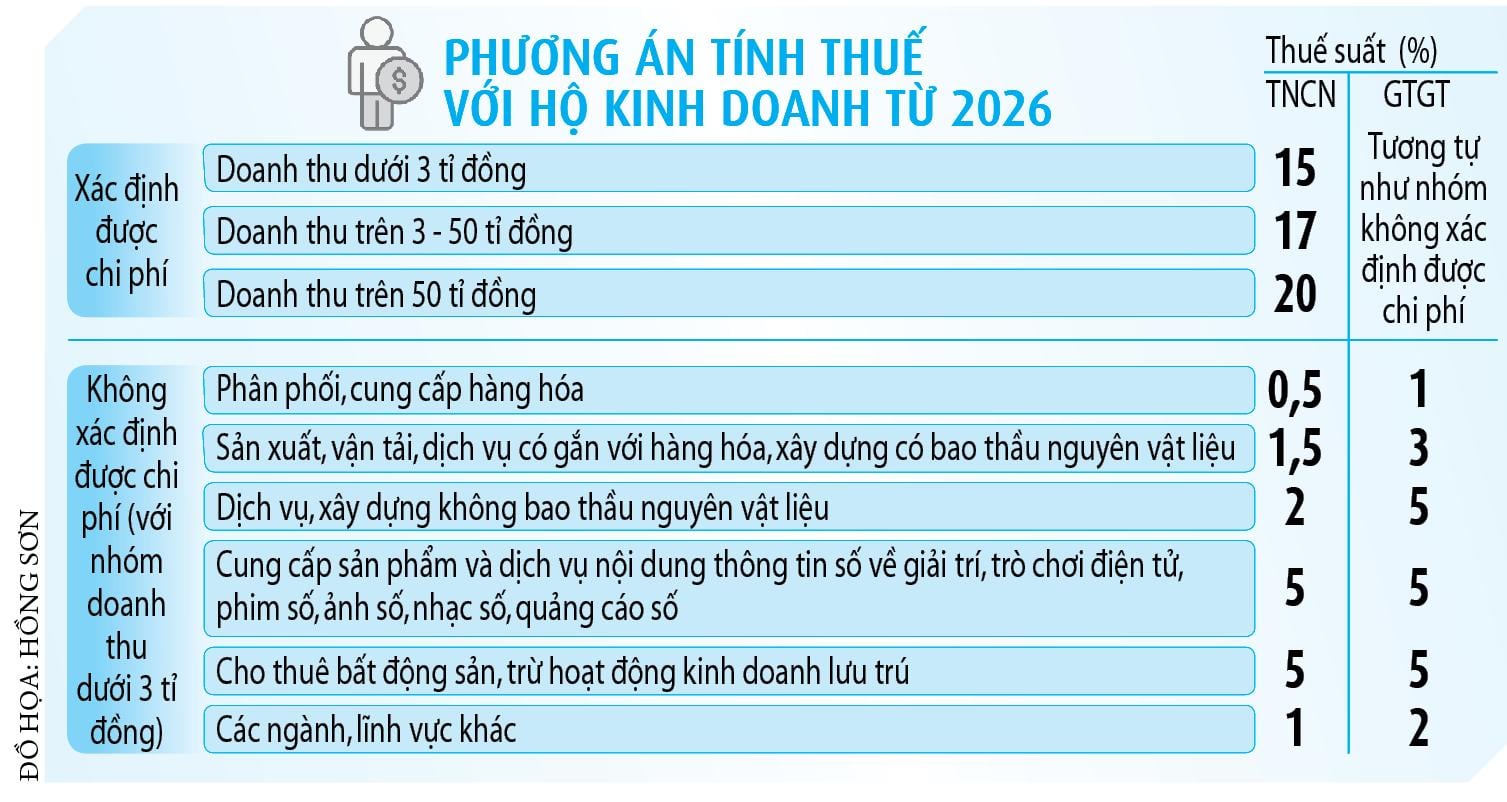
The law also adds a method for calculating tax on profits (the difference between revenue and expenses) for household businesses. Specifically, households with annual revenue under 3 billion VND, if input costs can be determined, will be subject to a 15% tax rate on the profit. This rate corresponds to the preferential corporate income tax rate for micro-enterprises with equivalent revenue. Household businesses with annual revenue from 3 to 50 billion VND will be subject to a 17% tax rate; a 20% tax rate applies to households with revenue exceeding 50 billion VND/year. In cases where expenses cannot be determined, individuals and household businesses will continue to pay tax at a rate of 0.5% - 5% on revenue, depending on the industry and income within the tax-free threshold (500 million VND/year), which is deducted before tax calculation. This means that household businesses will not be taxed on their entire revenue, from the very first dollar.
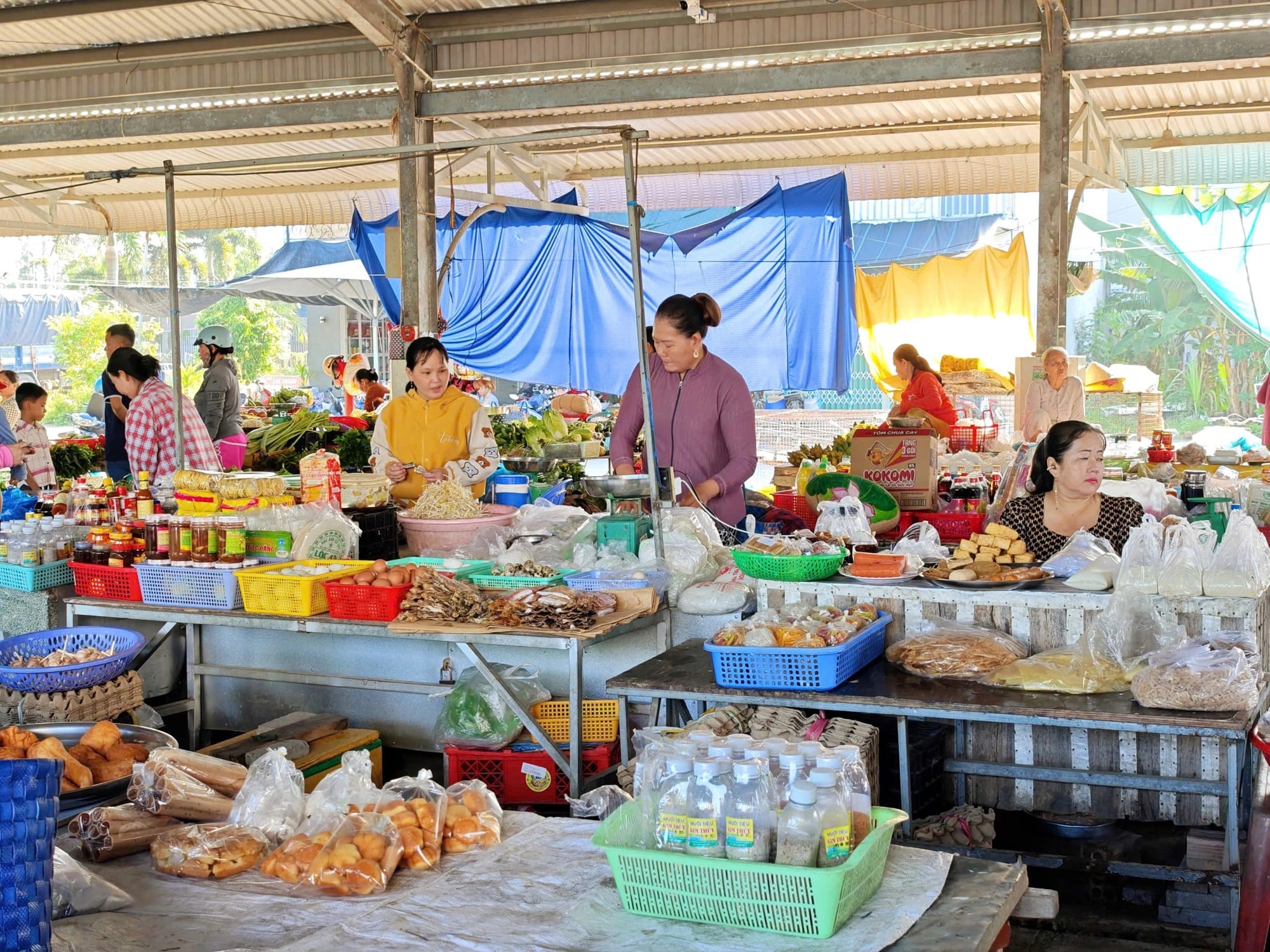
Many small businesses are still confused about the declaration process.
Thus, assuming a food and beverage business achieves an annual revenue of 1 billion VND, with input costs undetermined (common for small businesses), the tax payable is 4.5% (1.5% personal income tax and 3% VAT) on 500 million VND, equivalent to 22.5 million VND/year; a retail business with an annual revenue of 1 billion VND must pay 0.5% personal income tax and 1% VAT, equivalent to 7.5 million VND/year. If input costs are determined to be 800 million VND/1 billion VND, the personal income tax payable is 15% on a profit of 200 million VND, equivalent to 30 million VND/year, plus 20 million VND VAT, the total tax payable by the business is 50 million VND/year. Similarly, a household business selling construction materials with an annual revenue of 3 billion VND, without determining expenses, would pay 4.5% personal income tax and VAT on 2.5 billion VND, equivalent to 112.5 million VND per year; if expenses and profit are determined to be 300 million VND, the tax payable would be 54 million VND (45 million VND personal income tax and 9 million VND VAT).
There are still many concerns before the big moment.
Speaking to Thanh Nien newspaper , many businesses selling construction materials, electronic equipment, motorcycles, etc., argued that calculating taxes based on the same revenue for all businesses is unfair and puts businesses with high sales but low profits at a disadvantage. For example, businesses selling construction materials, cars, or electronics can exceed 500 million VND in revenue in a week with just a few large orders, without even waiting until the end of the year. "Even with revenue exceeding the threshold, our actual profit margin is only 3-5%, only 1/10 of that of service businesses in the food and beverage or hairdressing sectors, which can reach 30-50%. Therefore, calculating taxes based solely on revenue creates significant difficulties for businesses with high revenues," shared a construction materials business owner on Ly Thuong Kiet Street ( Ho Chi Minh City).
Some businesses selling raw materials and components on Hau Giang Street (Ho Chi Minh City) are concerned about the quarterly tax declaration and payment system. Many businesses sell seasonal goods, so how can they know if their annual revenue exceeds 500 million VND and they need to pay taxes? Should they declare quarterly but only pay taxes at the end of the year if the threshold is exceeded, or should they declare and pay taxes and then wait until the end of the year for a refund? "The difference lies in revenue. Businesses using the lump-sum tax system use estimated revenue from the beginning of the year, while those declaring taxes use actual revenue generated. Paying taxes upfront and then claiming a refund via the app will be very complicated. Businesses need the tax authorities to provide clear and simple guidance on this," said Ms. Mai Thao, a business owner selling raw materials and components in Ho Chi Minh City.
According to tax expert Dinh Thi Huyen, Director of Savitax Tax Consulting Joint Stock Company, business households, especially small and medium-sized enterprises, still express concerns about the complexity of the tax declaration and payment process. Although authorities have provided guidance and support, accessing new software remains difficult for these households. Specifically, they struggle with determining the tax payment method, required forms, and deadlines. Secondly, accurately determining revenue and expenses is a challenge for almost all business households contacted by tax consulting companies. Many are unsure whether they fall under tax group 2 or group 3. Furthermore, businesses without input invoices are showing clear signs of confusion and difficulty in finding a stable business direction.
Furthermore, a problem may arise after applying the tax revenue threshold, focusing on certain groups of household businesses with high sales. "The issue is that revenue exceeding the tax threshold happens very quickly. Therefore, large-scale household businesses tend to split their operations into multiple smaller businesses. For example, the husband registers one business, the wife registers another, the children register yet another… to ensure each business has revenue below 500 million VND per year. Of course, this creates risks for household businesses if they are not familiar with the regulations because multiple businesses operate in the same location. For the tax authorities, it risks not collecting taxes and requires additional timely review," tax expert Dinh Thi Huyen warned.
Vietnam currently has over 5.2 million business households. Last year, the total state budget revenue from this group of business households and individuals was approximately 26,000 billion VND. This revenue reached over 17,000 billion VND in the first half of this year.
According to the Ministry of Finance, with the new taxable revenue threshold, it is expected that approximately 2.3 million business households will not have to pay taxes, equivalent to 90% of business households. Tax authorities estimate that the amount of tax revenue reduced each year will be approximately 11,800 billion VND.
Source: Thanh Nien
Source: https://htv.com.vn/ho-kinh-doanh-tinh-thue-the-nao-tu-nam-2026-222251212091322098.htm
![[Image] Close-up of the newly discovered "sacred road" at My Son Sanctuary](/_next/image?url=https%3A%2F%2Fvphoto.vietnam.vn%2Fthumb%2F1200x675%2Fvietnam%2Fresource%2FIMAGE%2F2025%2F12%2F13%2F1765587881240_ndo_br_ms5-jpg.webp&w=3840&q=75)














































































Comment (0)