

Many local residents are dissatisfied with the location of the Quang Tri BOT toll station, arguing that it negatively impacts the province's socio -economic development and their own lives. Faced with this situation, provincial leaders have made numerous efforts to address the issue, submitting proposals and recommendations to the central government. However, this difficult problem has yet to receive support from the central government.
The location of BOT toll stations falls under the authority of the Ministry of Transport.
The Quang Tri BOT toll station is located at km 763+800 on National Highway 1 and is invested in by Truong Thinh Group Joint Stock Company. The station is built on the North-South route through Quang Tri, at the southern gateway to Dong Ha City, the provincial capital of Quang Tri province.
The station is located between two major cities in Quang Tri province: Dong Ha City and Quang Tri town, home to the Quang Tri Ancient Citadel National Special Historical Site. This location inadvertently "separates" Dong Ha City from Quang Tri town and the two districts of Trieu Phong and Hai Lang. This "division" has negatively impacted the socio-economic development of the province as a whole and the affected localities in particular.

The Quang Tri BOT toll station is said to be located in an unsuitable position, becoming a "barrier" to the province's development - Photo: Provided
According to reports, a significant number of vehicles belonging to organizations, businesses, and individuals in the aforementioned localities pass through the BOT toll station daily. Recently, people have been abuzz with news that the toll fees at the Quang Tri BOT toll station will be increased starting December 29, 2023. While it's understood that the price increase is inevitable and part of a planned process, the pressure it creates still needs to be addressed.
For several years now, many people in Quang Tri have had to spend a considerable amount of money each month to pass through the toll station. That amount is now increasing amidst the general economic difficulties. What's concerning is that despite the increased toll fees, the road surface quality on the section invested in by Truong Thinh Group is showing signs of deterioration. In many places along the route, cracks, potholes, and wheel ruts are quite numerous. Some severely damaged areas have been patched up temporarily.
Furthermore, the appearance of the Quang Tri BOT toll station has disrupted the lives of many households in the vicinity. According to Bui Quoc Hung, Chairman of the People's Committee of Trieu Giang commune, Trieu Phong district, on average, the commune's 5-meter-wide concrete road has to "bear" 1,200-1,500 vehicles daily as they avoid the toll station. Among the convoys of vehicles, many are heavy-duty trucks, causing damage to the road and bridges. "There are three schools with a large number of students along the main road in the commune. The constant flow of large and small vehicles increases the risk of traffic accidents. Many accidents have already occurred, causing great concern among the residents," Mr. Hung said.
According to an investigation by a reporter from Quang Tri Newspaper, the toll station at km763+800 on National Highway 1 was built to collect tolls to recoup the investment for the BOT project to expand National Highway 1 from Dong Ha City to Quang Tri town and the project to expand National Highway 1 from km741+170 to km756+705.
Previously, given the difficulties in the state budget, attracting resources for infrastructure development through public-private partnerships (PPP) was considered necessary and consistent with the Party and State's policies. Therefore, the Ministry of Transport coordinated with the Provincial People's Committee to successfully attract investment for these two projects.
Upon completion, the projects will create a continuous and synchronized axis along National Highway 1 from Hanoi to Can Tho, promoting socio-economic development nationwide. It is understood that during implementation, the determination of the location of the BOT toll stations falls under the authority of the Ministry of Transport and has been carried out by the ministry in accordance with the prescribed procedures.
Specifically, according to point 1, Article 4 of Circular 15/2020/TT-BGTVT dated July 22, 2020, regulating the operation of toll stations for road usage services, the criterion for establishing a toll station is that it "must be located within the scope of the project".
Efforts to address shortcomings at BOT toll stations.
However, during the implementation process, recognizing the shortcomings regarding the location of the Quang Tri BOT toll station, the provincial leadership directed and organized numerous meetings to gather opinions, exchange ideas, and discuss with relevant departments, localities, and Quang Tri BOT Company Limited to find a solution.
In particular, delegations of provincial leaders have held numerous working sessions and submitted recommendations and proposals to the Prime Minister and relevant ministries and agencies. It is known that, based on one of the proposals from the provincial leaders, the Ministry of Transport has approved a price reduction for vehicles owned by individuals with permanent residency, and organizations and businesses with headquarters located in the province.

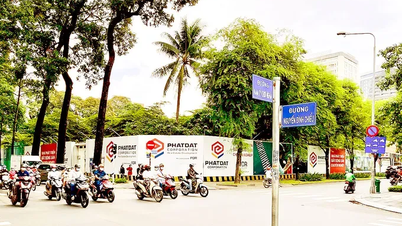
Since the Quang Tri BOT toll station was put into operation, the volume of traffic on the main road of Trieu Giang commune, Trieu Phong district, has increased dramatically - Photo: Provided.
National Assembly representative Ha Sy Dong, Permanent Vice Chairman of the Provincial People's Committee, has repeatedly expressed the concerns and aspirations of the people regarding the Quang Tri BOT toll station. According to Mr. Ha Sy Dong, since the establishment of the BOT station, the people and voters in the area have frequently petitioned about the unreasonable location of the station. One of the issues causing public resentment is that although people only use less than half the length of the BOT road, they have to pay for the entire route.
According to Mr. Ha Sy Dong, besides creating "division" and "barriers" to socio-economic development, the decision to locate the Quang Tri BOT toll station at km 763+800 on National Highway 1 has also given rise to many other problems. During the investment process for the province's socio-economic transportation system, the connecting routes to the BOT section on National Highway 1 did not receive the approval of the Ministry of Transport and the investor.
The reason given was that the connection would divert traffic flow through the BOT toll station, affecting the financial plan already signed between the Ministry of Transport and the BOT investor. “The refusal to approve the connection causes significant difficulties for the province's socio-economic development and affects the lives of people in the area, impacting half the population of four administrative units at the district, town, and city levels. It also poses a potential risk to security, order, and traffic safety,” Mr. Ha Sy Dong stated.
Faced with this situation, provincial leaders, including National Assembly representative Ha Sy Dong, the Standing Vice Chairman of the Provincial People's Committee, proposed to the Government and the Ministry of Transport a plan to relocate the BOT toll station to the southern end of the province. Along with that, a second option was proposed: the State providing budgetary support to buy back the BOT toll station from the investor. Although the cost of buying back the station is very high, estimated at around 1,700 billion VND, this could be an effective solution to overcome the difficulties.
Proposal for resource support to buy back the BOT toll station.
In response to the provincial leaders' recommendations, the Ministry of Transport has provided specific answers. Accordingly, during the implementation process, the Ministry followed the correct procedures and regulations regarding the location of the toll station. Relocating the toll station to the southern end of the province would be outside the project's scope, would not comply with regulations on station location, and would not be financially feasible. In fact, since the start of toll collection for the two projects, people and vehicles passing through the toll station have consistently complied with regulations, and there have been no incidents of insecurity or disorder.
According to the Ministry of Transport, the guiding principle of the National Assembly Standing Committee, the Government, the Prime Minister, as well as the opinions of ministries and agencies, is to implement the signed project contracts, only proposing solutions to address difficulties and shortcomings at toll stations related to the State's obligations. The Ministry of Transport is continuing to finalize and finalize the proposal for submission to the Prime Minister and the Government for consideration and decision. Upon review, the two aforementioned projects do not meet the requirements to be included in the list of projects for addressing shortcomings. The Ministry of Transport has directed relevant agencies to continue assessing the impact of BOT projects when putting expressways into operation, in order to find timely solutions.
During implementation, the fee rates, collection methods, management, and use of road tolls at toll stations are carried out according to the Ministry of Finance's circular. The open toll collection system (per trip) has drawbacks and limitations, as it can only ensure fairness to a relative degree. In areas near the toll station, vehicles using short distances still have to pay the fee when passing through the station, while vehicles traveling longer distances but not passing through the station do not have to pay.
Understanding this, and following the Government's directive, the Ministry of Transport negotiated with the investor and proposed, and subsequently received approval, a reduction in fees for vehicles of categories 4 and 5. The Ministry also approved the provincial leadership's proposal to reduce fees for vehicles owned by individuals with permanent residency and businesses headquartered in Quang Tri.
Regarding the connection of local roads to the BOT section of National Highway 1, the Ministry of Transport has issued Circular No. 39 on the management and protection of road transport infrastructure. Accordingly, for connection points to the national highway within the scope of investment projects under the PPP method, provided they meet the requirements stipulated in the circular and the documentation submitted by the Department of Transport, and have the investor's agreement, the provincial People's Committee will decide on the approval of the connection points, announce them, and organize their implementation. Therefore, the Ministry of Transport requests the provincial People's Committee to consider each specific location based on the local road connection needs with National Highway 1, reach an agreement with the investor, and make decisions within its authority.
It can be seen that the approach and responses from the Ministry of Transport are well-founded and reasonable. Within its authority, the Ministry of Transport has also made efforts to resolve difficulties related to the aforementioned BOT toll station. However, the core issue of resolving the shortcomings and serving the socio-economic development of the province and the travel of the people remains unresolved because the BOT toll station cannot be relocated. Therefore, the only option left is to buy back the BOT toll station from the investor, but this is beyond the province's budgetary capacity.
Given that Quang Tri province has suffered greatly during the two wars of resistance and is still facing many difficulties, the construction and placement of BOT toll stations in unsuitable locations has created further problems, forming a major obstacle to local socio-economic development and adding a financial burden to the people.
Therefore, officials and people of Quang Tri province earnestly hope that the National Assembly and the Government will provide resources to buy back the BOT toll station from the investor, thereby helping the province overcome difficulties and obstacles. This solution, considered reasonable and fair, has been and is being awaited by local officials and people.
Tay Long
Source



















































































Comment (0)