

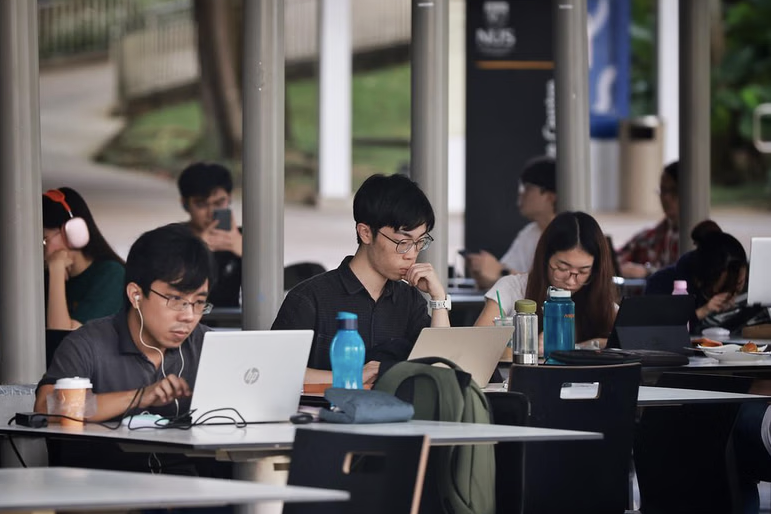
With AI developing rapidly and performing some tasks better than humans, many students are wondering what knowledge and skills they need to acquire in the next 3-5 years to avoid unemployment. Experts from Viettel point out that instead of fearing it, they should learn how to master the technology and master AI.
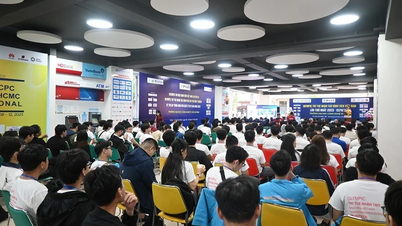
At the seminar "Make in Vietnam and Opportunities for Young Technology Engineers" held on the afternoon of December 12th at the Posts and Telecommunications Institute of Technology, Mr. Tran Van Bang, Deputy Director of Viettel Software Technology Investment Company, and Mr. Pham Cao Dinh, Deputy Director of Viettel IDC Cooperation Service Center, shared their insights on this topic with a large audience of university students.

According to Mr. Pham Cao Dinh, instead of fearing being replaced by AI, students need to learn to master AI, turning the technology into their assistant and helper. Essentially, AI can only replace simple tasks and will never understand jobs with emotional or humanistic elements.
However, to master technology, students need to master themselves. "Successful people aren't necessarily the best at any given time, but rather those who possess discipline, perseverance, and daily effort, always striving to be better than the day before," Mr. Dinh shared.
This is clearly demonstrated through how we use our time. Everyone has only 24 hours in a day, and how we use those 24 hours is what makes us different.
He gave the example that the founders of the world's largest technology corporations often start their day at 5 a.m.; they have their own schedules and know exactly what their goals are.
In terms of knowledge, the two Viettel experts emphasized that knowledge is never enough. Mr. Tran Van Bang pointed out that "the only thing that doesn't change is change." "Today it's AI, tomorrow it could be something even more incredible. Therefore, the question we should ask isn't what to learn, but how to learn in order to stay updated and not be left behind."
Sharing the same viewpoint, Mr. Pham Cao Dinh offered advice to students: "There's a little trick to never being unemployed: stay in the trend, because trends can never be stopped."
For example, with today's hottest technologies like AI and Big Data, we need to understand what they are, how they work, and what they require to operate. From there, we can gain further knowledge in the fields of electrical engineering, automation, servers, graphics cards, or data centers.
"Follow the actual needs, starting with what the application requires to run, then conduct in-depth research, build your expertise and skills," Mr. Dinh continued.
Overall, both speakers agreed that the current technology market is in dire need of skilled personnel, but specifically "high-quality" talent.
A journey of a thousand miles begins with a single step. Students need to proactively transform themselves into individuals who are always ready to embrace the times and understand what the times demand in order to acquire knowledge and become high-quality human resources.
Previously, according to the report "The Next Great Polarization - Why Artificial Intelligence Could Increase Inequality Between Countries" by the United Nations Development Programme (UNDP), the impact of AI is particularly serious for young people.
AI is gradually replacing basic jobs that young people often use as stepping stones to their careers, such as administration, scheduling, document writing, translation, or research.
This means that young people are being deprived of opportunities to access important entry-level jobs to build their careers.
According to the report, Vietnam is among the countries with the highest percentage of people in the region worried about losing their jobs or not being able to find employment due to AI, at 61%.
Meanwhile, in countries like South Korea, this rate is much lower because they have implemented strategies for retraining skills and coping with career changes.
To ensure that AI serves human development equitably, the UNDP report proposes a framework for action based on three core principles.
First, we must put people at the center, placing technological innovation within the framework of human development, prioritizing the expansion of human capabilities and the unleashing of human potential.
Next, we need to manage innovation responsibly. This involves establishing clear, risk-based regulations and enhancing accountability to balance progress with the protection of ethics and privacy.
Finally, build future-ready systems through robust investment in local talent and sustainable infrastructure, ensuring digital accessibility is considered essential infrastructure.
Source: https://vietnamnet.vn/hoc-gi-de-khong-that-nghiep-and-cau-tra-loi-cua-chuyen-gia-viettel-2471996.html


![[Image] Close-up of the newly discovered "sacred road" at My Son Sanctuary](/_next/image?url=https%3A%2F%2Fvphoto.vietnam.vn%2Fthumb%2F1200x675%2Fvietnam%2Fresource%2FIMAGE%2F2025%2F12%2F13%2F1765587881240_ndo_br_ms5-jpg.webp&w=3840&q=75)








































































Comment (0)