

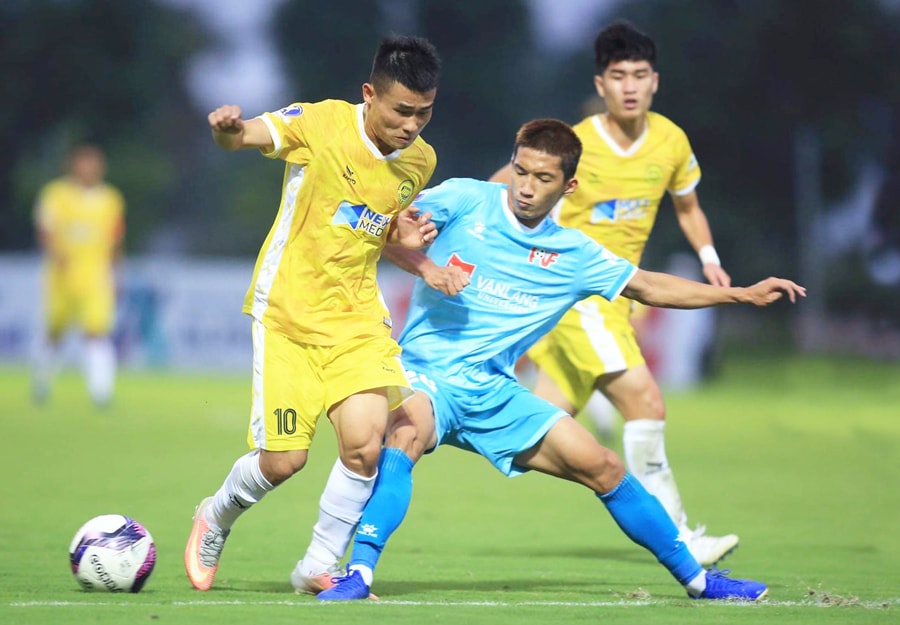
Financial crisis and its ripple effects
The direct cause of many football clubs withdrawing from the league largely stems from financial issues. Operating a professional football team costs an average of tens to hundreds of billions of Vietnamese dong per season. Currently, the main source of revenue still depends on sponsors or local budgets. Revenue from ticket sales, television rights, or commercial business remains very limited.
The story of Binh Dinh Football Club is a prime example. In 2021, Binh Dinh was promoted to the Vietnam National Football Championship (V.League). Thanks to financial backing with a budget of up to 300 billion VND for three seasons (an average of 100 billion VND per season), the team immediately rose to the same level as wealthy clubs by buying many players but neglecting youth training and having high ambitions in the V.League. However, by the 2024-2025 season, financial resources declined, causing the club to face difficulties. As a result, when the star players left, the team immediately suffered a personnel crisis, and relegation became a foregone conclusion.
Similarly, Quang Nam Football Club announced it would not register to participate in the 2025-2026 V.League due to financial reasons, leaving the league with only 13 teams. Recently, Hoa Binh Football Club officially withdrew from the 2025-2026 National First Division and National Cup. Hoa Binh Football Club's withdrawal significantly impacts the plan for organizing professional football leagues. Consequently, the National First Division will only have 12 participating teams, and the National Cup will only have 25 teams. This forces the Vietnam Football Federation (VFF) and the Vietnam Professional Football Joint Stock Company (VPF) to urgently reconsider their organizational plans. With only 12 teams in the National First Division and 13 teams in the V.League, VPF also has to recalculate the promotion and relegation spots.
VFF General Secretary Nguyen Van Phu emphasized: “Professional football cannot rely solely on one or two short-term sponsors. When financial resources depend entirely on businesses, the team easily falls into a passive position. If a sponsor withdraws, the entire system collapses.”
It's time to rebuild football for sustainable development.
According to VFF Vice President and VPF Chairman Tran Anh Tu, the disappearance of a club due to lack of operating funds is not unique to Vietnamese football. Even in developed football nations, many lower-division teams face similar difficulties. To develop professional football sustainably, Mr. Tran Anh Tu believes that clubs must build modern management models, engage with the community, invest in youth training, develop their brand, exploit broadcasting rights, and commercialize their products to create long-term revenue streams.
Meanwhile, football expert Phan Anh Tú commented that a team's withdrawal also negatively impacts the image of Vietnamese football in the eyes of fans and international partners. Therefore, clubs need to clearly define a long-term development model, avoiding chasing short-term achievements. Investing in youth training not only helps provide a stable source of players but also opens up business opportunities through transfers and international cooperation. This is the path that has helped many football nations in the region and the world maintain sustainable development.
Furthermore, it is crucial to build strong ties with the local community. A football team cannot survive solely on corporate funding; it needs to become a "spiritual asset" for the people. Encouraging small and medium-sized enterprises in the province to join hands, develop a loyal fan base, and organize community-building events will give the club a more solid social foundation.
From the perspective of the governing body, it is necessary to study and implement mechanisms to protect clubs, similar to those in many other countries. For example, establishing a financial support fund for struggling clubs, or applying mandatory financial transparency regulations before participating in a tournament. This would both enhance accountability and limit premature withdrawals, avoiding negative impacts on the quality and reputation of the leagues.
VFF Vice President Tran Anh Tu believes that the lessons learned from the withdrawal of football clubs like Quang Nam and Hoa Binh, or the previous difficulties faced by Binh Dinh, are not only losses for local football but also a reminder that: To build a strong football foundation, sustainability must be prioritized. Investing in football cannot focus solely on immediate results, but must have a long-term vision and a comprehensive development strategy encompassing youth training, infrastructure, and financial management.
With Vietnamese football aiming for big goals like the World Cup or the Olympics, a solid foundation in domestic leagues is crucial. Without a stable professional league system, long-term development is difficult to achieve.
Source: https://hanoimoi.vn/hoi-chuong-canh-tinh-cho-bong-da-chuyen-nghiep-716009.html






















![[Image] Vietnam's colorful journey of innovation](/_next/image?url=https%3A%2F%2Fvphoto.vietnam.vn%2Fthumb%2F1200x675%2Fvietnam%2Fresource%2FIMAGE%2F2025%2F12%2F14%2F1765703036409_image-1.jpeg&w=3840&q=75)















































Comment (0)