

In the cool weather of early spring, on January 26, 2024, the old French villa located at 49 Tran Hung Dao - 46 Hang Bai, Hanoi , officially opened its doors to visitors after two years of meticulous and elaborate restoration. This is one of the key projects in the Hanoi City Party Committee's urban renovation and development program, implemented with cooperation and technical support from the Ile-de-France region of France.
This two-story villa, with a built-up area of 174 m², is surrounded by a spacious nearly 1,000 m² garden and is one of the few buildings that still retains its original features with an expansive garden in the heart of Hanoi. Located in a prime location between Tran Hung Dao and Hang Bai streets, this villa is not only a witness to history but also a symbol of the cultural exchange between Vietnam and France during the colonial period. This building is also considered a pioneering model in the restoration and preservation of old villas in Hanoi, demonstrating the city's concern and efforts in preserving and promoting the value of urban architectural heritage.

The villa after renovation, viewed from the outside. Photo: Hoang Anh
The restoration process of the villa faced numerous challenges, particularly the lack of archival documentation on its original architecture. The original drawings and architectural records had been lost over time, leaving only a single photograph of the homeowner's family standing in front of the villa. Faced with this difficulty, experts from the Ile-de-France region and Hanoi had to conduct meticulous research, consulting various sources to restore the building according to heritage preservation principles. The primary goal was to preserve as many of the villa's original elements as possible while authentically recreating the distinctive classical French architecture of Indochina.
One of the highlights of the restoration process is the use of original construction techniques and materials. The ceiling of the first-floor living room, which had previously suffered significant peeling, was reinforced with load-bearing wooden panels and left exposed so that viewers could admire the house's original structure. Similarly, the second-floor ceiling was preserved, allowing visitors to directly observe the rafters, roof, and round ventilation windows. Broken floor tiles were also collected and reassembled instead of being completely replaced, preserving the authenticity and historical value of the building.
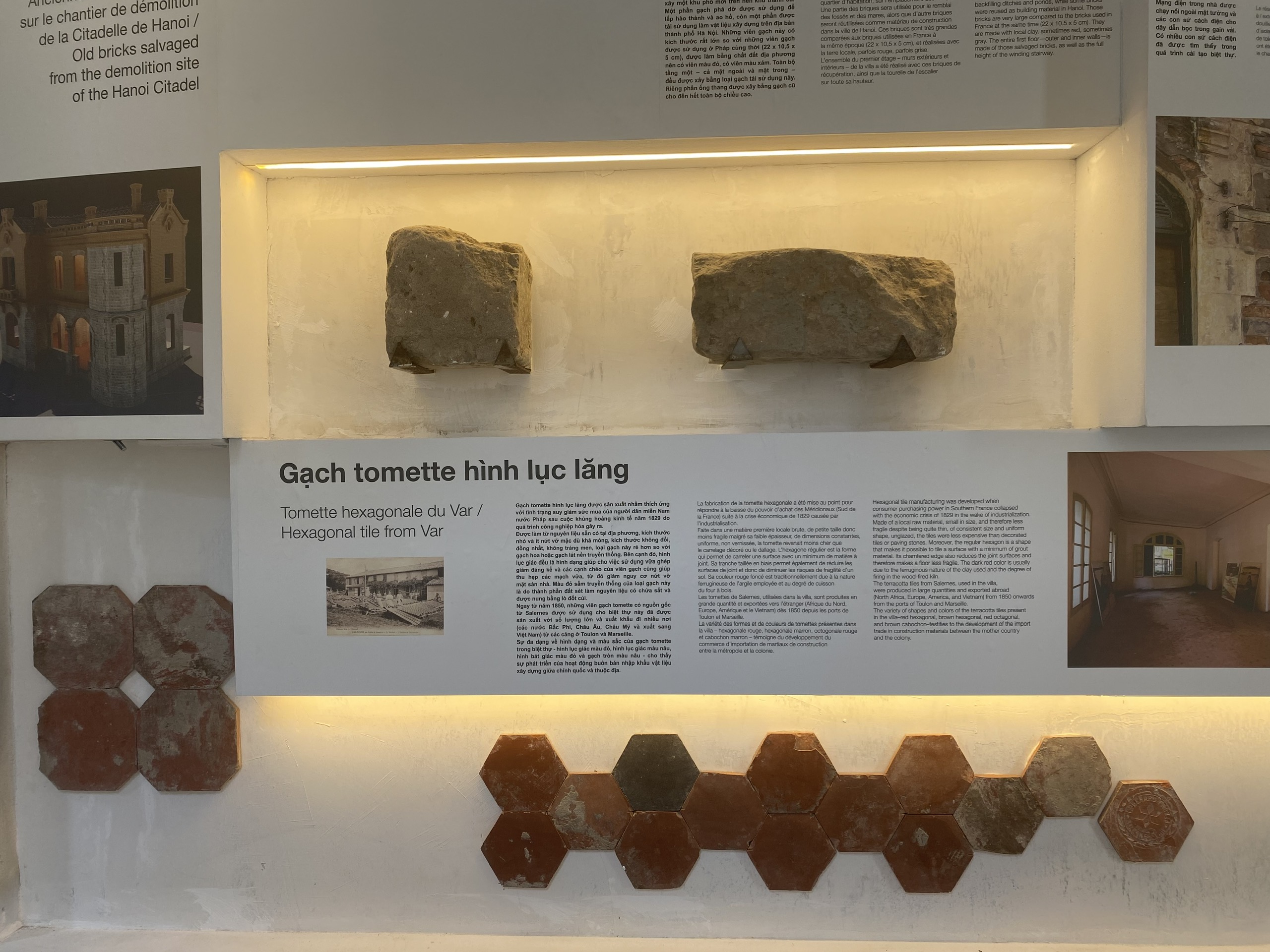
Samples of the tiles used in the villa, along with detailed explanations of their origin and versatility. Photo: Hoang Anh
Furthermore, the experts also used traditional construction methods such as plastering walls with quicklime mixed with straw instead of cement or plaster, and using natural-colored paint to protect the wooden and iron structures of the house. These construction techniques were very popular in Indochina and some Asian countries from the mid-19th to the early 20th century, giving the house a timeless and enduring antique beauty.
Besides touring the restored villa, visitors also have the opportunity to learn about the heritage restoration process through an on-site exhibition. The exhibition showcases maps, architectural drawings, and construction materials and techniques discovered during the restoration. Photographs taken before and during the restoration by photographer François Carlet Soulages are also on display, giving the public a deeper insight into the transformation of the building through each stage.
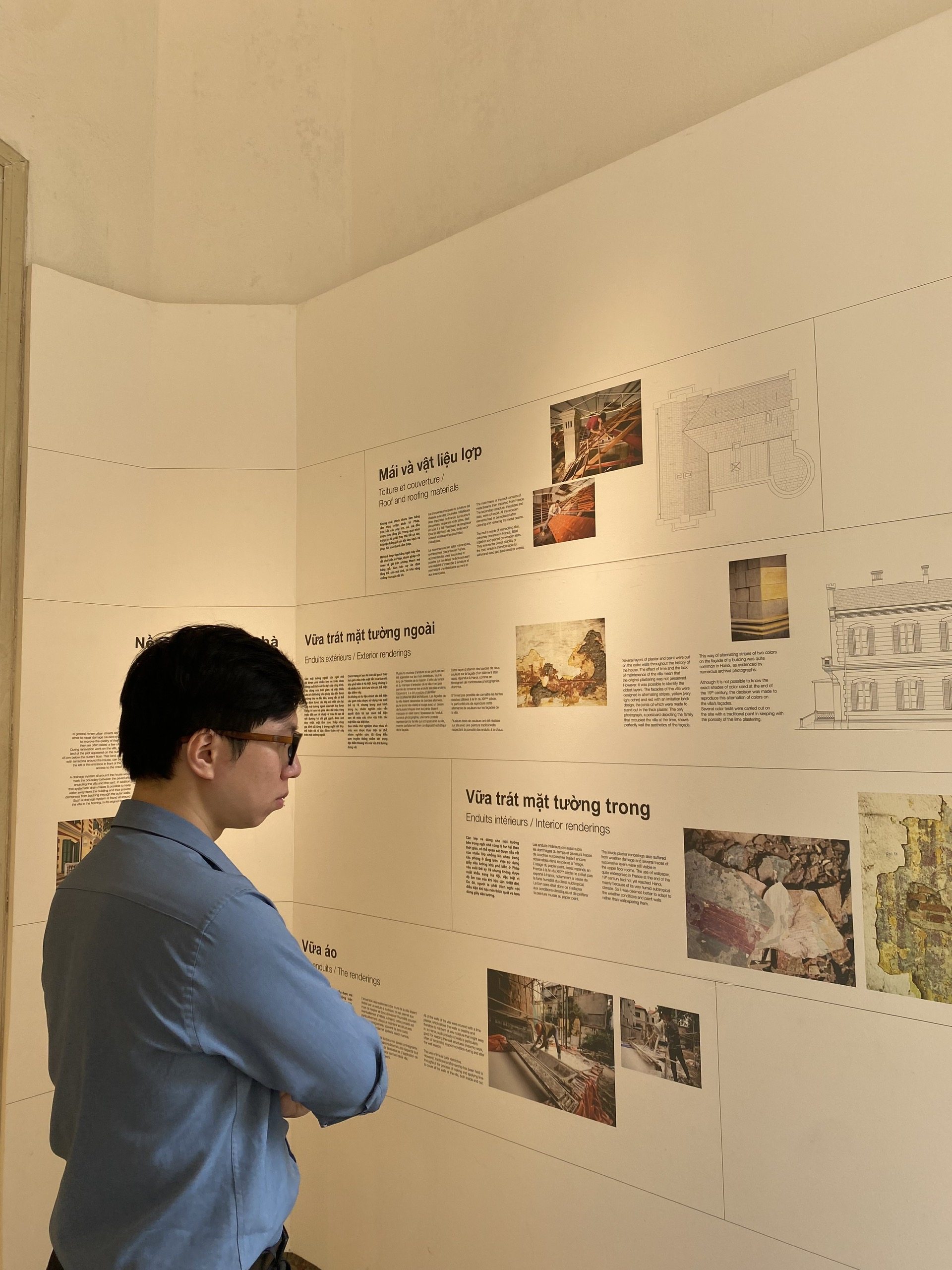
Visitors can learn more about the heritage restoration process through on-site documentation. Photo: Hoang Anh
This exhibition aims not only to showcase the results of the restoration project but also to call for community participation in the preservation of urban architectural heritage. It is an opportunity to emphasize the importance of preserving French-style architecture in Hanoi, as an integral part of the city's cultural heritage.
After restoration, the villa at 49 Tran Hung Dao - 46 Hang Bai will become the French Quarter Cultural Exchange Center, a space where tradition and modernity blend, offering visitors exciting experiences. The villa's front yard has been renovated with gravel, creating a comfortable space for visitors and also suitable for hosting large cultural events. The old kitchen has been transformed into an open space with transparent glass, where guests can enjoy coffee while admiring the entire house and the lush green garden surrounding it.
The villa restoration project breathes new life into an ancient building and contributes to raising community awareness of the value of architectural heritage. This affirms the necessity of preserving and promoting these values in the context of increasingly rapid urbanization, so that architectural heritage like this will always be a source of pride for Hanoi and Vietnam.

![[Photo] Prime Minister Pham Minh Chinh holds a phone call with the CEO of Russia's Rosatom Corporation.](/_next/image?url=https%3A%2F%2Fvphoto.vietnam.vn%2Fthumb%2F1200x675%2Fvietnam%2Fresource%2FIMAGE%2F2025%2F12%2F11%2F1765464552365_dsc-5295-jpg.webp&w=3840&q=75)


![[Photo] Closing Ceremony of the 10th Session of the 15th National Assembly](/_next/image?url=https%3A%2F%2Fvphoto.vietnam.vn%2Fthumb%2F1200x675%2Fvietnam%2Fresource%2FIMAGE%2F2025%2F12%2F11%2F1765448959967_image-1437-jpg.webp&w=3840&q=75)

































![[OFFICIAL] MISA GROUP ANNOUNCES ITS PIONEERING BRAND POSITIONING IN BUILDING AGENTIC AI FOR BUSINESSES, HOUSEHOLDS, AND THE GOVERNMENT](https://vphoto.vietnam.vn/thumb/402x226/vietnam/resource/IMAGE/2025/12/11/1765444754256_agentic-ai_postfb-scaled.png)










































Comment (0)