

.jpg)
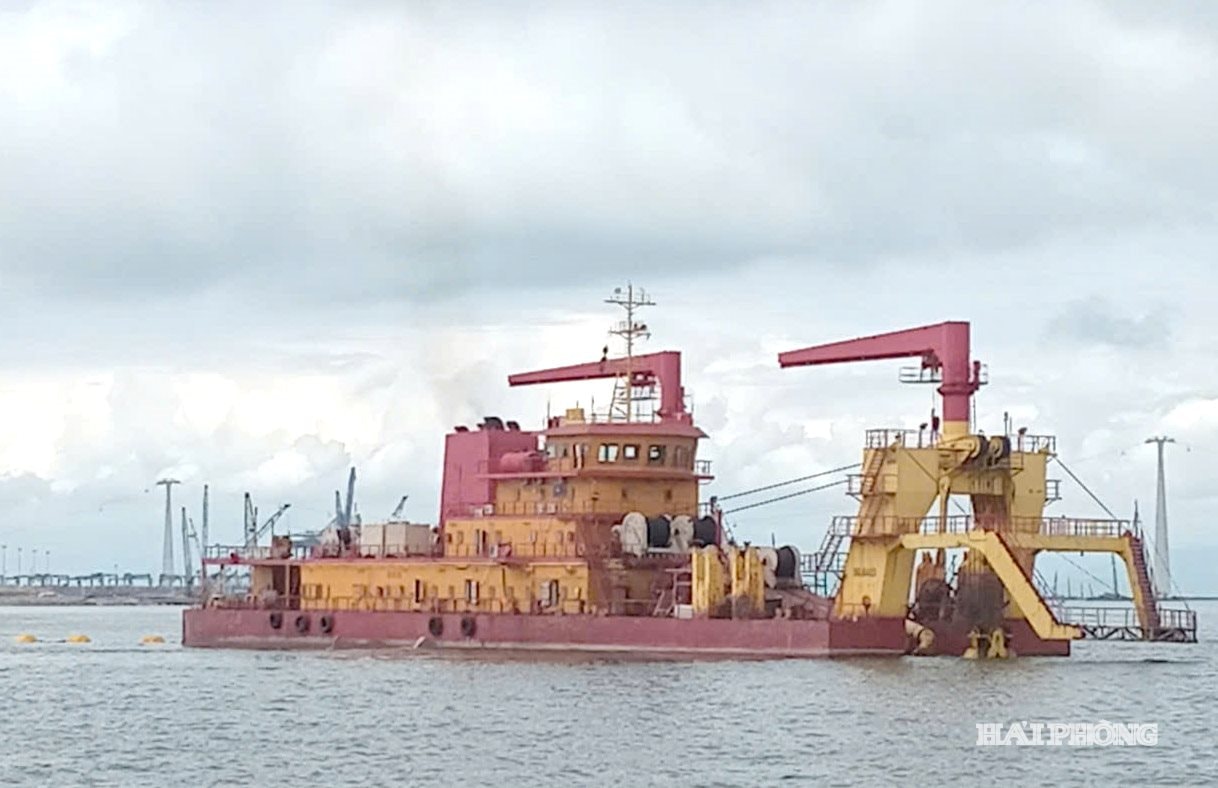
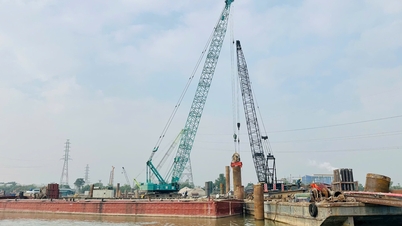
In 2026, construction is expected to begin on berths 7 to 12 at Lach Huyen Port, leading to a need to upgrade maritime channels to accommodate the rapidly increasing volume of vessels. In this context, planning and allocating dredged material disposal sites becomes crucial.
Identify the location for receiving dredged material.
In June 2025, the People's Committee of the city issued Decision No. 2447/QD-UBND announcing the list of locations for receiving dredged material. These locations include: areas 1 and 2 of the alluvial plain outside the dike in Thien Huong ward; the area of the Nam Dinh Vu Industrial Park infrastructure investment and construction project; DEEP C2A; the area of the International Gateway Port Industrial Park infrastructure investment and construction project - DEEP C3; the Doi Rong International Tourist Area project; and the aquaculture ponds along the dike in the Cat Hai special economic zone...
With a large number of operational ports and those under construction, the annual dredged material volume in Hai Phong reaches approximately 4-5 million m³ , not including millions of m³ of mud and soil from basic channel dredging operations.
In light of this situation, the Department of Agriculture and Environment advised the City People's Committee to proactively arrange additional dredged material receiving points to meet the city's development requirements. To ensure safe construction and disposal of dredged material and minimize pollution, the Department coordinated with relevant departments, units, and local authorities to supervise and complete the procedures for approving the waste disposal and dredging construction sites for investors.
At the same time, the investor of the dredging project is required to strictly adhere to the procedures for obtaining approval, as well as providing prior and post-completion notices.
According to Ms. La Thi Thu Trang, Deputy Head of the Department of Minerals, Sea and Islands (Department of Agriculture and Environment), in order to prepare locations for dumping dredged material to serve the dredging of maritime channels and the construction of large-scale seaports, the city plans and announces the locations for dumping dredged material on shore within its management scope, promptly resolving obstacles in maintenance work and ensuring the depth of maritime channels.
From 2024 to October 2025, the People's Committee of the city issued numerous documents approving the dumping of dredged material from waterways and maritime structures, with a total estimated volume of approximately 3.5 million m³ .
Combine
The placement of dredged material receiving points helps ensure the progress of maintenance and dredging of the Hai Phong maritime channel, meeting the requirements for operating ships entering the port.
As part of the project "Upgrading the maritime channel from the turning basin of Hai Phong International Container Port to Nam Dinh Vu Port," after the upgrade, the channel now has a depth of -8.5m (compared to -7m before the upgrade). Previously, ships with a deadweight of 25,000 DWT faced certain difficulties reaching this area during low tide, but now, ships can arrive without waiting for high tide. The berths have increased their capacity to receive larger ships, now able to accommodate vessels with a deadweight of up to 48,000 DWT fully loaded.
Since 2015, the People's Committee of Hai Phong City has assigned the Institute of Marine Resources and Environment to research the topic "Research on building justifications for disposing of dredged sediment in Hai Phong". The results identified four offshore locations (D1, D2, D3, D4) with a total area of 3,034 hectares capable of receiving approximately 206 million m³ of dredged material.
This is the basis for the Ministry of Agriculture and Environment to issue 3 permits for dumping, assigning the sea area to the Northern Maritime Safety Corporation to serve the dumping of dredged material from the maintenance of the Hai Phong maritime channel during the 2021-2025 period.
Every year, the Department of Agriculture and Rural Development advises the City People's Committee to announce the list of locations for disposing of dredged material on land and offshore. To date, the city has designated 7 receiving sites, with a capacity to process 15-20 million m³/year.
These areas are all located in saline coastal regions, so saline sand has been utilized for land reclamation in low-lying areas, reducing the risk of pollution and offering advantages over dumping it offshore. This also increases resource tax revenue, saves time, and reduces costs for investors.
Besides advising the City People's Committee on the location and volume of dredged material to be received, the Department of Agriculture and Environment also guides organizations and individuals managing disposal sites to fully comply with legal procedures regarding land, construction, and environment.
Hai Phong is characterized by its location downstream of many large rivers, resulting in frequent siltation of the shipping channels, affecting the navigation of seagoing vessels. Therefore, regular maintenance and dredging are necessary. Identifying suitable dumping sites has helped to resolve the "bottleneck" in dredging the shipping channels into the city's seaports.
Source: https://baohaiphong.vn/khoi-thong-luong-tau-vao-cang-bien-hai-phong-529468.html
![[Image] Vietnam's colorful journey of innovation](/_next/image?url=https%3A%2F%2Fvphoto.vietnam.vn%2Fthumb%2F1200x675%2Fvietnam%2Fresource%2FIMAGE%2F2025%2F12%2F14%2F1765703036409_image-1.jpeg&w=3840&q=75)




















































![[Image] Vietnam's colorful journey of innovation](https://vphoto.vietnam.vn/thumb/402x226/vietnam/resource/IMAGE/2025/12/14/1765703036409_image-1.jpeg)


























Comment (0)