

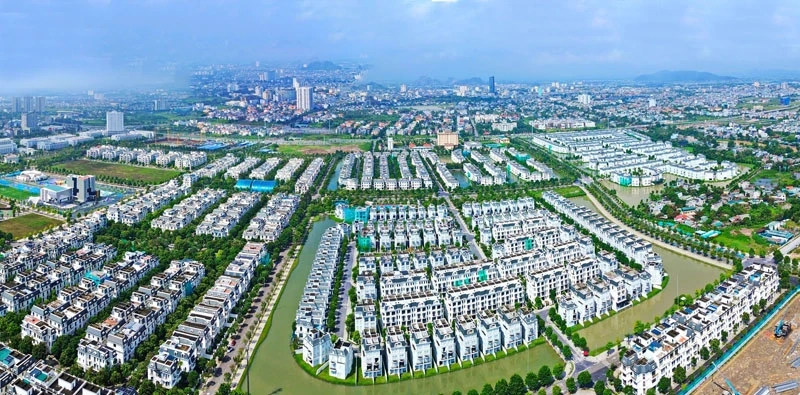
Synchronized infrastructure investment creates new urban spaces for localities in the development process. (In the photo: A view of Hac Thanh ward from above). Photo: Minh Hieu
In the context of Thanh Hoa province having completed the reorganization of 166 commune-level administrative units and operating a two-tiered local government system smoothly, the need to expand development opportunities for communes and wards has become even more urgent. The new development space is not only geographical, but first and foremost, it encompasses institutional space, mechanisms, infrastructure, and resources. The Resolution of the 20th Provincial Party Congress clearly outlines the main axes for localities to break through, aligning with the goal of double-digit growth and comprehensive modernization.
One of the groundbreaking new points is the emphasis on the requirement to "innovate management and operational thinking towards a constructive and service-oriented approach; strongly implement decentralization and delegation of authority coupled with inspection, supervision, and control of power." This opens up significant opportunities for communes and wards to be more proactive in land management, investment, land clearance, and the implementation of socio-economic development tasks. Notably, the province requires the development and application of a KPI system in evaluating officials – an unprecedented step at the commune level. When responsibility is quantified and effectiveness is measured, the grassroots level will be forced to change its approach, unable to be stagnant, evasive, or afraid of making mistakes. This is the institutional foundation for each commune and ward to assert its role as a "grassroots administrative unit with strategic thinking." In the context of many pressing issues such as land, environment, prolonged complaints and petitions, social evils, etc., all originating from the grassroots level, improving the management capacity of communes and wards is also a solution to reduce pressure on higher levels and increase the effectiveness of governance throughout the province.
The resolution clearly defines three pillars of growth: processing and manufacturing industries, large-scale high-tech agriculture , and tourism and services. While this appears as a major direction at the provincial level, a closer look reveals clear guidelines for communes and wards to shift their economic structure. Communes in the plains have the opportunity to participate in industrial value chains by developing industrial clusters, service clusters, worker housing projects, and commercial and service activities. Mountainous communes have significant potential to expand forestry, community tourism, circular economy, and organic agriculture. Coastal areas will continue to make breakthroughs in fisheries, aquaculture, port services, and marine tourism. The resolution sets a target of having at least 50% of communes and wards drug-free by 2030; at least 80% of communes meeting the standards of the New Rural Area program, with 35% being advanced New Rural Areas and 10% being modern New Rural Areas. This is not just a goal for new rural development, but also a framework for socio-economic development at the commune level, addressing every criterion related to infrastructure, environment, income, and people's living standards.
The role of communes and wards as "extended arms" of growth drivers—from industry and services to high-tech agriculture—shows a clear shift in mindset: no longer are communes purely focused on agriculture; no longer are wards solely responsible for population management; the grassroots level must directly participate in the province's development chains.
The Resolution of the 20th Provincial Party Congress identified infrastructure as the top priority for breakthroughs. A series of major projects have been outlined: coastal roads, roads connecting major transportation routes, inter-commune and inter-regional roads, irrigation works, dikes, digital infrastructure, tourism infrastructure, industrial infrastructure, etc. Previously, when infrastructure was not synchronized, many communes were "stuck" in their traditional development spaces. Now, with the opening of major transportation routes, investment in industrial parks and clusters, and the formation of new tourism centers, the "connectivity gap"—the biggest obstacle hindering the development of many localities—will be broken. In particular, strong investment in digital infrastructure and large databases creates conditions for communes to operate digital government, digital economy, and online public services. The grassroots level is no longer a "weak link" in digital transformation, but must become the frontline in serving the people.
The resolution emphasizes the goals of improving the quality of education, healthcare, culture, and sports; establishing multi-level boarding schools in border communes; developing high-quality healthcare services; reducing poverty by at least 1% annually; and building communes that meet food safety and security standards. These targets directly impact the lives of people in communes and wards – where all social policies are implemented. When the quality of public services improves, people have equitable access to healthcare, education, and socio-cultural activities, leading to healthier integration and development. The social space at the grassroots level will be expanded in the truest sense: civilized, safe, and progressive.
The resolution also calls for building a team of grassroots officials who are "of high quality, capable, and willing to think, act, and take responsibility," tightening discipline, and promptly replacing irresponsible leaders who cause stagnation. This shows that the development space of communes and wards cannot expand if the people do not change. This is a strategic highlight, because it is the grassroots officials who directly "transform the resolution into life." When the team is upgraded, empowered, and held accountable, localities will be more proactive, more creative, and effectiveness will come from the quality of governance, not just from investment resources.
In line with the vision of the Resolution of the 20th Provincial Party Congress, communes and wards in Thanh Hoa are not only places for implementing policies, but must also be places for initiating new models, new economic spaces, and new development values. This is the foundation for Thanh Hoa to realize its aspiration to "rise up," entering a new era of development on a solid foundation from the grassroots.
Minh Hieu
Source: https://baothanhhoa.vn/kien-tao-khong-gian-phat-trien-moi-nbsp-cho-xa-phuong-271698.htm
![[Image] Vietnam's colorful journey of innovation](/_next/image?url=https%3A%2F%2Fvphoto.vietnam.vn%2Fthumb%2F1200x675%2Fvietnam%2Fresource%2FIMAGE%2F2025%2F12%2F14%2F1765703036409_image-1.jpeg&w=3840&q=75)


























































![[Image] Vietnam's colorful journey of innovation](https://vphoto.vietnam.vn/thumb/402x226/vietnam/resource/IMAGE/2025/12/14/1765703036409_image-1.jpeg)

























Comment (0)