

At the meeting, Secretary Tran Luu Quang raised several issues, including: "What needs to be done to make Ho Chi Minh City the innovation center of the whole country, even to have a leading role? To achieve that, how should we start, what should the priorities be, where will the resources come from, and who will be responsible for implementation?"
In the current context, Ho Chi Minh City has achieved remarkable achievements. The city currently ranks second in the Digital Transformation Index and the National Innovation Index. The city's innovative startup ecosystem is ranked 110th globally and 5th in Southeast Asia.
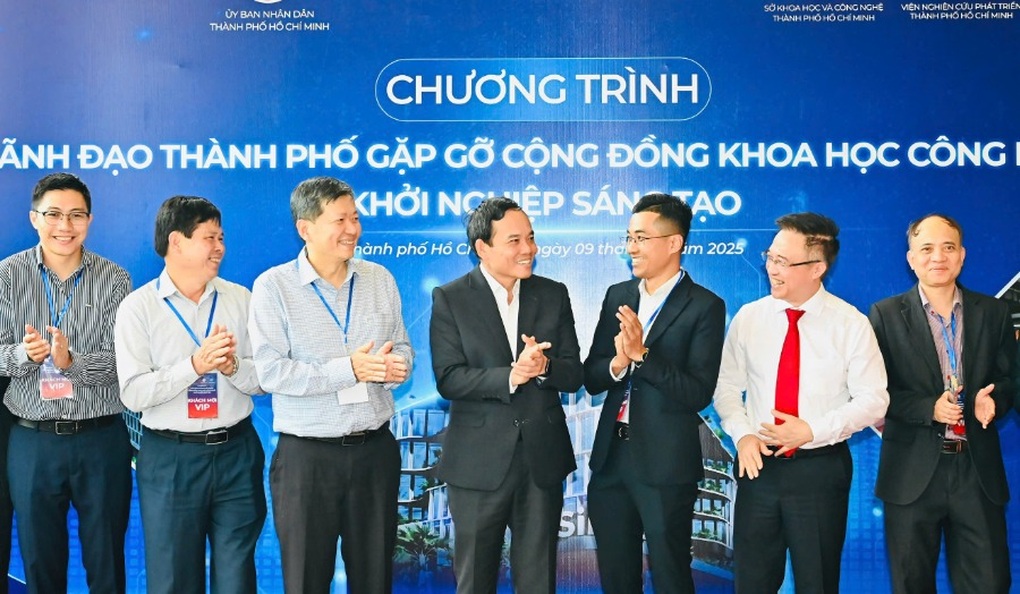
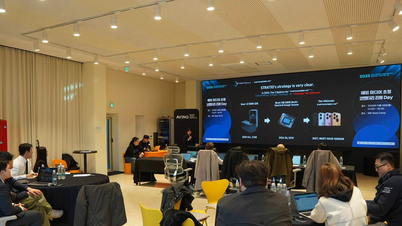
Secretary of the Ho Chi Minh City Party Committee Tran Luu Quang and city leaders attended a meeting with the science, technology, and innovation startup community (Photo: Viet Dung/SGGP).
In particular, the city has risen to 30th place in the world in blockchain, a rapidly growing field. These achievements are a solid foundation for future development.
To continue developing, Ho Chi Minh City has identified three main groups of topics to focus on: building an international Innovation and Startup Center, making a breakthrough in implementing Resolution 57, and developing the low-level economy .
Experts and businesses have put forward many ideas and solutions to promote the development of science, technology and innovation. One of the important proposals is to build specific mechanisms and policies to attract talent and investment capital.
Mr. Tran Kim Chung, Chairman of CT Group, proposed that the city could establish a center to collect and publish problems that need to be solved, from both the public and private sectors. Startups could participate in solving problems to receive prizes, while also verifying their capacity and market demand.
"HCMC can build the "HCMC Future" award in the same spirit as VinFuture but focus on application problems related to urban needs. Startups that solve the problem of both having money and customers," said Mr. Chung.
Meanwhile, Mr. Don Lam, General Director of VinaCapital, said that venture capital always accepts a high failure rate. However, those failures create lessons for the market to mature.
"The most important thing that Ho Chi Minh City can do is not to invest money but to become a customer and use the startup's products to help them prove their capacity to the global market," Mr. Lam shared.
In the next 5 years, Ho Chi Minh City aims for the digital economy to account for 30-40% of GRDP, becoming an international-class Innovation Center by 2030, and for its creative startup ecosystem to be in the Top 100 most dynamic cities globally.
To achieve these goals, Ho Chi Minh City has implemented three strategic breakthroughs: mechanisms, policies and investment attraction; strategic technology and innovation ecosystem; digital governance and digital human resources.
The city prioritizes the development of technologies such as artificial intelligence, cloud computing, semiconductor chips, robotics, blockchain, and biomedical engineering. Simultaneously, it is establishing a new model of startup support fund, attracting capital from venture capital funds, and focusing resources on supporting promising innovation centers.
Source: https://dantri.com.vn/cong-nghe/lanh-dao-tphcm-gap-go-cong-dong-khoa-hoc-cong-nghe-20251210114220618.htm


![[Photo] The captivating scenery of the fragrant maple forest in Quang Tri](/_next/image?url=https%3A%2F%2Fvphoto.vietnam.vn%2Fthumb%2F1200x675%2Fvietnam%2Fresource%2FIMAGE%2F2025%2F12%2F10%2F1765353233198_lan09046-jpg.webp&w=3840&q=75)


![[Photo] Explore the US Navy's USS Robert Smalls warship](/_next/image?url=https%3A%2F%2Fvphoto.vietnam.vn%2Fthumb%2F1200x675%2Fvietnam%2Fresource%2FIMAGE%2F2025%2F12%2F10%2F1765341533272_11212121-8303-jpg.webp&w=3840&q=75)























![[Video] The craft of making Dong Ho folk paintings has been inscribed by UNESCO on the List of Crafts in Need of Urgent Safeguarding.](https://vphoto.vietnam.vn/thumb/402x226/vietnam/resource/IMAGE/2025/12/10/1765350246533_tranh-dong-ho-734-jpg.webp)


























































Comment (0)