

According to information from Rong Viet Securities Company, a survey by the U.S. Fashion Institute of America (USFIA) compares the competitive advantages of various countries in the U.S., with higher scores being considered better. Currently, Vietnam's textile and garment industry has a higher overall score than China and Bangladesh, indicating a greater competitive advantage. However, compared to 2020, only Vietnam and China have seen a decrease in scores, while other countries are gradually increasing their scores, signaling that Vietnam is losing its competitive edge.
Compared to China, Vietnam holds a higher advantage in terms of adjusted weighting scores. Compared to Bangladesh, Vietnam has advantages in its large port system, geographical location, and diversified production capabilities, producing high-value and diverse products such as vests, winter coats, and swimwear, while Bangladesh mainly produces mass-produced basic t-shirts. However, Bangladesh's score is improving due to increasing product diversification. The value of Bangladesh's exports to the US is also steadily increasing, indicating improvement in the US market.
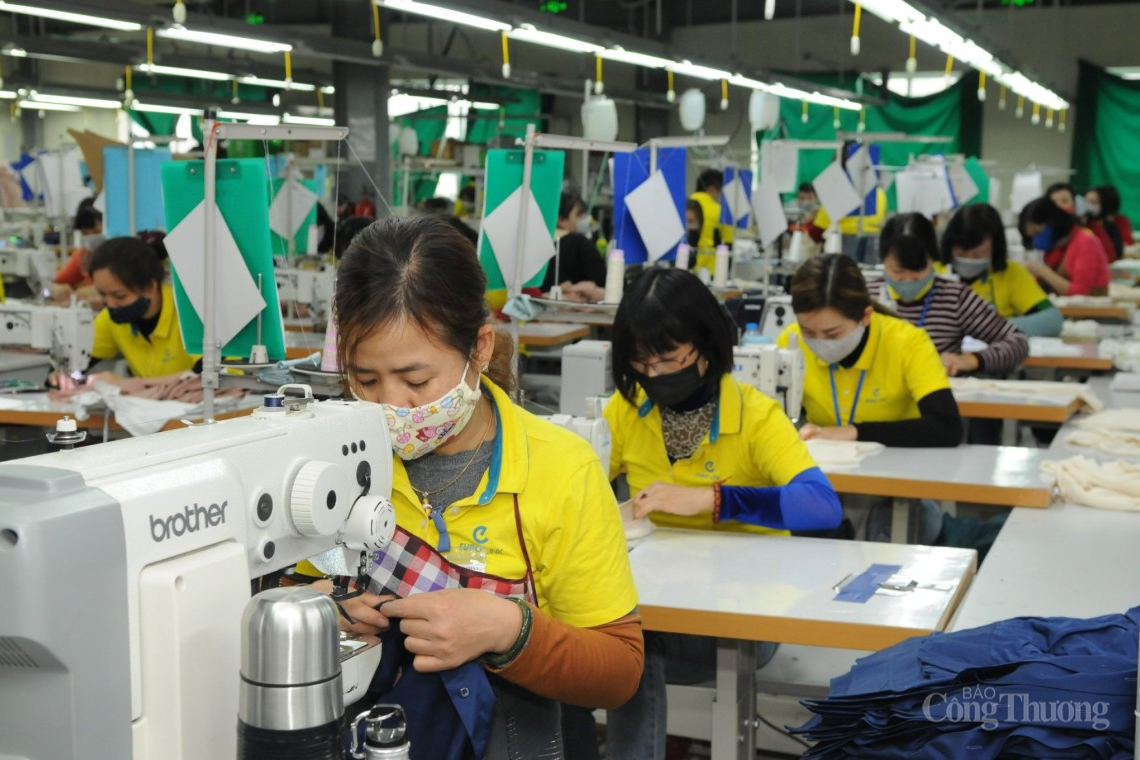 |
| Vietnamese textile and garment production. Photo: Can Dung |
Compared to other countries like India, Indonesia, and Sri Lanka, Vietnam currently offers faster delivery times and more flexible production capabilities. However, in the long term, if these countries catch up in terms of diversified production, Vietnam will face significant challenges.
Compared to Mexico, Vietnam has a lower score due to its geographical distance. However, Mexico's impact in the short term is minimal because Vietnam has the advantage of cheap labor and high-skilled manufacturing.
Compared to the Central American Dominican Republic (CAFTA-DR) bloc, which comprises six Central American countries—Costa Rica, El Salvador, Guatemala, Honduras, Nicaragua, and the Dominican Republic—Vietnam scores higher due to its geographical advantages and import duty exemptions. However, in the short term, this bloc's competitiveness is low because of the small scale of its textile industry, high labor costs, and the need to import raw materials such as yarn and fabric from Asia, resulting in slow production capabilities.
Overall, Vietnam is leading in its ability to produce a diverse range of products quickly thanks to investment in machinery and skilled labor. However, in the long term, other countries are likely to catch up, and this advantage will gradually diminish. Vietnamese businesses can boost investment in technology, optimize production and supply processes, and participate more deeply in the value chain to create a competitive advantage over other countries.
Responding to a reporter from the Industry and Trade Newspaper regarding the assessment by Rong Viet, Mr. Pham Xuan Hong, Chairman of the Ho Chi Minh City Textile, Garment, Embroidery and Knitting Association, stated that the report did not fully assess the current state of the industry. “ Basically, Vietnam’s textile and garment industry maintains its position in the US market, orders remain stable, and brands still highly value the quality of Vietnamese textiles and garments, ” Mr. Pham Xuan Hong said.
According to the Chairman of the Ho Chi Minh City Textile, Garment, Embroidery and Knitting Association, in the first six months of 2024, the US market still accounted for 50% of Vietnam's textile and garment exports, followed by Japan and the EU.
However, like other developed markets, the US is currently preparing to enact regulations related to labor, the environment, and producer responsibility, which domestic textile and garment businesses must comply with. This is a trend and a requirement that domestic textile and garment businesses must fulfill in order to meet regulations on green growth and the circular economy .
Providing further information on labor and environmental regulations in the US, Mr. Le Tien Truong, Chairman of the Board of Directors of Vietnam Textile and Garment Group, said that the US has had the Uyghur Forced Labor Prevention Act since 2021 to more closely monitor the supply chain and prevent products originating from areas with forced labor. The country also has laws protecting garment workers, requiring all countries producing clothing for export to the US to comply.
In addition to existing regulations, the US has now introduced legislation to promote accountability and practical organizational change. This legislation requires stakeholders to be held accountable for wage violations to encourage responsible production; sets a minimum hourly wage; and eliminates piece-rate pay.
The US Fashion Social Responsibility and Sustainability Act, proposed in 2022 but not yet passed, requires large fashion companies to map their supply chains, establish and disclose ESG (E-environment; S-Social; G-Governance) goals, and address the environmental and social impacts of their operations.
" The transition to a circular economy and green growth is truly challenging; it's not a problem with a single solution, forcing businesses to make efforts to find their own path, " said Mr. Le Tien Truong.


![[Photo] Closing Ceremony of the 10th Session of the 15th National Assembly](/_next/image?url=https%3A%2F%2Fvphoto.vietnam.vn%2Fthumb%2F1200x675%2Fvietnam%2Fresource%2FIMAGE%2F2025%2F12%2F11%2F1765448959967_image-1437-jpg.webp&w=3840&q=75)
![[Photo] Prime Minister Pham Minh Chinh holds a phone call with the CEO of Russia's Rosatom Corporation.](/_next/image?url=https%3A%2F%2Fvphoto.vietnam.vn%2Fthumb%2F1200x675%2Fvietnam%2Fresource%2FIMAGE%2F2025%2F12%2F11%2F1765464552365_dsc-5295-jpg.webp&w=3840&q=75)







































![[OFFICIAL] MISA GROUP ANNOUNCES ITS PIONEERING BRAND POSITIONING IN BUILDING AGENTIC AI FOR BUSINESSES, HOUSEHOLDS, AND THE GOVERNMENT](https://vphoto.vietnam.vn/thumb/402x226/vietnam/resource/IMAGE/2025/12/11/1765444754256_agentic-ai_postfb-scaled.png)














































Comment (0)