

Russia tests the possibility of combining tanks and unmanned aerial vehicles (UACVs) in combat.
According to sources from the Russian Ministry of Defense , Russian tank crews have begun training to operate unmanned combat vehicles (UACVs), which can provide combat support to tanks on the battlefield.
Specifically, tank crews are training at the firing range to master a series of special exercises related to the operation, maintenance, and combat use of UACVs equipped with 7.62 mm RPK machine guns or AGS-17 Plamya automatic grenade launchers.
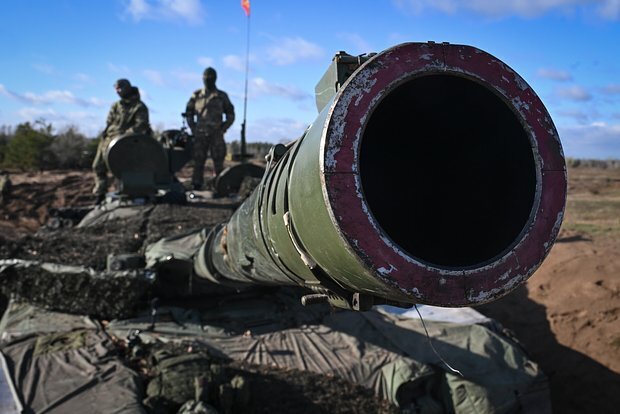
Russia tests integrated control between tanks and unmanned aerial vehicles (UACVs). Photo: RIAN
Military expert Yuri Lyamin stated: "Many believe that the future of tank forces lies in the interaction between manned combat vehicles and various UACV platforms."
The primary function of a UACV is to provide fire support for tanks in combat. Russian military experts believe that UACVs can also assist in reconnaissance and carry electronic warfare systems to suppress similar enemy vehicles.
In August 2025, The National Interest magazine noted that the development of the most modern heavy UACV, the Shturm, based on the T-72 tank chassis, demonstrated a lack of innovation in Russia and a reduction in spending on the development of new combat vehicles. However, during the Ukraine conflict, the Russian military actively used various new UACVs to refine their design and test technologies, contradicting Western assessments.
Australia conducts its first test of a UAV in an air-to-air mission.
The Royal Australian Air Force's Boeing MQ-28A Ghost Bat unmanned aerial vehicle (UAV) has successfully launched the advanced AIM-120 medium-range air-to-air missile (AMRAAM) for the first time. According to TWZ, the UAV struck a flying target during the test.
The test firing was conducted at a test range in Australia as part of the ongoing Kareela 25-4 test. The Ghost Bat drone served as support for the Australian Air Force's E-7A Wedgetail airborne early warning and control aircraft. An AMRAAM missile struck the Phoenix drone.
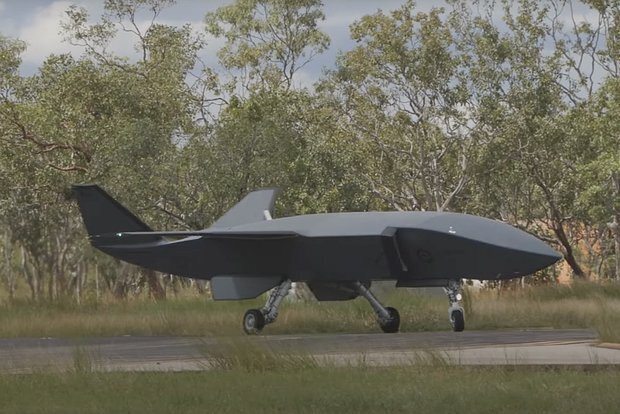
The Boeing MQ-28A Ghost Bat UAV participates in testing. Photo: Defense News
The MQ-28A carries a single missile externally. This mounting method increases the drone's radar signature, but the current Ghost Bat variant is not designed with an internal weapons bay.
It remains unclear how the experimental UAV detected and tracked the target. It may have used equipment from the Ghost Bat or target information received from a support aircraft. Infrared sensors capable of detecting targets and guiding missiles to them have previously been found to be integrated into the MQ-28.
In November 2025, the YFQ-44A UAV prototype, manufactured by Anduril to support the fifth-generation F-35 fighter jet, made its first test flight.
China is developing a satellite network system similar to Starlink.
China is preparing to inaugurate a "mega-factory" for satellites capable of producing 1,000 per year. This could be a major step forward for China in developing a satellite system in low Earth orbit, similar to billionaire Elon Musk's Starlink system.
According to Xinhua News Agency, the Wenchang Satellite Manufacturing Center in Hainan Province will integrate a 'factory-to-launch' assembly line, encompassing assembly, testing, and integration of satellites onto launch vehicles. This is the only facility of its kind in China and the largest satellite manufacturing center in Asia.
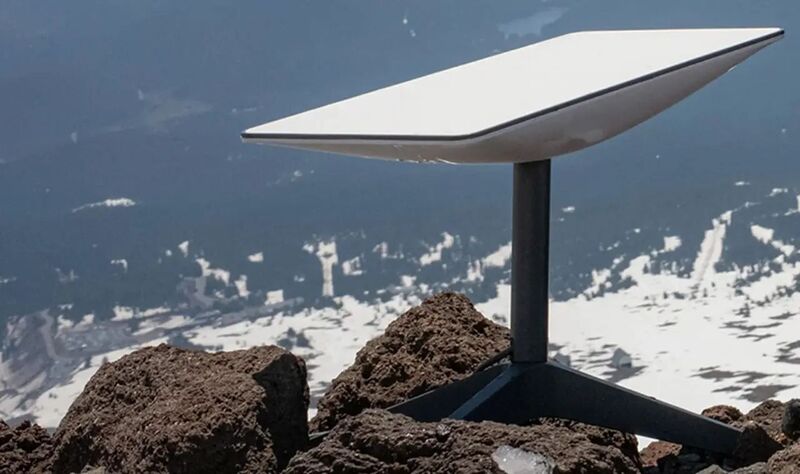
China could potentially build a satellite network system similar to Elon Musk's Starlink. (Image: Topwar)
This new megafactory emerges amidst a booming commercial space industry in China. Thanks to preferential policies, a rise in private rocket launches, and plans to develop space tourism , China is accelerating its efforts to compete with the United States in this field.
The main advantage of this facility is the speed of the production process, which can significantly reduce costs. With commercial launch sites in Wenchang and Hainan just a few kilometers away, satellites can be transported from final assembly to the launch pad in just a few hours.
China has set a record for the number of spacecraft launches in 2025, reaching 80 as of December 6th, according to data from Space Stats Online.
Source: https://congthuong.vn/nga-thu-nghiem-ket-hop-xe-tang-voi-uacv-434353.html

![[Photo] Closing Ceremony of the 10th Session of the 15th National Assembly](/_next/image?url=https%3A%2F%2Fvphoto.vietnam.vn%2Fthumb%2F1200x675%2Fvietnam%2Fresource%2FIMAGE%2F2025%2F12%2F11%2F1765448959967_image-1437-jpg.webp&w=3840&q=75)







































![[OFFICIAL] MISA GROUP ANNOUNCES ITS PIONEERING BRAND POSITIONING IN BUILDING AGENTIC AI FOR BUSINESSES, HOUSEHOLDS, AND THE GOVERNMENT](https://vphoto.vietnam.vn/thumb/402x226/vietnam/resource/IMAGE/2025/12/11/1765444754256_agentic-ai_postfb-scaled.png)






































Comment (0)