

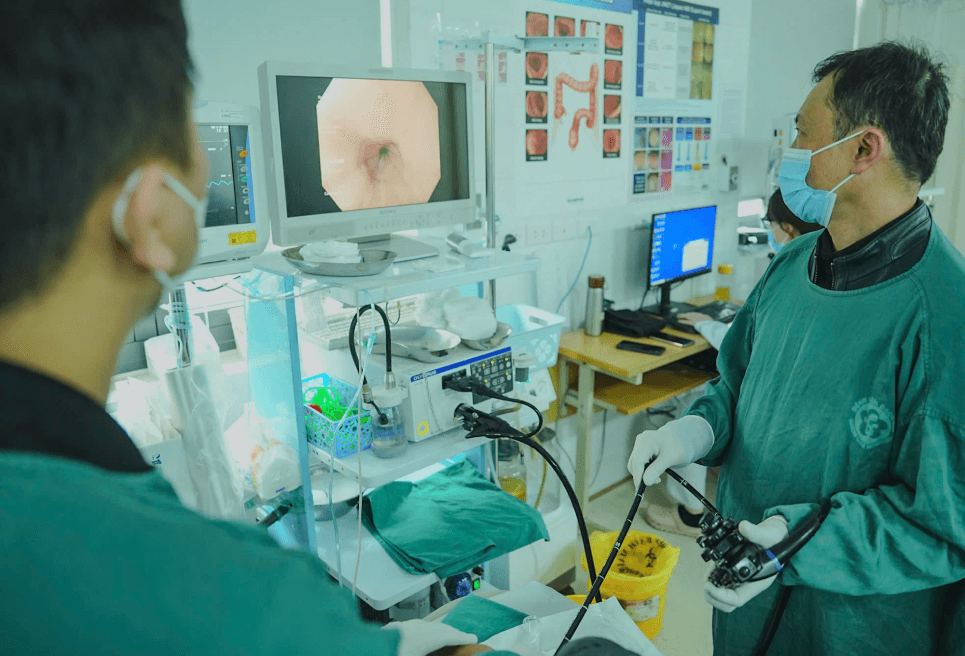
Mr. NAD (26 years old, residing in Hai Phong) went to the Oncology and Nuclear Medicine Center, Bach Mai Hospital ( Hanoi ) and was diagnosed with colorectal cancer. The patient came for examination due to persistent abdominal pain and fatigue.
The endoscopic examination revealed a large, ulcerated tumor in the transverse colon, which was identified as colorectal adenocarcinoma through histopathology.
Upon reviewing the patient's medical history, the doctor observed an unusual genetic history in Mr. D. and his relatives: his father, paternal aunt, paternal uncle, and cousin all suffered from colorectal cancer. Gene sequencing revealed that the patient carried a mutation in the MLH1 gene – one of the important genes that helps repair DNA replication errors, associated with Lynch syndrome – a genetic condition that increases the risk of cancer.
According to Associate Professor Pham Cam Phuong, Director of the Center for Oncology and Nuclear Medicine, Lynch syndrome occurs when "gatekeeper" genes (such as MLH1, MSH2, MSH6, PMS2) mutate, losing their ability to repair errors during DNA replication. As a result, mutations accumulate rapidly, promoting the formation of malignant tumors. Individuals with this syndrome have a high risk of developing many types of cancer at a young age, including:
- Colorectal cancer: The risk increases from 1.9% to 52-82% (27-43 times higher).
- Endometrial cancer (in women): Risk increases from 1.6% to 25-60% (15-37 times higher).
- Stomach cancer: Risk increases from 0.3% to 6-13% (20-43 times higher).
- Ovarian cancer (women): Risk increases from 0.7% to 4-12% (5-17 times higher).
Lynch syndrome is not limited to colorectal cancer but also increases the risk of multiple organ cancers, affecting both men and women.
Upon discovering that the patient had Lynch syndrome, the doctor provided treatment and genetic counseling. In this case, the doctor clearly explained the genetic risk and recommended that family members, especially the patient's brother, undergo genetic testing. The benefits of testing include early detection of risk and identification of carriers of the mutated gene.
Individuals carrying the gene mutation should undergo colonoscopies every 1-2 years starting at age 20-25, combined with other screening programs earlier than the general population. Early detection of polyps or cancer increases cure rates and improves quality of life.
According to experts, gene sequencing not only helps accurately identify Lynch syndrome but also supports the development of screening and prevention plans for family members. This syndrome can silently exist without being detected. Therefore, if two or more people in your family have colorectal, endometrial, or stomach cancer, you should consider genetic counseling and early gene testing.
Doctors also recommend that colorectal cancer screening is especially important for families with a history of the disease. Several factors can help prevent this disease, such as avoiding tobacco, alcohol, and stimulants; exercising regularly ; and maintaining a healthy weight.
PV (synthesis)Source: https://baohaiphong.vn/ly-giai-nguyen-nhan-khien-chang-trai-hai-phong-cung-4-nguoi-than-bi-ung-thu-520177.html
































![[Video] The craft of making Dong Ho folk paintings has been inscribed by UNESCO on the List of Crafts in Need of Urgent Safeguarding.](https://vphoto.vietnam.vn/thumb/402x226/vietnam/resource/IMAGE/2025/12/10/1765350246533_tranh-dong-ho-734-jpg.webp)



























































Comment (0)