A capital city steeped in culture, nestled against the mountains and overlooking the river.
Báo Thanh niên•10/10/2024
From having only the Long Bien Bridge (built in 1898, put into use in 1903), Hanoi now has 8 more bridges crossing the Red River, including: Thang Long, Chuong Duong, Vinh Tuy, Thanh Tri, Nhat Tan, Vinh Thinh, Van Lang, and Trung Ha; of which, 6 bridges are in the inner city.
According to Dr. Dao Ngoc Nghiem, Vice President of the Vietnam Urban Planning and Development Association, each bridge spanning the Red River carries a unique meaning. The Long Bien Bridge holds historical significance, having been built during the French colonial era; the Thang Long Bridge symbolizes socialist friendship; the Thanh Tri Bridge represents international integration; and the Chuong Duong and Vinh Tuy bridges represent domestic strength and a spirit of "frugality"…
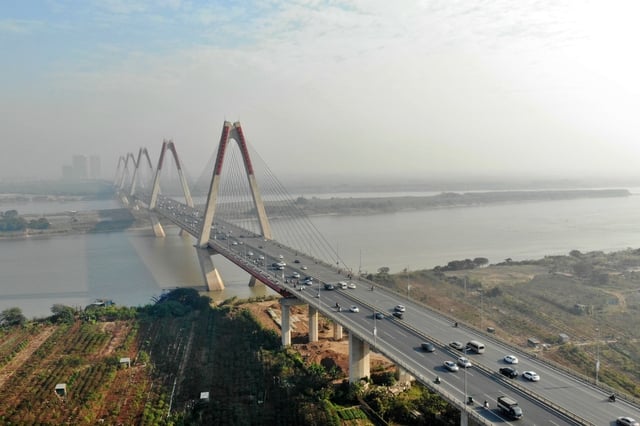
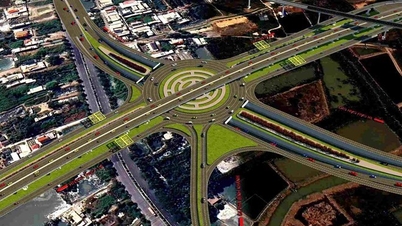
The Nhat Tan Bridge, connecting Tay Ho District and Dong Anh District, has helped to enhance the value of the land since its construction.
PHOTO: HUU THANG
Previously, Hanoi's development was primarily concentrated south of the Red River, resulting in significant disparities between regions. Following urban planning, Hanoi began to develop strongly north of the Red River, with the construction of the Chuong Duong Bridge connecting Hoan Kiem District with Gia Lam District. In 2003, Long Bien District was established, marking the first time Hanoi's central urban area "crossed the Red River." Therefore, the Chuong Duong Bridge is associated with the symbol of Hanoi's internal development strength. The Nhat Tan Bridge, on the other hand, is a new symbol of Hanoi's development west of the Red River, connecting Tay Ho District with Dong Anh District. According to the transportation planning document for 2030, with a vision to 2050, approved by the Prime Minister, Hanoi will have 18 bridges crossing the Red River, seamlessly connecting economic and political centers; and linking local areas and satellite cities. Mr. Dao Ngoc Nghiem stated that building more bridges not only helps reduce traffic pressure and population density in the inner city but also contributes to the efficient use of abundant land resources for economic restructuring and the formation and development of new residential areas. This, in turn, changes and enhances the value of land. For example, after the Nhat Tan Bridge was put into operation, land prices in Dong Anh District rose significantly; similarly, the Thanh Tri Bridge also increased land prices in Thanh Tri and Gia Lam Districts. "Previously, bridge construction was solely for the purpose of facilitating travel and trade between the two sides of a river. Now, these bridges also carry the responsibility of balancing development. Bridges are like giant scales, regulating and harmonizing between both sides," Mr. Nghiem remarked. He cited the Seine River (France) as an example, which has 37 bridges. Among them, the four bridges Pont des Arts, Pont Neuf, Pont de Bir-Hakeim, and Pont Alexandre III stand out, forming a comprehensive picture of the history and people of Paris. "And according to the plan, the Tu Lien Bridge, when built, will connect two historical areas, located within the West Lake - Co Loa spatial axis, which is a heritage connection axis," Mr. Nghiem said. Regarding the identification of the Red River axis as one of the five driving axes of the Hanoi Capital City Planning for the period 2021-2030, with a vision to 2050, Dr. Nguyen Quang Anh, from the University of Social Sciences and Humanities (Vietnam National University, Hanoi), assessed this as a strong reaffirmation of the central position of this river throughout its long history, representing balanced, harmonious, rapid, strong, and sustainable development of the capital city, reaching far and wide on both banks. Thus, Ly Thai To's "mountain-backed, river-facing" model has been correct for a thousand years and will certainly continue to be correct for decades, even centuries to come. "Therefore, the goal of developing Hanoi into a 'cultured, civilized, and modern' city; a driving force for the development of the Red River Delta region, the key economic zone of Northern Vietnam, and the entire country; a globally connected city on par with the capitals of developed countries in the region will certainly become a complete and vibrant reality," said Mr. Nguyen Quang Anh.






















































































Comment (0)