

Overall, Japanese literature has several notable characteristics. Written literature emerged quite early, asserting its individuality in poetry in the 8th century and in novels in the 9th century.
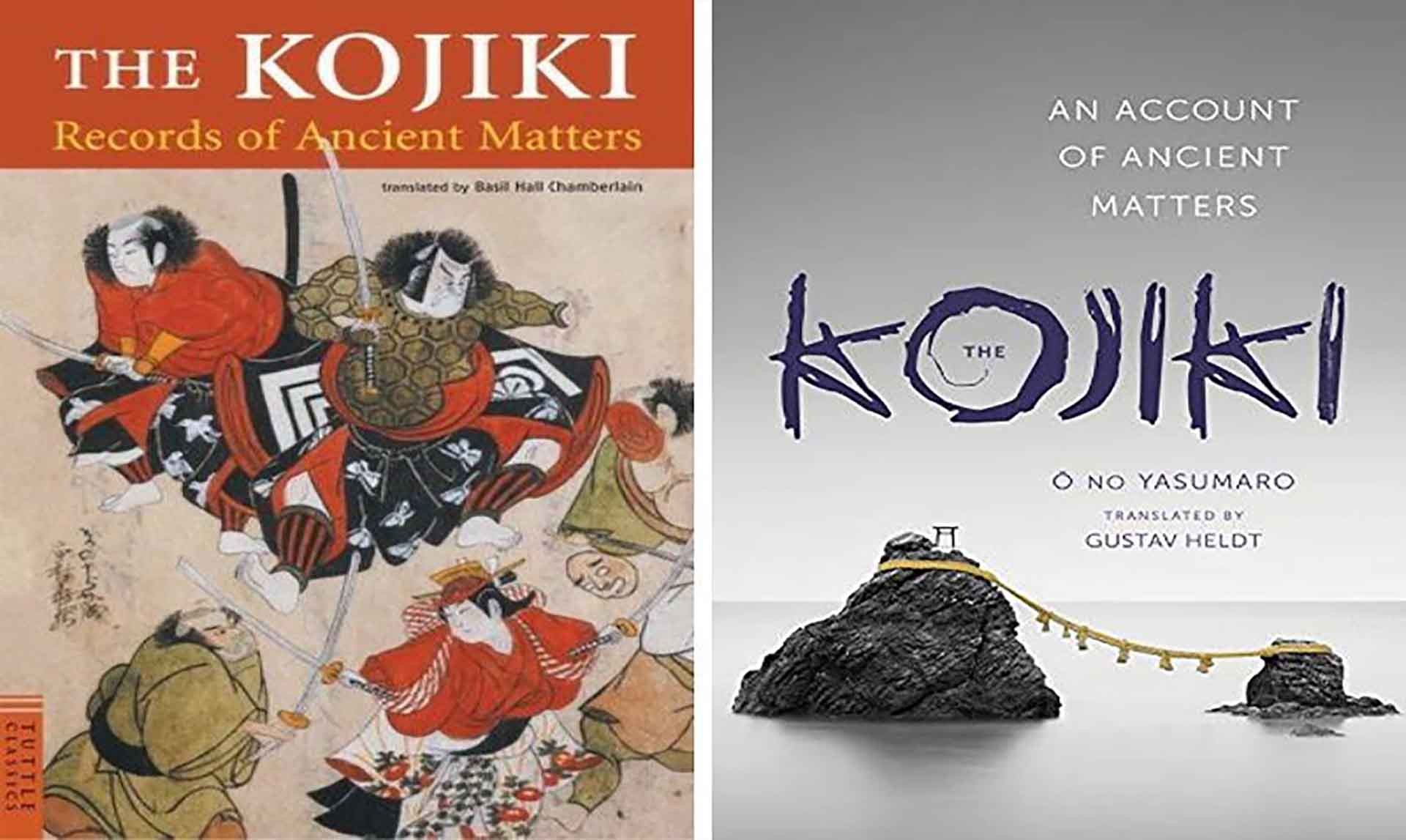 |
| Two of the many English translations of Kojiki. |
As in other fields, Japanese literature has borrowed from foreign sources (Chinese influence from the very beginning, including writing; Western influence in thought and genre); but after absorbing these influences, it has created unique works bearing the national imprint.
Japanese literature is a diverse tapestry, encompassing some of the world's longest novels, some of the world's shortest poems, and plays that subtly suggestive alongside those that are incredibly lengthy.
In terms of content, four trends reflecting the political and social changes in Japan can be distinguished: First, aristocratic and court literature in the 12th century; second, heroic literature during the feudal war centuries (until the end of the 16th century); third, bourgeois and folk literature after the Tokugawa shogunate restored peace ; and fourth, modernized literature during the Meiji era.
Literature has an aristocratic, courtly character.
Until the end of the 8th century, very few manuscripts survived. The two most famous works of that time were the Kojiki by Ō no Yasumaro (Ancient Tales - a collection of prose recording old stories, compiling myths about the origin of Japan and its gods) and the Manyoushu by Ōtomo no Yakamochi (Collection of Many Leaves - a collection of poems).
During the period when the imperial capital moved to Heian (8th-12th centuries), Japanese literature flourished, arguably its golden age. A prime example of this period was the creation of a writing system to transcribe the Japanese language from Chinese characters (similar to the Vietnamese Nôm script, but based on different principles). Confucian scholars and Buddhist monks used Chinese characters to create simpler writing systems called Kana. Kana was gradually perfected, popularized, and paved the way for a purely nationalistic literary style, distinct from that of China.
The Heian period was a time of peace and tranquility. Literature reflected the pleasures of the imperial court and the aristocracy in an aesthetic and hedonistic society, passionate love affairs, and refined pastimes such as music, chess, poetry, painting, and travel. The major works, mostly novels, poems, and diaries, were written by women, hence this period is also known as the period of women writers, although it lacked richness in subject matter and style. The Tanka poetic form of this period later became a classic, still used by many modern poets. Prose novels such as Murasaki Shikibu's *The Tale of Genji* (Genji Monogatari) appeared, considered one of the four or five greatest novels in world literature, and according to Nobel Prize-winning author Kawabata Yasunari (1899-1972): "That work is the pinnacle of Japanese literature; to this day, no work of fiction can compare." The diary and essay genre (similar to Vietnam's Vũ trung tùy bút) is famously exemplified by Sei Shōnagon's *Makura No Soshi* (Bedtime Stories), a work that still retains its fresh and captivating charm to this day.
Literature of the era of chivalrous men
By the 12th-14th centuries, the period when the Shoguns usurped the Emperor's power and established their lordly residences in Kamamura (lasting approximately 150 years, from 1185 to 1333) marked the beginning of the feudal era, marked by incessant wars between the Shogun clans. With the emergence of the warrior class, the hierarchy of spiritual values shifted from art and pleasure to a spirit of chivalry and austerity.
The "Wartime" period emphasized martial arts novels where warriors became the main characters instead of princes and royal family members. Typical examples from this period include Heike Monogatari (The Tale of the Heike Clan), which recounts the power struggle between the Heike (or Taira) and Minamoto clans and the emergence of the samurai class; and Shin Kokinshu (or Shin Kokin Wakashu, Shin Kokin - New Collection of Ancient and Modern Poetry), a collection of ancient and modern poetry by various authors, expressing the suffering and tragic fate of people in war, and a deeper sense of disillusionment with the world during the Heian period.
The period when the Shogunate's residence was located in Muromachi (from the latter half of the 14th to the 16th century) continued to be a time of war and turmoil. Simultaneously, trade and urbanization flourished, urban classes formed, and relations with the West gradually opened, especially towards the end of the 16th century. A popular literary theme during this period and throughout the Middle Ages was "separation." A timeless essay, Tsurezuregusa (Leisurely Thoughts or Leisurely Harvest), by the monk Urabe Kenko, consists of 243 separate passages, ranging from a few lines to 3-4 pages in length. Themes such as death and impermanence, the beauty of nature, and some humorous stories have greatly influenced Japanese literature, aesthetics, and lifestyle for over 600 years afterward.
(To be continued)
Source


![[Photo] Prime Minister Pham Minh Chinh holds a phone call with the CEO of Russia's Rosatom Corporation.](/_next/image?url=https%3A%2F%2Fvphoto.vietnam.vn%2Fthumb%2F1200x675%2Fvietnam%2Fresource%2FIMAGE%2F2025%2F12%2F11%2F1765464552365_dsc-5295-jpg.webp&w=3840&q=75)
![[Photo] Closing Ceremony of the 10th Session of the 15th National Assembly](/_next/image?url=https%3A%2F%2Fvphoto.vietnam.vn%2Fthumb%2F1200x675%2Fvietnam%2Fresource%2FIMAGE%2F2025%2F12%2F11%2F1765448959967_image-1437-jpg.webp&w=3840&q=75)



![Strolling in the American Literature Garden [Part 19]](https://vphoto.vietnam.vn/thumb/402x226/vietnam/resource/IMAGE/2025/1/19/282450858d7345568984c556f7bb952d)
![Strolling through the American Cultural Garden [Part 17]](https://vphoto.vietnam.vn/thumb/402x226/vietnam/resource/IMAGE/2025/1/20/d66f4bb035b24a638d3710594d9d915f)






















![[OFFICIAL] MISA GROUP ANNOUNCES ITS PIONEERING BRAND POSITIONING IN BUILDING AGENTIC AI FOR BUSINESSES, HOUSEHOLDS, AND THE GOVERNMENT](https://vphoto.vietnam.vn/thumb/402x226/vietnam/resource/IMAGE/2025/12/11/1765444754256_agentic-ai_postfb-scaled.png)


































Comment (0)