

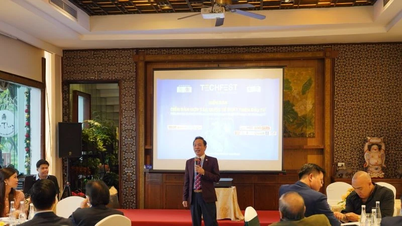
At the Think Apps 2023 event organized by Google in Ho Chi Minh City at the end of July, citing a report by DataAI & AppMagic, a Google representative stated that from 2019 to Q1/2023, Vietnam jumped from the top 15 to the top 5 globally in terms of app downloads, corresponding to 4.2 billion downloads.
Recently, the renowned news agency Bloomberg also assessed Vietnam as a gaming powerhouse. Bloomberg cited data showing that Vietnam is among the top 5 countries producing mobile games globally , based on downloads in the first six months of 2023.
Assessing the potential, advantages, and development opportunities of Vietnam's game industry, Mr. Le Quang Tu Do, Director of the Department of Broadcasting, Television and Electronic Information ( Ministry of Information and Communications ), said that the game industry contributes significantly to the country's development in the era of the 4.0 industrial revolution. The Vietnamese game industry currently has two groups: game production and game distribution. We have enormous potential in the game production group. Currently, Vietnam has many programmers skilled enough to create games for the two largest app stores, Google and Apple. Apple announced that 180,000 Vietnamese people are developing applications, with games being the largest and generating foreign exchange. We produce games but don't sell them domestically; we sell them abroad, on app stores, and then collect foreign revenue.
Mr. Le Quang Tu Do added that, according to data compiled from the Department of Broadcasting, Television and Electronic Information, approximately 50% of currently popular mobile games originate from Vietnam, either through outsourcing or entirely developed. Vietnamese developers have a significant advantage in simple games, while complex (G1) games are rare. For every 25 games uploaded to app stores, one is from Vietnam, a much higher percentage than other countries. Therefore, the gaming industry is a non-polluting sector in which Vietnam has many advantages for development and attracts foreign investment.
According to data from several market research companies, Vietnam in particular and Southeast Asia in general have the highest mobile game growth rate in the world, at 7.4% per year during the period 2022-2025. Vietnam's gaming market ranks 5th in Southeast Asia in terms of revenue.
The Ministry of Information and Communications aims for the Vietnamese gaming industry to reach a revenue milestone of $1 billion USD within the next five years, while significantly increasing the number of operating gaming businesses from the current 30 to the peak of the industry's golden age (100-150 businesses), and encouraging approximately 400 game development startups to join the community.
Although Vietnam has approximately 33 million mobile gamers, ranking third after Thailand and Indonesia in Southeast Asia (Digital 2022: Global Overview Report), compared to the population size and telecommunications infrastructure development of some countries in the region, the revenue of Vietnam's online gaming industry in recent years has remained very modest, and Vietnam is seen as a market with great potential and ample room for growth.
According to a report by the Ministry of Information and Communications, the total revenue of Vietnam's gaming industry in 2021 was estimated at 14,500 billion VND, an 11% increase compared to 2020. However, in reality, the revenue of Vietnam's gaming industry could be much higher.
According to domestic and international experts, as well as market research organizations, the development of numerous new technologies such as 5G, Blockchain, cloud computing, and the significant improvements in hardware for online gaming devices (PCs, smartphones) in recent times have helped Vietnam rapidly increase the number of gamers, boost revenue and profits, and create opportunities for companies worldwide to participate in the online gaming industry.
In fact, over the years, seizing opportunities in the global gaming industry's development trends, online game production and publishing companies in Vietnam have leveraged their abundant and high-quality human resources to focus on developing games in genres such as: MMORPG (Massively Multiplayer Online Role-Playing Games), Turn-Based Games (Turn-Based Strategy Games), MOBA (Massively Multiplayer Online Battle Arena Games), Casual Games (Simple, Popular Games), SLG (Strategy Simulation Games), RPG (Role-Playing Games), etc.
Particularly with its young population, which easily adapts to and embraces new technological waves, Vietnam is considered a "trading hub" for leading online game publishers from Japan, South Korea, China, and North America.
According to statistics from the Ministry of Information and Communications, nearly 85% of legally released G1 games in Vietnam originate from foreign countries, with China accounting for over 76% of the total number of G1 games released.
A significant number of Vietnamese companies and individuals are involved in producing and publishing games for the global market. As of 2021, Google estimated that there were approximately 430,000 game developers in Vietnam, with 70% targeting the global mobile game market. According to statistics from Sensor Tower and the Vietnam Game Studio Club, there are currently around 5,000 games produced by Vietnamese developers, primarily focusing on themes and content for children, entertainment, and education.
Overcoming challenges for the Vietnamese gaming industry.
Assessing Vietnam's game development workforce, it is noted that they possess good capabilities, strong programming expertise, and are diligent and hardworking. A Vietnamese programmer can even create a product from start to finish, making game startups in Vietnam very favorable for development. A team of 2-3 people with an idea and investment connections can develop a game. However, Mr. Le Quang Tu Do believes that the mobile game industry in Vietnam still faces many challenges, with the biggest limitation being the lack of collaboration among businesses.
He stated: "Over the past 10 years, the biggest limitation of the Vietnamese gaming industry has been its tendency to go it alone in order to move quickly, resulting in only a few businesses developing while the gaming community remains stagnant. Because they haven't worked together, they've encountered increasing difficulties. Because they haven't worked together, they haven't been able to leverage each other's strengths."
Game developers who are skilled at writing and developing games often lack publishing experience, resulting in limited reach for users. Conversely, publishers who excel at publishing struggle to find high-quality Vietnamese games. This leads to a situation where most Vietnamese people play foreign games, while Vietnamese game developers don't produce games for the domestic market.
In addition, there are shortcomings in the gaming industry, such as the Ministry of Finance's plan to introduce excise tax on online games, or the fact that the gaming industry in particular and the internet in general are developing very rapidly and strongly, but policies have not kept pace...
Pointing out that the Vietnamese gaming industry is facing three major problems – competition from cross-border pirated games; game publishers being unable to purchase good games from abroad because those games are sold across borders; and game producers being very fragmented and lacking unity – Mr. Le Quang Tu Do stated that the Ministry of Information and Communications is resolutely working to resolve these three major issues.
Specifically, in its fight against game piracy, the Department of Broadcasting, Television and Electronic Information has established a regular mechanism with Google and Apple to scan, detect, and request the removal of pirated games. The Department has formed a team with 10 core businesses that take turns scanning online platforms/stores to detect pirated games and promptly request Google and Apple to block them.
Next, there's the issue of blocking game payments. Recently, the Ministry of Information and Communications held a conference on solutions to prevent game payments. Regulations prohibit payments for games that violate the law or are unlicensed. Currently, intermediary payment businesses and banks are still processing many payments for these types of games, claiming they are unaware of the regulations. Therefore, the Ministry is connecting with and sending lists of licensed games, and through a scanning process, sending lists of unlicensed games to these entities for exclusion.
Besides objective difficulties, payment intermediary businesses, banks, the State Bank of Vietnam, and the Ministry of Public Security generally agree that they will take decisive action to rectify this issue in the near future. To combat illegal games, there are two main solutions: scanning, detecting, removing, and blocking payments.
Regarding the second major issue, which is the need for policies to support the gaming industry, especially by exempting it from excise tax, the Ministry of Information and Communications, specifically the Department of Broadcasting, Television and Electronic Information, has worked and connected with relevant units of the Ministry of Finance, VCCI, and the General Department of Taxation to provide information on the current situation and propose not to impose excise tax on the gaming sector, as this is a sector that needs support for development.
The Ministry is also advising on streamlining procedures, such as drafting a Decree to replace Government Decree 72 on the management of the Internet and online information, which eliminates some licenses for the gaming industry, removes some administrative procedures, and creates a more favorable and transparent environment for gaming businesses to develop.
In addition, the Ministry is also researching pilot policies (sandbox) for new game genres such as Blockchain games and NFT games, and will propose them to the Prime Minister and other ministries and agencies for joint development.
The third major issue is connecting and bringing together stakeholders for mutual development. In 2022, the Ministry established the Alliance of Game Producers and Publishers, launching it on June 30, 2022. Since then, it has organized three networking and cooperation conferences to promote the development of the game industry, yielding very positive results.
On April 1st, 2023, the Department collaborated with several units to organize the first Game Festival, which included major activities such as the Vietnam Game Awards. This was the first time game awards were presented to encourage game businesses and programmers to write games, prioritizing Vietnamese-produced games and categories dedicated to Vietnamese games.
This year, the Department will connect and coordinate with universities that need to train game programmers. Currently, connections have been established with Ton Duc Thang University, FPT University, and the Posts and Telecommunications Institute of Technology – all institutions with training needs. Accordingly, game companies will accept students from these universities for internships and practical training, and recruit outstanding students to serve as graduates.
In parallel with addressing the aforementioned bottlenecks, Mr. Tu Do stated that the Alliance of Game Producers and Publishers, under the direction of the Department of Broadcasting, Television and Electronic Information, is currently intensifying its communication efforts to change the image of games, highlighting that this industry makes a significant contribution to national development in the era of the Fourth Industrial Revolution, encompassing both programming and technology, and generating high income... Simultaneously, it encourages the development and production of games with educational value, focusing on the country's culture and history.
With the above communication plan, the perception of the community, the people, and society about the gaming industry will gradually change, thus promoting its development.








![[INFOGRAPHIC] Huawei FreeBuds 7i, Noise-Canceling Headphones 4.0](https://vphoto.vietnam.vn/thumb/402x226/vietnam/resource/IMAGE/2025/12/13/1765633184506_info-tainghechongon-02-jpg.webp)
















































































Comment (0)