

The forum took place in the context of Vietnam's economy accelerating the application of technology and promoting green growth, requiring the Industry and Trade sector to continue promoting innovation, modernizing the value chain and enhancing competitiveness in the process of increasingly deep international integration.
Speaking at the opening of the Forum, Deputy Minister of Industry and Trade Nguyen Sinh Nhat Tan emphasized that the world economy continues to grow, driven by services, digital consumption and innovation. For Vietnam, the digital economy continues to improve significantly and become a new pillar to help improve productivity, expand markets and increase the resilience of the economy. Retail e-commerce is forecast to exceed the 25 billion USD mark and continue to be the main pillar of the Internet economy.

Deputy Minister Nguyen Sinh Nhat Tan pointed out that the Government has identified 2025 as the year to accelerate the implementation of Resolution 57 on digital transformation, with the consistent view that digital transformation is an important driving force to develop the productive forces and enhance national competitiveness. The Industry and Trade sector has promoted digital transformation on all three pillars: Digital Government; digital economy of the Industry and Trade sector and data infrastructure. However, 2025 requires the sector to innovate more strongly and comprehensively to take advantage of opportunities from dual transformation—digital transformation and green transformation.
Reporting on “Orientation for digital transformation of the Industry and Trade sector by 2026”, Mr. Hoang Ninh, Deputy Director of the Department of E-commerce and Digital Economy, Ministry of Industry and Trade, affirmed that digital transformation continues to be identified as a strategic task, closely linked with green transformation and sustainable development, and is an important driving force to promote comprehensive restructuring of the Industry and Trade sector by 2030. According to Mr. Hoang Ninh, the three pillars of Digital Government - Digital Economy - Digital Society will continue to be consistently implemented to ensure effective implementation and expand the impact of digital transformation across the sector.
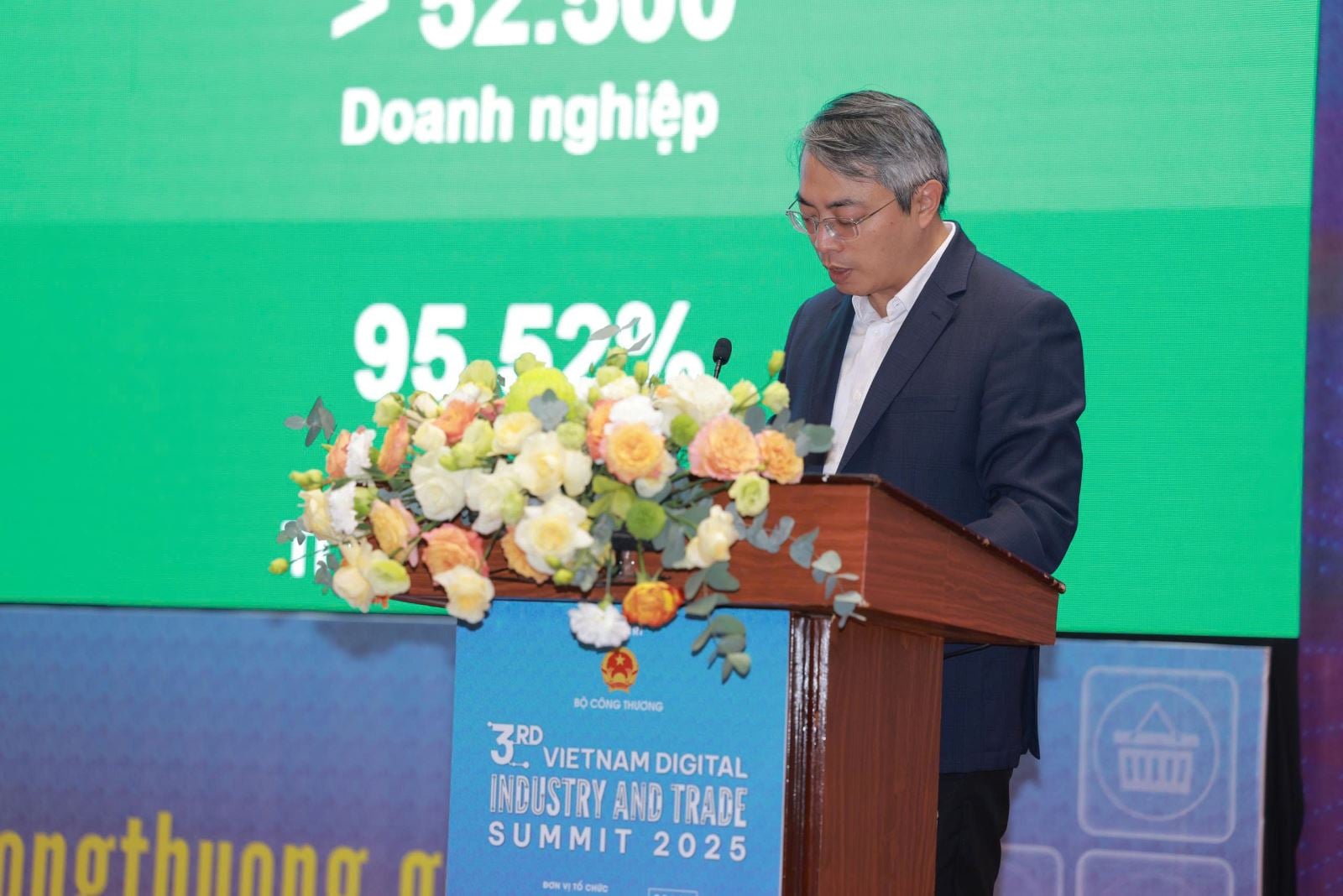
Deputy Director Hoang Ninh said that in recent times, the Industry and Trade sector has achieved many remarkable results in implementing the Digital Government, demonstrated through 224 full-process online public services, the digitization rate of records reaching 95.52%, more than 691 thousand sets of records exchanged through the ASEAN Single Window Mechanism in 2024 and over 52,500 businesses served through the system. The Ministry of Industry and Trade continues to lead the country in terms of satisfaction with online public services with an absolute score of 18/18, of which the satisfaction rate reached 100% with handling feedback and recommendations and 97.54% with receiving and resolving administrative procedures. These results, according to Mr. Ninh, not only reflect the "user-centered" approach but also create an important data foundation for the digital transformation process of the entire sector.
In the development of the digital economy, Mr. Hoang Ninh said that e-commerce continues to be the main growth driver with the B2C scale in 2024 reaching about 25 billion USD, accounting for 10% of total retail sales of goods and consumer services. Digital transformation in industry - smart manufacturing recorded many positive signals with the IIP index increasing by 8.4% - the highest level in 5 years; about 90% of processing - manufacturing enterprises have partially deployed digital solutions; 35% applied robots and sensors in production; and 10-12% reached the level of smart factory 3.0. In addition, the energy sector continues to transform strongly with the application of smart metering, real-time operating data, AI load forecasting, EMS systems in enterprises, and the expansion of renewable energy models. Mr. Ninh also emphasized that Vietnam's digital economy is expected to reach 39 billion USD by 2025, continuing to be among the fastest growing in the region; more than 40 AI startups have attracted 123 million USD in private capital; 81% of users interact with AI daily and 96% expressed trust in AI agents.
From these results, Mr. Hoang Ninh believes that 2026 will be the time for the Industry and Trade sector to create a number of strategic breakthroughs, including standardizing national e-commerce data, expanding the 3.0-4.0 generation smart factory model and mass deploying smart energy metering and management nationwide.
According to the leader of the Department of E-commerce and Digital Economy, these tasks can only be achieved effectively when there is synchronous coordination between ministries, branches, localities and enterprises, ensuring that digital transformation brings measurable value to the economy, from better services for people to lower production costs, cleaner energy and higher market confidence.
From a local perspective, Party Secretary and Chairman of the People's Council of Phuong Duc Commune (Hanoi) Le Van Binh shared a different perspective on digital transformation - not only at the macro level or at the large enterprise level, but also in traditional craft villages. Through the story of "awakening the land of hundreds of crafts through digital transformation", Mr. Binh showed how technology helps craft villages gradually approach the market, increase product value and improve management quality. The transformation from a manual business model to a modern distribution model through a digital platform has contributed to proving that digital transformation is only truly sustainable when it spreads to every grassroots level, where small-scale production and business activities are facing new requirements for innovation and market access.
Representing the technology business sector, Ms. Dang Thuy Trang, Director of External Relations of Grab Vietnam, said that digital platforms are becoming an important tool to support localities in developing the digital economy by providing a multi-service ecosystem, meeting people's daily needs while promoting digital transformation in the fields of tourism, promoting heritage, culture and cuisine.
The cooperation between businesses and local authorities is clearly demonstrated through signed cooperation agreements, typically with Hue City (February 2025) and Da Nang (September 2025), aiming to develop smart cities and promote the application of technology in urban management and operation. Through these cooperation programs, Grab deploys many local support solutions, from optimizing driver-partner operations with technologies such as GrabMaps and route suggestions, to increasing business efficiency for merchant partners through the order management system. In addition, digitalizing local restaurants, promoting multi-channel cuisine and supporting e-commerce have contributed to promoting the flow of goods and services locally.
Grab also makes it easier for people and merchants to participate in the digital business environment by expanding income opportunities for driver-partners and freelancers. The company also focuses on implementing training programs on digital skills, foreign languages, and knowledge of AI applications for driver-partners, merchants, students, and local communities.
Ms. Nguyen Nhu Quynh, co-founder and Operations Director of the Anti-Fraud Organization, analyzed through the presentation "Safe digital transformation: Protecting Industry and Trade enterprises from cyber attacks and AI fraud 2025". Ms. Quynh stated that as the Industry and Trade sector promotes digitalization on a comprehensive scale, the risk of cyber attacks also increases accordingly, especially with high-tech crimes such as online fraud, fake email/partner information to change payment terms (BEC), attacks on industrial operation systems and cross-border trade fraud. In the context of rapid development of AI technology, new forms of attacks such as automated phishing, real-time deepfake - from fake voices to fake images and videos of leaders - make the risks more serious and directly target people, the most vulnerable link in the cybersecurity system.
To respond, Ms. Quynh recommends that businesses need to build an active defense system, apply a multi-layered defense model including infrastructure, data and people; apply AI in cybersecurity to monitor and warn of abnormalities early; and strengthen public-private cooperation to share data, experience and attack models. Improving human capacity through periodic training, practical simulation and building a culture of "safety first - transformation later" is considered the key to ensuring that businesses can implement sustainable digital transformation. According to Ms. Quynh, information security is not only a technical issue but must become a core management capacity of businesses in the digital age.
The Industry and Trade Digital Transformation Forum 2025 did not stop at evaluating the results, but opened up a broader discussion on the strategic orientation of the industry in the dual transformation period. From energy, manufacturing, e-commerce to logistics and market management, every sector is facing strong innovation requirements, where data, technology and green standards become the driving focus. With that spirit, this year's Forum is expected to create a strong driving force for the digital transformation and green transformation journey of the Industry and Trade sector, contributing to improving the effectiveness of state management, promoting competitiveness and moving towards the goal of sustainable development in the coming years.
Source: https://baotintuc.vn/kinh-te/nganh-cong-thuong-huong-toi-muc-tieu-kep-so-hoa-va-xanh-hoa-den-2030-20251203111609902.htm

![[Photo] Parade to celebrate the 50th anniversary of Laos' National Day](/_next/image?url=https%3A%2F%2Fvphoto.vietnam.vn%2Fthumb%2F1200x675%2Fvietnam%2Fresource%2FIMAGE%2F2025%2F12%2F02%2F1764691918289_ndo_br_0-jpg.webp&w=3840&q=75)
![[Photo] Worshiping the Tuyet Son statue - a nearly 400-year-old treasure at Keo Pagoda](/_next/image?url=https%3A%2F%2Fvphoto.vietnam.vn%2Fthumb%2F1200x675%2Fvietnam%2Fresource%2FIMAGE%2F2025%2F12%2F02%2F1764679323086_ndo_br_tempimageomw0hi-4884-jpg.webp&w=3840&q=75)



































































































Comment (0)