

Anne L'Huillier, one of the three recipients of the 2023 Nobel Prize in Physics, and her colleagues once set a world record for creating the smallest laser pulse.
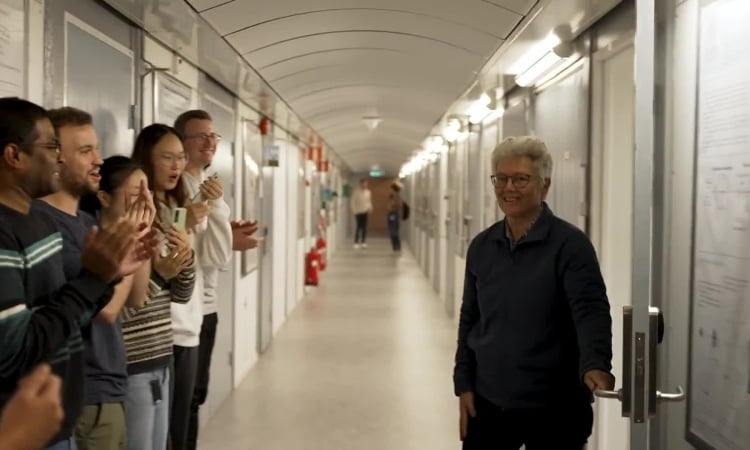
Anne L'Huillier's colleagues and students came to congratulate her on winning the 2023 Nobel Prize in Physics. Video : Nina Ransmyr/Lund University
On the morning of October 3rd (Swedish time), the Nobel Committee had difficulty contacting Anne L'Huillier to inform her that she had been awarded the 2023 Nobel Prize in Physics. They finally succeeded after several missed calls because she was teaching.
The news brought about a major change to the lesson, and her students were very excited. L'Huillier still "tried to continue the lecture," she shared in a phone conversation with Adam Smith, scientific director at Nobel Media. However, the last half hour of the lesson became "a little difficult."
Anne L'Huillier (65 years old) is a professor at Lund University, Sweden. She, along with two other scientists, Pierre Agostini (55 years old) and Ferenc Krausz (61 years old), were honored for their experimental methods that helped create attosecond light pulses (1 attosecond equals 1 × 10⁻¹⁸ seconds – an extremely small period of time) to study electron dynamics in matter.
L'Huillier is the fifth woman to win the Nobel Prize in Physics in the more than 120-year history of this prestigious award. The four previous women were Polish scientist Marie Curie (1903), German-American physicist Maria Goeppert-Mayer (1963), Canadian doctor Donna Strickland (2018), and American astronomer Andrea Ghez (2020).
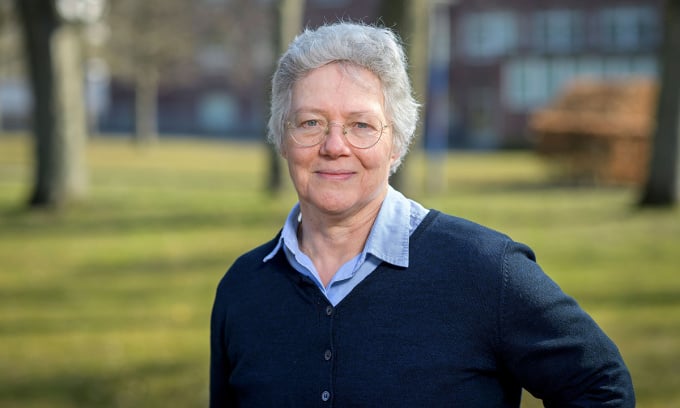
Anne L'Huillier is the fifth woman to win the Nobel Prize in Physics. Photo: Kennet Ruona/Lund University
L'Huillier was born in Paris, France, in 1958. She defended her dissertation on multiphoton ionization in 1986 at the Pierre et Marie Curie University in Paris. That same year, she secured a permanent research position at the French Atomic Energy Council (CEA). In 1995, she became an associate professor at Lund University, followed by a professor of Physics in 1997. She has been a member of the Royal Swedish Academy of Sciences since 2004.
L'Huillier's research, both experimental and theoretical, focused on generating high-order sinusoidal waves in gases and their applications. In the time domain, these waves correspond to a series of ultrashort light pulses, in the ultraviolet spectrum, lasting a few tens or hundreds of attoseconds. Her research involved developing and optimizing attosecond sources and using this radiation to study ultrafast electron dynamics. Additionally, L'Huillier actively studied electron dynamics in atomic systems following a photoionization event caused by the absorption of attosecond light pulses.
In the late 1990s and early 2000s, physicists used knowledge of resonant frequencies to generate attosecond pulses in the laboratory. Agostini and his colleagues developed a technique called Rabbit, and in 2001, they successfully created a series of laser pulses, each lasting 250 attoseconds. That same year, Krausz's group used a slightly different method to create and study single pulses, each lasting 650 attoseconds. In 2003, L'Huillier and his colleagues surpassed both with a laser pulse lasting only 170 attoseconds, setting the world record for the smallest laser pulse.
Interestingly, from 2007 to 2015, L'Huillier was a member of the Nobel Physics Committee. This made receiving the Nobel Prize even more special for her. "I know what it's like to receive a Nobel Prize, it's incredibly difficult, and I also know the work the committee does behind the scenes. So I'm very, very grateful," she told Smith over the phone.
L'Huillier also stated that she is constantly discovering new things in her field of research. "Even now, after 30 years, we are still learning new things. We are trying to improve processes for a number of applications. It's a complex field of physics, but that's what makes it so incredibly interesting," she shared.
Thu Thao ( Synthesis )
Source link

![[Photo] Closing Ceremony of the 10th Session of the 15th National Assembly](/_next/image?url=https%3A%2F%2Fvphoto.vietnam.vn%2Fthumb%2F1200x675%2Fvietnam%2Fresource%2FIMAGE%2F2025%2F12%2F11%2F1765448959967_image-1437-jpg.webp&w=3840&q=75)

![[Photo] Prime Minister Pham Minh Chinh holds a phone call with the CEO of Russia's Rosatom Corporation.](/_next/image?url=https%3A%2F%2Fvphoto.vietnam.vn%2Fthumb%2F1200x675%2Fvietnam%2Fresource%2FIMAGE%2F2025%2F12%2F11%2F1765464552365_dsc-5295-jpg.webp&w=3840&q=75)









































![[OFFICIAL] MISA GROUP ANNOUNCES ITS PIONEERING BRAND POSITIONING IN BUILDING AGENTIC AI FOR BUSINESSES, HOUSEHOLDS, AND THE GOVERNMENT](https://vphoto.vietnam.vn/thumb/402x226/vietnam/resource/IMAGE/2025/12/11/1765444754256_agentic-ai_postfb-scaled.png)






















![[Infographic] Preventing students from making their own firecrackers: 7 things parents need to know](https://vphoto.vietnam.vn/thumb/402x226/vietnam/resource/IMAGE/2025/12/11/1765466656703_img_0320_20251211183542.jpeg)




















Comment (0)