

Many factors, from macroeconomic policies to the specific circumstances of individual businesses, form the basis for supporting the outlook of the electricity sector in 2025.
Many factors, from macroeconomic policies to the specific circumstances of individual businesses, form the basis for supporting the outlook of the electricity sector in 2025.
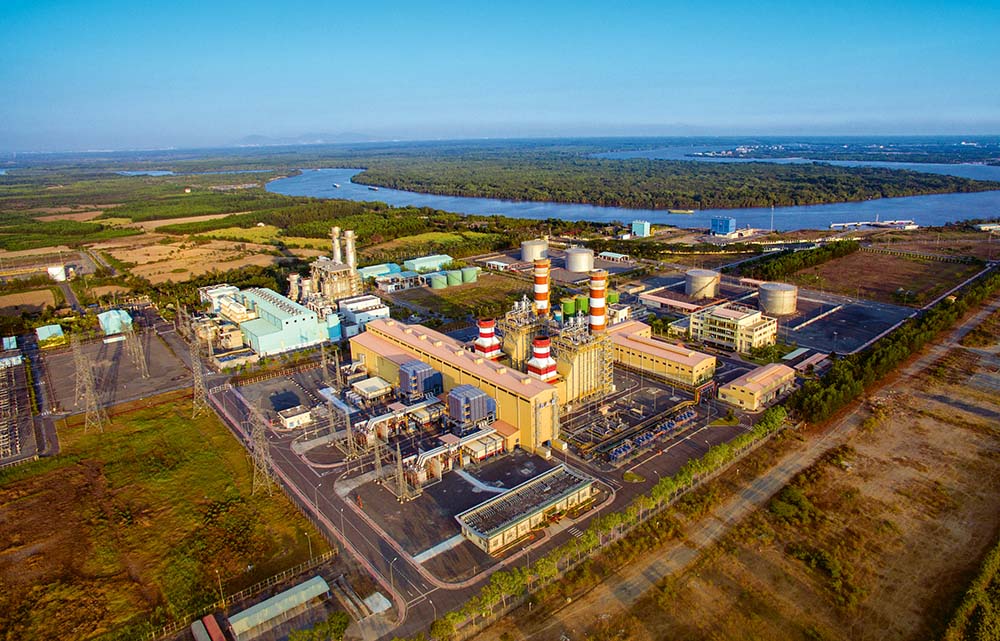 |
| Nhon Trach 2 Petrochemical Power Joint Stock Company achieves its profit target for 2024 (Photo: Duc Thanh) |
A somber picture in 2024
Looking back at 2024, electricity companies have not seen many breakthroughs in either business operations or stock price movements.
The third quarter of 2024 was the first business quarter of the year to see many power sector businesses achieve good profit growth. In particular, for hydropower companies, favorable hydrological conditions in the fourth quarter of 2024, with the El Nino phenomenon ending and shifting to La Nina, helped increase profits. For example, Hua Na Hydropower (HNA) saw a 75% increase in profit, and Thac Ba Hydropower (TBC) recorded profits eight times higher than the same period last year…
Similarly, Vietnam Oil and Gas Power Corporation (POW) also saw a dramatic increase in profit in the third quarter of 2024, reaching VND 453 billion, eight times higher than the third quarter of 2023. However, this profit mainly came from financial revenue due to exchange rate differences and interest on bank deposits.
Meanwhile, Nhon Trach 2 Petrochemical Power Joint Stock Company (NT2) recorded a net profit after tax of VND 50.3 billion in the third quarter of 2024, compared to a loss of over VND 123 billion in the same period of the previous year.
However, a strong business quarter is unlikely to lift the overall economic outlook for the entire industry.
NT2 recently held a Board of Directors meeting to summarize the results of 2024, which were not very positive. The figures show that in 2024, electricity production is estimated at 2.72 billion kWh, equivalent to 85% of the annual plan; total revenue reached VND 6,093 billion, equivalent to 96% of the annual plan; and pre-tax profit reached VND 76 billion, meeting the set target.
Although the company achieved its profit target for 2024, compared to previous periods, this profit figure is at a 10-year low.
The NT2 Board of Directors meeting also stated that, since the Nhon Trach 2 Power Plant began commercial operation (in 2011), 2024 has been the most challenging year. Besides the reduced gas supply, the contracted electricity output has decreased significantly, greatly impacting production and business operations.
Overall, the business results of electricity companies in 2024 were quite bleak, mainly due to the harsh mobilization environment amidst EVN's financial difficulties.
Hydropower recorded very low output in the first six months of 2024, coupled with lower selling prices from many plants as EVN cut the Qm ratio (output on the electricity market) from 10% to 2%, reducing the room for high-priced mobilization of hydropower plants. Meanwhile, gas-fired power plants continued to be underutilized due to gas shortages and high selling prices; coal-fired power plants maintained good output, but profit margins decreased sharply amidst rising input costs and falling electricity market prices.
What opportunities will the electricity sector have in 2025?
With strong economic growth projected for 2025, the Ministry of Industry and Trade has set a baseline scenario for electricity consumption growth at 11-12%. This is seen as a foundation for mobilizing investment capital for power projects amidst slowing power generation growth.
The context of slower electricity generation growth compared to load growth is a challenge, but also an opportunity for power plants to benefit from more proactive mobilization trends, especially as the Ministry of Industry and Trade is strengthening preparations and determined to prevent electricity shortages like those in 2023.
Furthermore, EVN's increase in retail electricity prices will improve the environment for mobilizing power plants from 2025 onwards, creating greater room to mobilize high-cost electricity sources such as gas-fired power plants.
In addition, the amended Electricity Law, passed in November 2024, serves as a comprehensive legal framework for the industry, encompassing major policies on electricity development planning, investment in power projects, and the development of renewable and new energy sources.
Besides some prominent issues such as allowing the development of nuclear power, eliminating cross-subsidization of electricity prices, and reforming the electricity market, the amended Electricity Law continues to emphasize the role of renewable energy sources, LNG power, and requires mechanisms to accelerate investment in these sources.
Immediately after the Electricity Law was passed, the Government issued a plan for its implementation. This plan clearly defines the scope of work and responsibilities for important circulars and decrees in the sector. MBS believes this will be an important basis for accelerating the issuance of circulars and decrees in 2025, creating a more favorable investment environment, especially for renewable energy and gas-fired power plants.
In its 2025 investment strategy for the power sector, MBS analysts note that investors can choose stocks with good upside potential at low valuations, especially prominent representatives with long-term investment stories aligned with the development of wind and gas power, along with forecasts of profit growth recovering from low base levels based on analysis of mobilization trends. PC1, NT2, and POW are all considered to have positive prospects in 2025.
Regarding the detailed outlook for each group in the power sector, MBS forecasts that 2025 will be a period of restarting renewable energy development, while thermal power will benefit in terms of mobilization. From 2025 onwards, the renewable energy sector will benefit from several important policies that have been and are being accelerated, including the Direct Power Purchase Agreement (DPPA) mechanism and preliminary calculations on the wind power price framework.
On the other hand, the analysis team also expects to reach final conclusions and determine appropriate actions for the renewable energy sector that has committed violations. These factors will end the gloomy period of the industry over the past three years, restarting the sector's development process to align with the tasks outlined in the Power Development Plan VIII.
For the gas-fired power sector, in addition to facilitating the LNG electricity pricing framework and supporting the deployment of new plants, businesses also expect a recovery in power generation after the poor generation period of 2023-2024 due to gas shortages. Coal-fired power generation is also expected to remain at a high level, while needing to prepare for unfavorable hydrological scenarios from the second quarter of 2025.
Source: https://baodautu.vn/nhieu-co-hoi-cho-doanh-nghiep-nganh-dien-d240120.html


![[Photo] Prime Minister Pham Minh Chinh attends the Conference summarizing and implementing tasks of the judicial sector.](/_next/image?url=https%3A%2F%2Fvphoto.vietnam.vn%2Fthumb%2F1200x675%2Fvietnam%2Fresource%2FIMAGE%2F2025%2F12%2F13%2F1765616082148_dsc-5565-jpg.webp&w=3840&q=75)






















































































Comment (0)