

Dining at a fine steakhouse can be a truly memorable experience. Steak expert Scott Weiner offers his tips for enjoying this dish properly and elegantly.
Dress appropriately
Most upscale steakhouses favor a smart-casual or business casual look.
For women, that means a nice dress, or a stylish shirt and skirt, or smart trousers with a nice shirt.
For men, opt for a nice pair of trousers and a dress shirt, or a button-down Oxford shirt. A blazer is optional but makes a nice statement.
If you're craving a great steak but want to wear something more casual (like jeans and a button-down shirt), head to a more casual steakhouse chain.
Describe how you want your steak.
Steakhouse doneness terms include "rare," "medium rare," "medium," and "well done."
Rare meat is very red and cold inside, medium rare is pink and warm, medium is slightly pink, and well done is hardly pink at all.
Rare is usually best with leaner steaks like sirloin, medium rare is ideal for more marbled steaks, such as ribeye, medium is best with thicker steaks, and well done is best with New York strip steak.
Don't cut the whole steak.
This mistake is not only about etiquette; it is also about the quality of each piece.
When you cut a whole steak right after it comes out, the meat cools immediately, and the juices run clear.
So when the steak comes out, use your fork and knife to cut a bite-sized piece. Put the steak in your mouth and enjoy.
Hold the fork in your left hand and the knife in your right hand, with your index finger pointing down towards the edge of the steak.
Cut off a piece of steak and place the knife on the plate. Switch the fork to your right hand and take a bite of the steak, or vice versa if you are left-handed. Don't cut into the next piece until you have finished chewing and are ready for the next.
Use eating utensils properly
When a restaurant clears the table, they arrange the utensils in order of use, from outside to inside. For example, the outermost spoon is for soup, and the outermost fork is for salad (if you order salad with a steak).
If you remember that, you'll never pick up the wrong utensil again. Just start at the outside and work your way in.
In particular, if there is a dish you did not order, the waiter will take the spoon or fork for that dish off the table.
Also, use the utensil for its intended purpose. Use the knife to cut the steak, not to push the meat onto the fork. And place the knife and fork on the plate, not the table.
Putting used knives and forks directly on the table is not only considered uncultured behavior in restaurants but also unhygienic.
In particular, when chewing food, place your knife and fork on the plate. The position of the knife and fork on the plate does not really matter, as long as they are not lying on the table.
Putting your knife and fork down between bites has another benefit: it helps you slow down.
Don't gnaw on steak bones.
No matter how good a bone-in steak is, the bone should never be removed from the plate. Steakhouses provide plates and knives, so you don't have to eat with your hands.
If you want to eat every last piece of meat close to the bone, use a fork and knife to gently cut the meat off, leaving the bone on the plate.
For stubborn smaller pieces of meat, gently scrape them off with your fork and bring them to your mouth. Please do not gnaw on bones at the table.
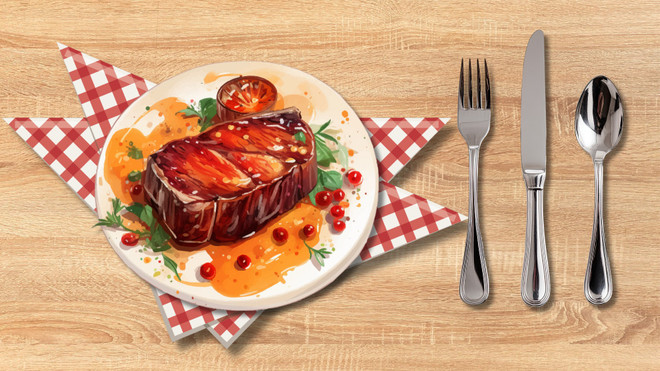
Don't hide tough pieces of meat in napkins.
No matter how good the meat at a restaurant is, steaks often have tendons. We shouldn't feel obligated to eat those tough bits, but we should know how to handle them.
Many people think it is proper to bring the napkin to their mouth, spit out the offending vein, and then put the napkin back down on the table, or worse yet, on their lap. But this is not true.
First, the meat might fall on the floor, making other diners uncomfortable. Second, you're being rude to the waiter, who will eventually have to clear your napkin.
The correct way to remove the tendon from your mouth is to gently remove the meat from your mouth with your fingers and place it on the upper left corner of the plate.
If you don't want to use your fingers, you can use the same utensil that brought the food to your mouth in the first place - a fork.
If you don't want to see the chewed-up connective tissue on your plate all dinner, cover it with another piece of food. Or maybe a bread roll.
Leave some food
This may seem like a strange mistake. Respecting the chef's hard work might mean leaving the plate empty. However, this is not necessarily the case. When a plate is completely empty, the server may think that the amount of food is too small.
Leaving a small piece on your plate at fancy restaurants is a polite gesture, as it shows that the meal was delicious and you were satisfied.
But honestly, if you just spent $75 on a perfect steak and want to eat every last piece, just eat it. Or maybe leave a little piece of bread.
Do not put napkins on the table
Once seated at a steakhouse, place your napkin on your lap and keep it there throughout the meal, except when you gently dab your mouth (just dab, don't wipe).
If you've dabbed your mouth politely, fold your napkin and place it back in your lap. If your napkin gets stained (which isn't uncommon with red wine and steak), fold it under the table and out of sight of your tablemates to hide the stain.
If you need to go to the restroom, fold your napkin loosely and place it on your chair. Do not place your napkin on the table or your plate; it is impolite and unsanitary. After the meal is over, fold your napkin loosely and place it to the left of your plate.
In short, there are two times when you need to put your napkin on the table - when you arrive and when you leave./.
Source: https://www.vietnamplus.vn/nhung-quy-dinh-khong-phai-ai-cung-biet-khi-an-bittet-tai-nha-hang-post1080862.vnp


![[Photo] Cat Ba - Green island paradise](/_next/image?url=https%3A%2F%2Fvphoto.vietnam.vn%2Fthumb%2F1200x675%2Fvietnam%2Fresource%2FIMAGE%2F2025%2F12%2F04%2F1764821844074_ndo_br_1-dcbthienduongxanh638-jpg.webp&w=3840&q=75)









































![[VIMC 40 days of lightning speed] Da Nang Port: Unity - Lightning speed - Breakthrough to the finish line](https://vphoto.vietnam.vn/thumb/402x226/vietnam/resource/IMAGE/2025/12/04/1764833540882_cdn_4-12-25.jpeg)










































Comment (0)