

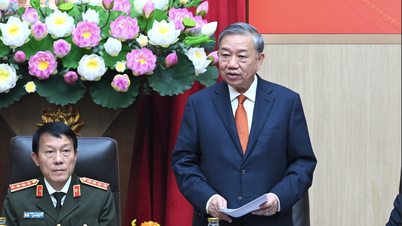
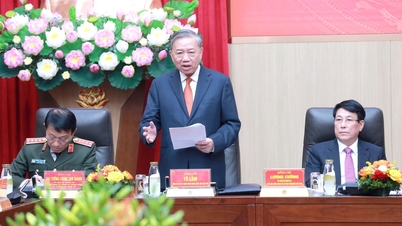
On the morning of December 4, continuing the 52nd Session, the National Assembly Standing Committee gave opinions on explaining, accepting, and revising the draft Press Law (amended).
Ensuring consistency in press management in cyberspace and application of artificial intelligence
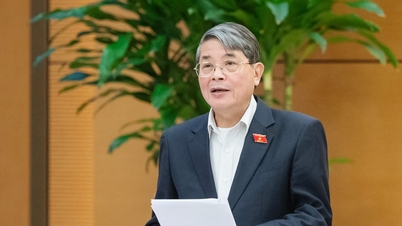
Reporting on a number of major issues in receiving, explaining, and revising the draft Press Law (amended), Chairman of the National Assembly's Committee on Culture and Society Nguyen Dac Vinh said that on October 23 and November 24, the National Assembly discussed and gave opinions in groups and halls on the draft Press Law (amended).
Implementing the direction of the National Assembly Standing Committee and assigned tasks, the Standing Committee of the Committee for Culture and Social Affairs coordinated to synthesize opinions of National Assembly deputies, organized many meetings with the drafting agency, relevant agencies and experts to study, absorb, explain and revise the draft Law...
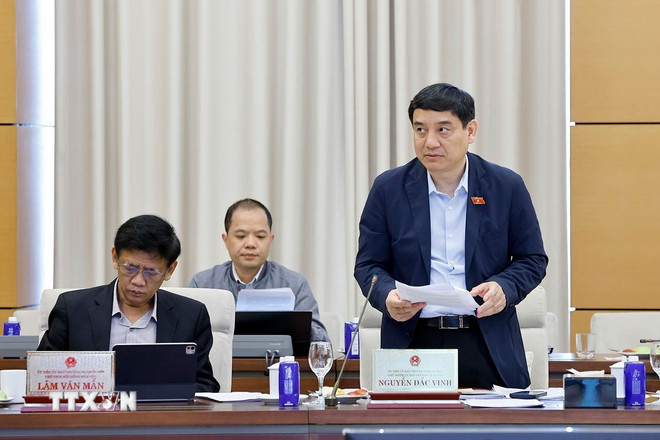
Regarding types of press, taking into account the opinions of National Assembly delegates, the Standing Committee of the Committee and the drafting agency have revised the name of the type "spoken newspaper, visual newspaper" to "radio, television."
Regarding the main multimedia press agency (Article 15), taking into account the opinions of National Assembly deputies, the Standing Committee of the Committee and the drafting agency agreed to revise the phrase "main multimedia media agency" to "main multimedia press agency" to ensure accuracy and consistency with the scope of the draft Law.
Regarding the contents related to "press economy ," absorbing the opinions of National Assembly deputies, the Standing Committee and the drafting agency reviewed and revised the regulations related to public investment, autonomy mechanism, and regulations on revenue from business activities of press agencies in Articles 9, 20, and 23 of the draft Law.
Regarding press activities in cyberspace (Article 29), taking into account the opinions of National Assembly deputies, the Standing Committee of the Committee and the drafting agency reviewed and revised Article 29 of the draft Law in the direction of regulating state management measures for press activities in cyberspace similar to those for four types of traditional press, while integrating online services, ensuring the integrity of information content posted and broadcast on the national digital press platform.
At the meeting, one of the contents that received many opinions was to continue to carefully review and ensure consistency and uniformity in the legal system, especially ensuring consistency with the Artificial Intelligence Law project.
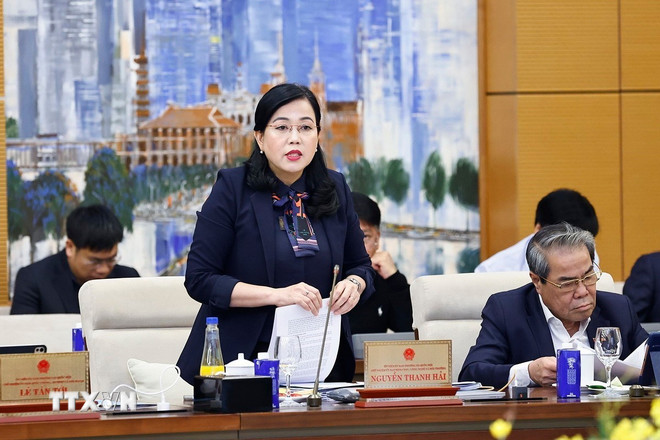
At this 10th Session, for the first time the National Assembly will consider and pass the Law on Artificial Intelligence (AI), which has content related to the draft Law on Press (amended) this time.
As the agency in charge of reviewing the draft Law on Artificial Intelligence, Chairman of the Committee on Science, Technology and Environment Nguyen Thanh Hai said that the Committee has proposed to add contents related to the application and use of artificial intelligence in scientific research, education and training, and in the press and media.
However, the Government is currently accepting the direction that the contents of using AI in specialized fields will be regulated in specialized laws.
Chairman of the Committee Nguyen Thanh Hai suggested considering adding a "framework" article to ensure consistency and coordination between laws when applied in practice.
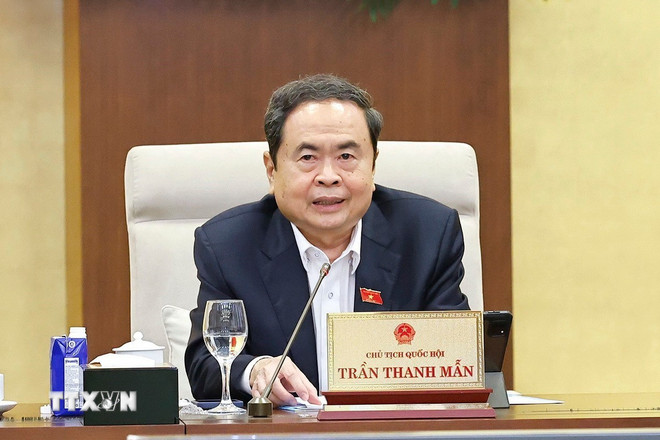
Commenting on the draft Law, National Assembly Chairman Tran Thanh Man emphasized the need to review and complete regulations on: policies for press development; press management in cyberspace and the issue of artificial intelligence (AI); protecting the safety of journalists; licensing and management conditions for collaborators; and definitions and legal status.
The National Assembly Chairman highly agreed on amending specific and feasible regulations on press support policies and tax incentives for the press as stipulated in the Law on Corporate Income Tax. Accordingly, press agencies are entitled to a tax rate of 10%, instead of previously only print press was entitled to this tax rate, other types of press were subject to a tax rate of 20%.
The National Assembly Chairman also noted that to ensure copyright and related rights, the draft Law has added Clause 2, Article 39 in the direction that agencies, organizations and individuals using press works must reach an agreement with the press agency according to the provisions of law.
The National Assembly Chairman requested that agencies carefully and comprehensively review the draft Law with current laws as well as related Law projects being amended and supplemented, to ensure consistency and uniformity in regulations related to the press, science and technology, digital transformation, information security, advertising and intellectual property.
Modernization of education and training
Also in the morning session on December 4, the National Assembly Standing Committee gave opinions on explaining, accepting and revising 5 drafts: Law amending and supplementing a number of articles of the Law on Education; Law on Higher Education (amended); Law on Vocational Education (amended); Resolution of the National Assembly on breakthroughs in education and training development; Resolution on investment policy for the national target program on modernization and improvement of education and training quality in the 2026-2035 period.
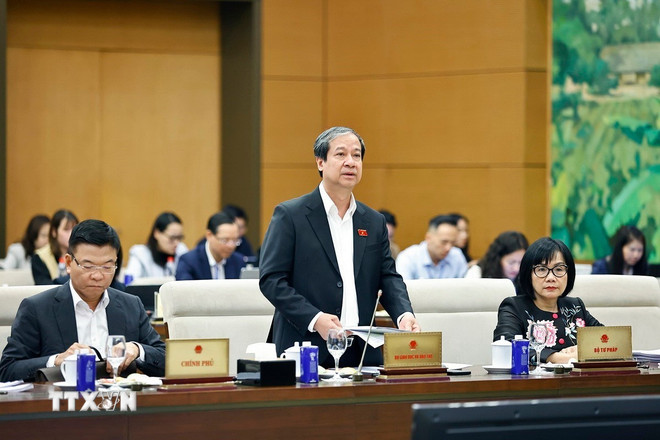
Regarding some issues on education and training, many delegates gave their opinions. The Government's report said that some National Assembly delegates proposed to supplement the training program and recognize diplomas for training in specialties 1, 2 and resident doctors, and at the same time recognize the training types as postgraduate training programs in the national education system.
The Government said that in response to the opinions of National Assembly delegates, the draft law has been revised in the direction: "The specialized post-graduate training program in the health field that grants degrees as resident physicians and specialists is managed by the Ministry of Health."
Regarding the model and system of higher education institutions, some opinions believe that the current regional university model with a 2-level management mechanism increases the administrative intermediary layer, causing organizational inadequacies, so it is recommended to consider not maintaining or establishing this model. Some opinions suggest studying the restructuring of regional universities (into 1-level universities) to ensure streamlined administration.
The Government explained that the assessment of the superiority of a university model needs to be viewed from many aspects, summarized and evaluated comprehensively. The Draft Law continues to stipulate the regional university model in Article 12 to carry out the mission of promoting regional connectivity, pooling resources and supporting the socio-economic development of the region.
Through review, the Government has found that this model has recently revealed limitations in organization and operation. To overcome these shortcomings, the draft Law is designed to clearly define the mission, functions and enhance unity in internal governance of organization, operation, coordination mechanism, decentralization and resource use of regional universities; at the same time, restructuring and perfecting the apparatus according to the roadmap, clearly defining the intermediate stage of regional universities to implement the process of reducing the number of focal points.
Regarding the policy of issuing a unified set of textbooks nationwide and implementing it from the 2026-2027 school year, many delegates proposed to clearly define the scope of "mandatory books or standard books for selection." Delegates also proposed to clarify the policy of free, reusable, and shared textbook libraries.
Regarding this content, the Government said that institutionalizing the task in Resolution No. 71 of the Politburo, the draft law stipulates that "The Ministry of Education and Training decides on a set of general education textbooks to be used uniformly nationwide".
This regulation is intended to ensure that the Ministry of Education and Training can choose to compile a new set of books or select and edit from existing sets of books, depending on the practical situation and the decision of the competent authority.
“At the present stage, it is not feasible to determine in the law whether the unified set of books will be compiled directly by the State or implemented through socialization, because the specific plan is being considered by the competent authority,” according to the Government's report.
The Government affirmed that open regulations as drafted will ensure the stability of the law and will not create rigid constraints while the policy is still being researched and its impact assessed.
In addition, the Government said it has assigned the Ministry of Education and Training to develop a report on the plan to deploy a unified set of textbooks nationwide from the 2026-2027 school year, ensuring publicity, transparency, objectivity, thrift, and anti-waste.
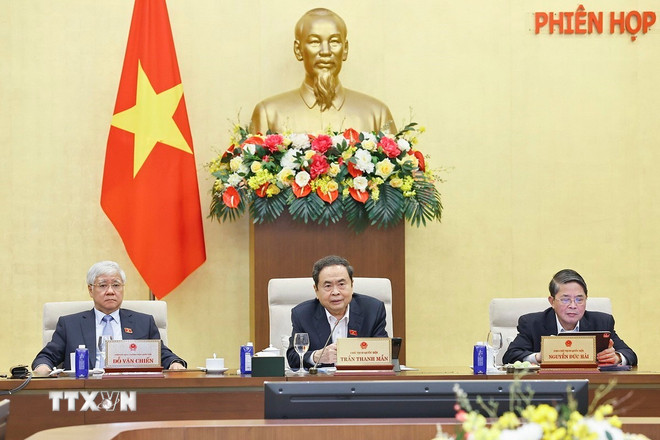
Commenting at the meeting, National Assembly Chairman Tran Thanh Man emphasized that education and training is one of the very important fields that voters and people are very interested in. The National Assembly Chairman requested the Government to fully absorb and explain the opinions of National Assembly deputies.
The National Assembly Chairman also noted that there are five key issues that need to be explained, clarified and adjusted by the Government, including: university autonomy and education finance; facilities, teachers and textbooks; digital transformation, application of artificial intelligence (AI) technology in education; specific mechanisms and organizational models.
Regarding the investment policy of the National Target Program on modernization and improving the quality of education and training for the 2026-2035 period, the National Assembly Chairman emphasized that this is a large-scale program aimed at modernizing education and training in our country.
The National Assembly Chairman said that to develop education, it is necessary to prioritize investment in digital transformation; ensure flexible capital allocation, allowing localities to proactively adjust to actual conditions; innovate capital allocation and management mechanisms in accordance with the spirit of promoting decentralization and delegation of power./.
Source: https://www.vietnamplus.vn/uy-ban-thuong-vu-quoc-hoi-bo-sung-cac-chinh-sach-nguon-luc-phat-trien-bao-chi-post1081017.vnp


![[Photo] Cat Ba - Green island paradise](/_next/image?url=https%3A%2F%2Fvphoto.vietnam.vn%2Fthumb%2F1200x675%2Fvietnam%2Fresource%2FIMAGE%2F2025%2F12%2F04%2F1764821844074_ndo_br_1-dcbthienduongxanh638-jpg.webp&w=3840&q=75)



























![[VIMC 40 days of lightning speed] Da Nang Port: Unity - Lightning speed - Breakthrough to the finish line](https://vphoto.vietnam.vn/thumb/402x226/vietnam/resource/IMAGE/2025/12/04/1764833540882_cdn_4-12-25.jpeg)



































Comment (0)