

In Lam Dong , many H'Mong and K'Ho women are more than half their lives away from sitting at a desk for the first time; and in Kem Don village (Nghe An), Mr. Vi Van Xien, over 80 years old, still encourages family members to go to school every day "to correct what their parents left unfinished."
On a national scale, Vietnam’s literacy picture continues to achieve wide and stable coverage. The literacy rate in the 15-35 age group reached 99.39% (level 1 - equivalent to having completed grade 3 of primary school) and 98.97% (level 2 - equivalent to having completed primary school); the 15-60 age group reached 99.10% and 97.72% respectively.
All 34/34 provinces and cities have been recognized as meeting the level 1 literacy standards; 26/34 have reached level 2 (76.5%). In the 2020-2023 period alone, the whole country mobilized 79,280 people to participate in literacy classes, of which nearly 75% are ethnic minorities under the National Target Program 1719.
These figures reflect the political system's persistent coordination capacity and the effectiveness of the legal framework: Decree 20/2014/ND-CP, Circular 07/2016/TT-BGDDT, Circular 33/2021/TT-BGDDT of the Ministry of Education and Training on the literacy program; and strategic guidance documents such as Resolution 29-NQ/TW (2013) of the 11th Central Executive Committee on fundamental and comprehensive education innovation, and especially Directive 29-CT/TW of the Politburo, dated January 5, 2024, requiring a focus on "functional illiteracy eradication", sustainably maintaining literacy results in the context of digital transformation.
Vietnam is also implementing its international commitment to SDG4 - ensuring lifelong learning opportunities for all. Despite many achievements, the work of eliminating illiteracy is entering a challenging turning point.
In many ethnic minority areas, the risk of illiteracy is returning: the mother tongue dominates life, while Vietnamese easily fades after a few months.
This is the form of functional blindness that the Politburo’s Directive 29-CT/TW warned about: being literate but not being able to use words to access technology, law or public services. Seasonal economy makes the classroom fragile.
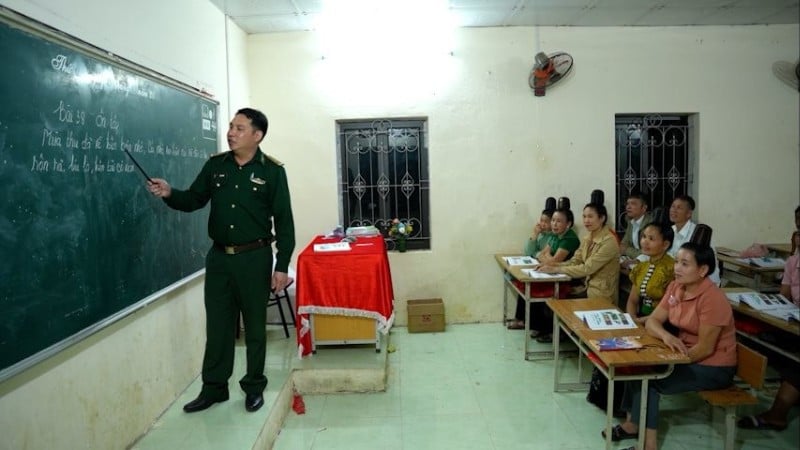
Major Lo Van Thoai, Nam Lanh Border Guard Station, Sop Cop Commune, Son La Province shared: “There are days when there are only 5 people left in the class, but the fewer the students, the more I have to teach. Because if I stop teaching, they will be embarrassed and won’t come back.”
Facilities in many classrooms are still makeshift; teachers are mostly part-time and do not know the ethnic language, while older students need special methods. Bilingual learning materials are lacking, and the content is not yet linked to livelihoods.
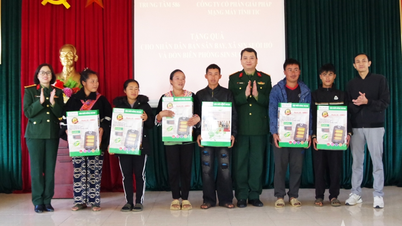
Fluctuating population data has led to many places opening classes for the wrong target group. In this context, the border guards play a key role, eliminating illiteracy for more than 70,000 people, mobilizing 50,000 students to return to school, eliminating 40 education white papers, and maintaining more than 30 regular classes with 700 students.
The “Helping Children Go to School” program supports 3,000 students, sending 383 of them to college or university. “If you want people to study, you must first help them have enough food,” said Major Lo Van Thoai.
Faced with increasingly obvious challenges, literacy needs to be viewed with a new vision, not just stopping at reading and writing, but must become a process of building life skills in the digital age.
Directive 29-CT/TW of the Politburo clearly identified the requirement to shift from “basic illiteracy eradication” to “functional illiteracy eradication”, considering this as the foundation for implementing streaming, sustainable poverty reduction, strengthening border security and building a learning society by 2030.
This is also in line with the goal of SDG4 - ensuring that everyone has the opportunity to learn throughout their lives. Policy movements will only be meaningful when they are translated into real life. The story in Ky Son Economic-Defense Zone (Nghe An) is a proof.
Here, the poverty rate is nearly 75%, ethnic minorities account for nearly 99%, and conditions are extremely difficult. Officials must "eat, live, and work together" so that people believe and learn to read and write.
Thanks to this, 22 classes were maintained, 648 people became literate, and many families encouraged each other to go to school so that they “would not be tricked into signing documents again”. When literacy was linked to people’s rights and safety, it became part of their livelihood, not just a purely educational task.
In An Giang province, where the classroom is located in the middle of the church, the High Priest and the High Monk participate in the class, and the entire Cham and Khmer community study together.
In a small classroom in the middle of Nhon Hoi Cathedral (An Giang), a woman over 60 years old trembles as she practices writing her first strokes, and her eyes light up when she reads a few words on a traffic sign - not uncommon in remote areas. "Just knowing a little bit of letters makes me feel grown up," said teacher Tran Thi Ngoc Dung.
And so the word takes root because it touches the cultural fabric and beliefs of the community. The lesson here is not just method, but philosophy: Education is only lasting when it is integrated into life.
From these bright spots, we can see that the true power of literacy lies not only in the number of classes but also in the changes in each individual.
When a highlander can write his name, calculate sales prices, read medication instructions, or open a bank account to receive support, it is not only the success of an education program but also the maturity of a country that is opening the door to capacity for each citizen.
In the digital age, “literacy” is not just reading and writing, but the ability to use words to master technology, understand policies, transact electronically, access knowledge and expand livelihoods. Without these abilities, re-illiteracy becomes a vicious cycle of poverty and backwardness.
Source: https://nhandan.vn/no-luc-de-tai-mu-chu-khong-xuat-hien-tro-lai-post928674.html













![[Video] “Happy Vietnam 2025” Award: Contributing more beautiful slices of a humane and culturally rich country](https://vphoto.vietnam.vn/thumb/402x226/vietnam/resource/IMAGE/2025/12/07/1765120096965_gen-h-z7302026251876-0c4feb61bdc05ac1e4a8af98b1ba524c-701-jpg.webp)
![[Video] Producing high quality dried bamboo shoots using heat pump drying technology](https://vphoto.vietnam.vn/thumb/402x226/vietnam/resource/IMAGE/2025/12/08/1765155799525_avatar-of-video-1031232-png.webp)


























































Comment (0)