

Major US financial institutions are withdrawing en masse from the Net Zero Banking Alliance (NZBA) ahead of Donald Trump's inauguration. This is a headwind to the goal of achieving zero emissions by 2050.
US banks are withdrawing en masse.
According to ESG Today, on January 2nd, Morgan Stanley became the next US bank, after Citi and Bank of America, to withdraw from the Net Zero Banking Alliance (NZBA).
Earlier in December, Goldman Sachs Group and Wells Fargo also left the alliance.
This is a rather unexpected development and casts a less bright light on the future of the NZBA, as leading corporations, including its founding organizations, have withdrawn.
NZBA is an alliance established in 2021 to ensure that member banks maintain consistency in lending and investments toward achieving net zero emissions by 2050 as outlined in the Paris Agreement.
In a statement provided to ESG Today, a Morgan Stanley spokesperson said: “Morgan Stanley has decided to withdraw from the Net Zero Banking Alliance. Morgan Stanley’s commitment to net zero emissions remains unchanged.”
Morgan Stanley did not give a reason for the decision. But this announcement marks the latest in a wave of rapid withdrawals by NZBA members in recent weeks. Observers suggest the leading US bank may be under pressure from some Republican politicians .
Morgan Stanley joined NZBA in April 2021 as a founding member of the alliance. Initially, NZBA had 43 founding members, which later expanded to more than 130 banks from 41 countries.
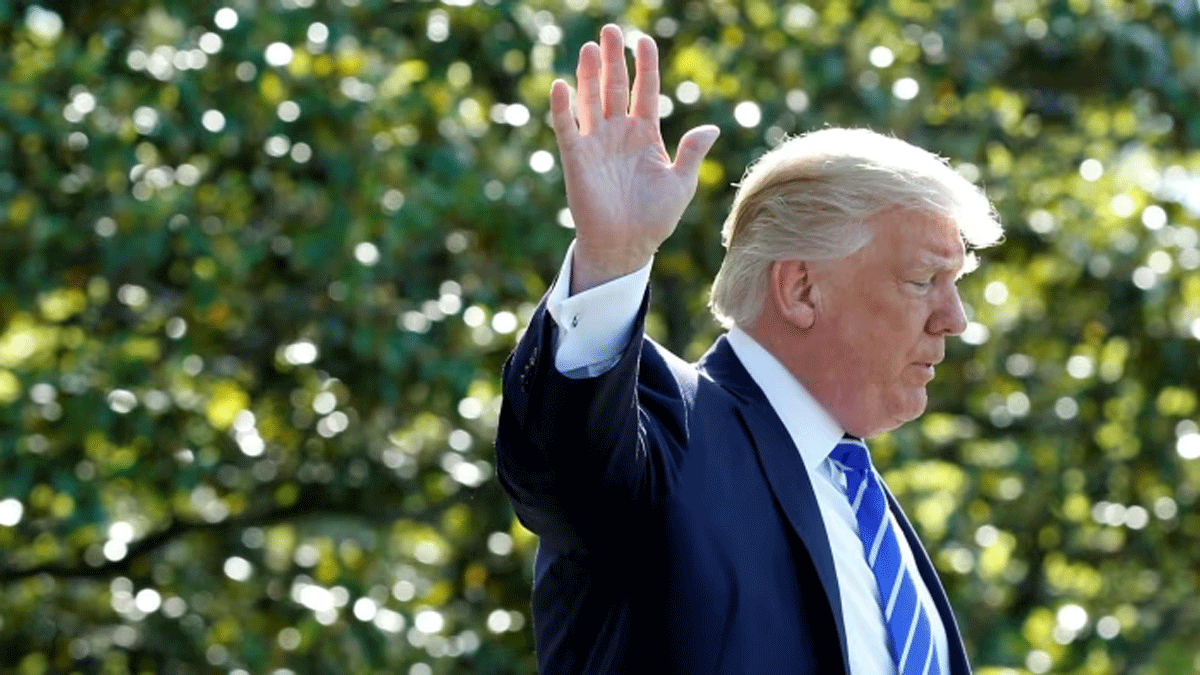
Energy policy under Donald Trump
During his election campaign, Donald Trump repeatedly stated he would impose high tariffs on goods imported into the United States, especially from China. This has led investors to worry about rising inflation. The Federal Reserve (Fed) will have to be cautious and avoid lowering interest rates too quickly, which could negatively impact economic growth.
However, one of Trump's most frequently mentioned policy commitments was the goal of halving energy costs within a year of taking office, by accelerating oil and gas extraction, reducing barriers to building power plants, and thus curbing inflation.
According to the NYT, Trump's transition team has prepared executive orders and a statement announcing withdrawal from the Paris climate agreement, which the US president-elect considers "exploitative of America" and a "disaster."
During his first term, Trump canceled many environmental commitments and made the US the first country to withdraw from the Paris climate agreement. In 2017, Trump also announced his withdrawal from the agreement, and the withdrawal process was officially completed on November 4, 2020. However, on January 20, 2021, President Joe Biden decided to rejoin the agreement shortly after taking office.
In addition, during his second term, Trump also plans to reduce the size of some national reserves to expand mining operations and resume licensing the export of liquefied natural gas (LNG) to Asia and Europe.
Many US states and some major technology companies like Apple, Microsoft, and Amazon are still pursuing the goals of the Paris Agreement, despite the federal government's decision. However, the pressure on major banks is immense if they continue to participate in climate alliances and do not finance oil and gas companies…
According to the NYPost, in November, Texas led a lawsuit filed by 11 Republican states against BlackRock, Vanguard, and State Street. The states accused these financial regulators of "conspiring to artificially restrict" the coal market through anti-competitive practices.
The states allege that these corporations have accumulated large stakes in coal producers and then supported environmental initiatives aimed at reducing coal production in order to drive up prices.
For major U.S. banks, restricting financing for fossil fuel companies could violate antitrust laws, according to allegations from Donald Trump's Republican party.
Republican-led campaigns against environmental, social, and governance (ESG) goals garnered significant attention last year.
Chairman of the House Judiciary Committee Jim Jordan (Republican, Ohio) recently criticized climate alliances such as Climate Action 100+ and the Glasgow Financial Alliance for Net Zero (GFANZ), accusing them of undermining fair competition.
In a recent statement to The Post, Citi told The Post that it decided to withdraw from the NZBA to focus its attention on the Glasgow Financial Alliance for Net Zero (GFANZ) as the group undergoes restructuring.
Earlier this week, Bloomberg reported that GFANZ – a general group for climate alliances – is adjusting its working methods with smaller, industry-specific groups following a wave of bank withdrawals.
Despite leaving the NZBA, major US banks like Citi and Goldman Sachs have stated their commitment to achieving net-zero emissions. Wells Fargo and Bank of America, however, have yet to comment on their decision to leave the NZBA.
Source: https://vietnamnet.vn/ong-trump-sap-nham-chuc-loat-ong-lon-my-rut-khoi-lien-minh-net-zero-2360081.html



































































































Comment (0)