

In Barnham, Suffolk (England), scientists discovered a layer of fired earth forming a hearth, flint axes cracked by heat, and two fragments of pyrite – a mineral that can produce sparks used to start fires.
The research, published in the journal Nature, is based on a multi-year study of a red sediment deposit excavated at Barnham.

Excavation site in Barnham, Suffolk (England) (Photo: Jordan Mansfield).
“This site, dated to 400,000 years old, is the earliest evidence to date of fire creation, not just in Britain or Europe but in the whole world ,” said Nick Ashton, lead author of the study and curator of the Paleolithic collection at the British Museum.
However, the absence of fossils from ancient hearths makes it difficult to reconstruct the "technology" behind creating those first fires.
The Barnham excavations also failed to find any human remains, so identifying the group that created the fire remains unclear. However, these traces most likely belong to Neanderthals – close relatives of modern humans who interbred with our ancestors.
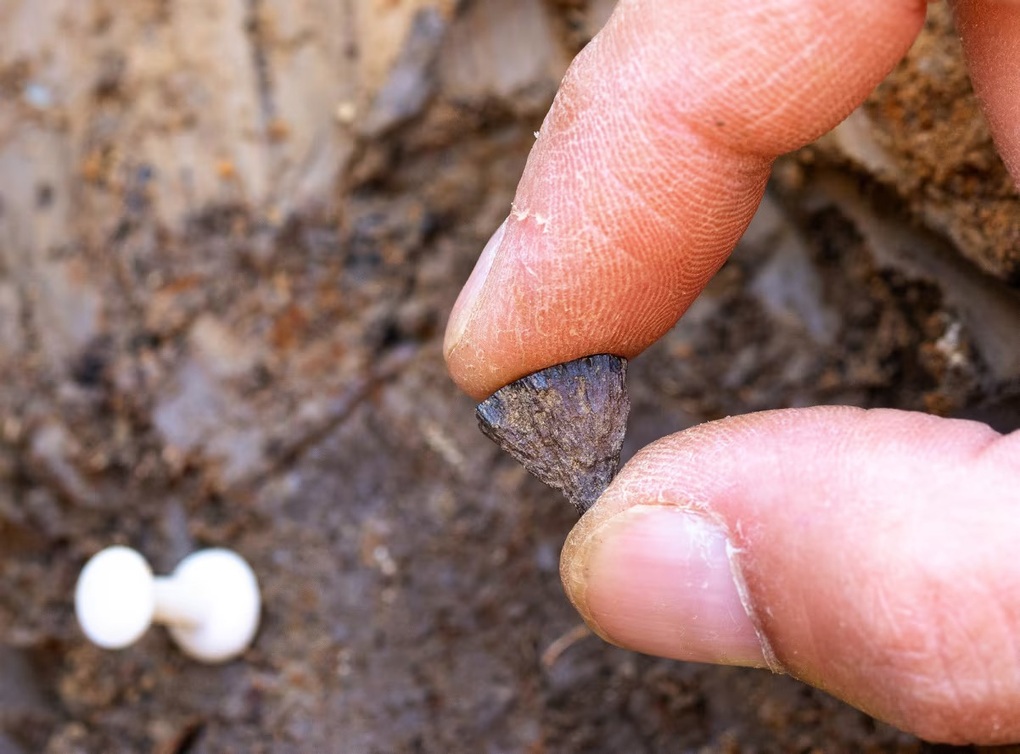
A piece of iron pyrite mineral was first discovered in 2017 at Barnham (Photo: Jordan Mansfield).
“Ash and coal from fires are easily washed away, and sediment layers can also be eroded,” Ashton said. “The research team only found one pocket of sediment – in a fairly large area – where traces were preserved.”
Even when traces of fire are preserved, distinguishing between man-made fires and those caused by lightning strikes or forest fires remains a challenge for archaeologists.
Furthermore, a greater challenge is determining whether ancient peoples actually knew how to create fire themselves or simply used embers from natural fires.
For example, some sites in Israel, Kenya, and South Africa show signs of fire dating back 800,000 to over 1 million years, but the possibility of natural forest fires cannot be ruled out.
The artifacts found at Barnham predate the oldest known evidence of fire-making previously recorded in northern France by 350,000 years. However, Ashton noted that this does not mean fire-making began at Barnham.
The research team analyzed the red-stained sediment at Barnham and found that its chemical properties differed from traces of natural fires. The hydrocarbon signatures indicated high temperatures from concentrated wood burning, rather than widespread combustion.
The most compelling evidence is the two pieces of pyrite – a mineral that can produce sparks when struck with flint to start a fire. This mineral does not occur naturally in the surrounding area, suggesting that the Barnham residents understood pyrite's fire-generating properties and actively sought it out.
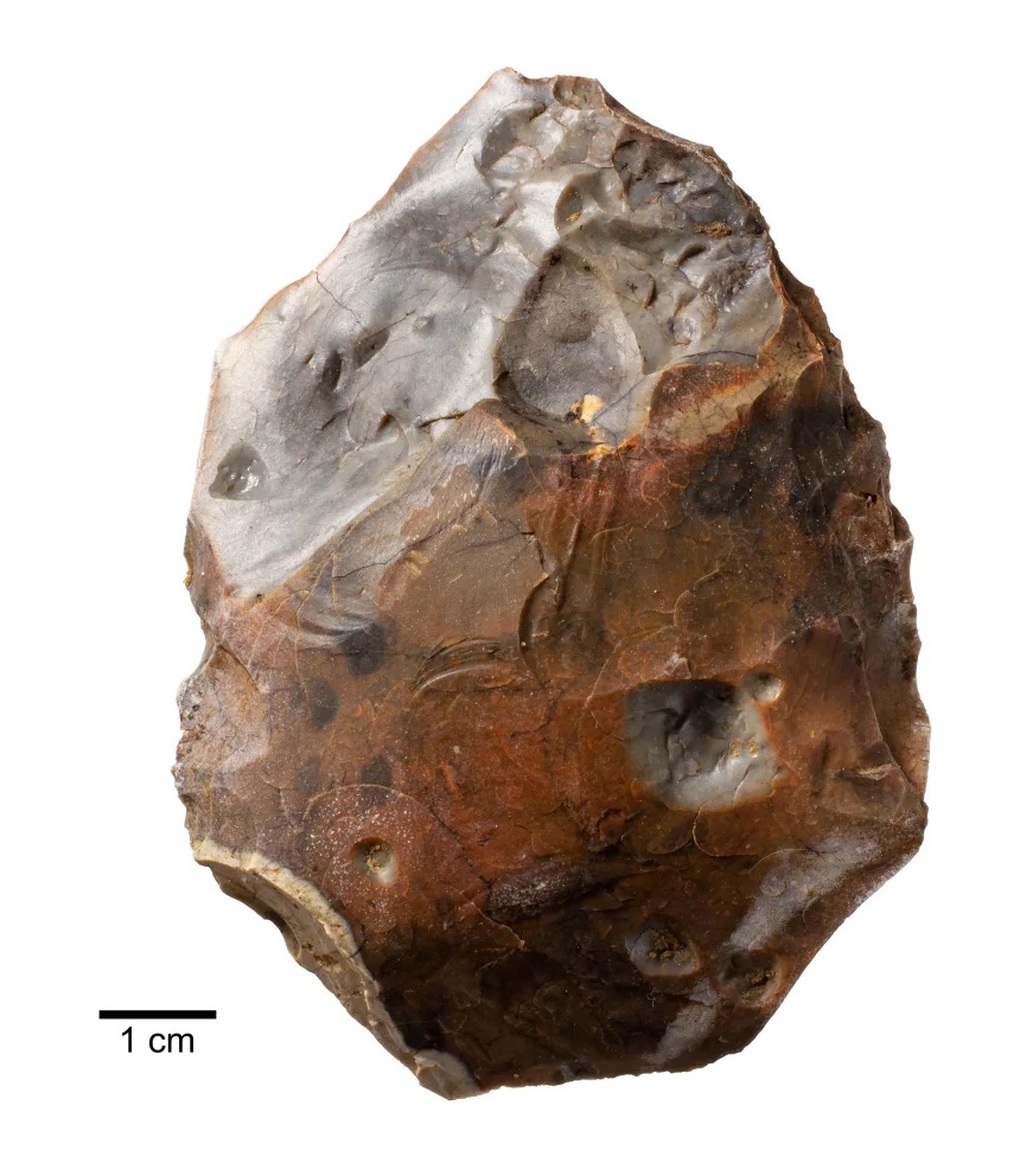
A heat-damaged hand axe was found near a 400,000-year-old hearth (Photo: Jordan Mansfield).
"When did our human ancestors create fire?" is one of the greatest mysteries in human history.
Professor John McNabb, from the Centre for Archaeology of the Origins of Humankind at the University of Southampton, commented on the importance of fire in the lives of ancient people: “Without fire, humans were still dependent on nature. Mastering fire allowed humans to begin to control the world around them.”
Mastering fire helped humans to keep warm, ward off wild animals, cook food, digest better, provide more energy and nutrients, and support brain development—a prerequisite for the development of many human behaviors and social activities.
Furthermore, fire also played a crucial role in forging and creating metal tools, contributing significantly to the formation of later civilizations.
Source: https://dantri.com.vn/khoa-hoc/phat-hien-moi-co-the-thay-doi-hieu-biet-ve-ngon-lua-dau-tien-duoc-tao-ra-20251211154658670.htm
![[Photo] Closing Ceremony of the 10th Session of the 15th National Assembly](/_next/image?url=https%3A%2F%2Fvphoto.vietnam.vn%2Fthumb%2F1200x675%2Fvietnam%2Fresource%2FIMAGE%2F2025%2F12%2F11%2F1765448959967_image-1437-jpg.webp&w=3840&q=75)



![[Photo] Prime Minister Pham Minh Chinh holds a phone call with the CEO of Russia's Rosatom Corporation.](/_next/image?url=https%3A%2F%2Fvphoto.vietnam.vn%2Fthumb%2F1200x675%2Fvietnam%2Fresource%2FIMAGE%2F2025%2F12%2F11%2F1765464552365_dsc-5295-jpg.webp&w=3840&q=75)









































![[OFFICIAL] MISA GROUP ANNOUNCES ITS PIONEERING BRAND POSITIONING IN BUILDING AGENTIC AI FOR BUSINESSES, HOUSEHOLDS, AND THE GOVERNMENT](https://vphoto.vietnam.vn/thumb/402x226/vietnam/resource/IMAGE/2025/12/11/1765444754256_agentic-ai_postfb-scaled.png)

















































Comment (0)