

On December 11th, Deputy Prime Minister Bui Thanh Son signed Decision 46, completely repealing Decision 53/2012 of the Prime Minister on the issuance of a roadmap for applying the blending ratio of biofuels with traditional fuels.
Decision 53/2012 is no longer legally valid. All regulations in this decision, including the roadmap, timing, and mandatory blending ratio of biofuels (such as E5, E10) into traditional gasoline and diesel, are no longer applicable.
The Ministry of Industry and Trade acknowledges that, after nearly a decade of implementation, Decision 53/2012 has contributed to paving the way for biofuels in Vietnam; however, it has also revealed many shortcomings as it enters the stage of extensive development, and therefore needs to be replaced.
On November 7th, the Ministry of Industry and Trade issued Circular 50/2025 stipulating the roadmap for applying the blending ratio of biofuels with traditional fuels in Vietnam. The Circular will take effect from January 1st, 2026.
From June 1st, 2026, unleaded gasoline (according to current national technical standards) must be blended into E10 gasoline (mixing 10% ethanol with unleaded gasoline) for use in gasoline engines nationwide.
At the same time, the blending and mixing of E5 RON 92 gasoline (mixing 5% ethanol into RON 92 gasoline) for use in gasoline engines will be implemented until the end of December 2030.
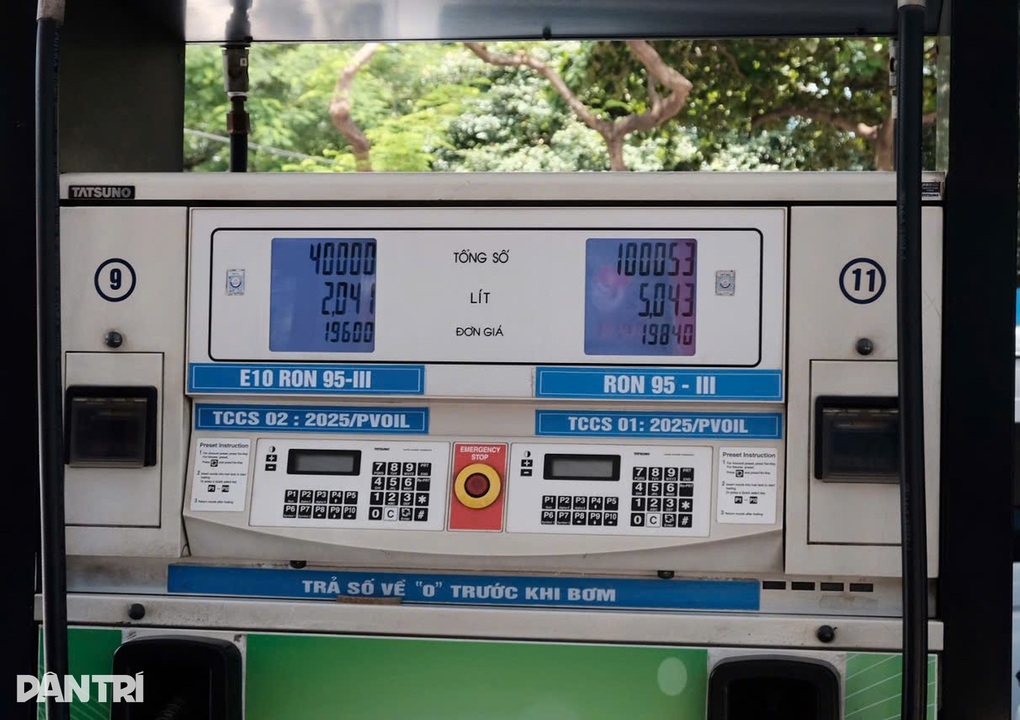
E10 gasoline will be used nationwide from June 2026 (Photo: Thanh Thuong).
Furthermore, B5 and B10 biodiesel are not yet required to be blended for use in diesel engines. The Ministry of Industry and Trade encourages organizations and individuals to participate in the production and trading of these biodiesel products.
On November 25th, Deputy Prime Minister Bui Thanh Son requested Minister of Industry and Trade Nguyen Hong Dien to chair a meeting with relevant ministries and agencies to urgently clarify remaining issues to ensure feasibility and consistency in the implementation of the roadmap for the production, blending, distribution, and use of biofuels in Vietnam.
The Ministry of Industry and Trade and other ministries and agencies are tasked with assessing the production, supply, and distribution capacity of domestic and imported ethanol, as well as the costs and impact on E10 gasoline prices. They will review the blending capacity of key enterprises, determine their ability to meet the roadmap, and clarify responsibilities when supply requirements are not met.
The Deputy Prime Minister requested the Ministry of Industry and Trade and relevant agencies to determine the scientific basis, the agency responsible for appraisal, and the mechanism for inspecting and monitoring the quality and technical safety of E10 gasoline.
In addition, government leaders noted the need to propose solutions for managing and ensuring that the price of E10 gasoline does not adversely affect the lives of people and businesses, and to report the results of implementation to the Prime Minister in November.
According to Circular 50/2025, biofuels are bio-based fuels including denatured or undenatured fuel ethanol (E100) and bio-based diesel (B100). Traditional fuels are unleaded gasoline (base gasoline) including RON 92, RON 95, other unleaded gasolines, or diesel fuel (DO) that meets the quality requirements of the law.
In this circular, biofuels are mixtures of fuel ethanol and base gasoline, including E5 RON 92 and E10 gasoline. Blending biofuels involves adding E100 in varying proportions to base gasoline using blending methods in storage tanks and pipelines, or other suitable blending methods.
Source: https://dantri.com.vn/kinh-doanh/bo-lo-trinh-cu-nguoi-dan-bat-buoc-dung-xang-e10-e5-tu-thang-62026-20251211220233611.htm



![[Photo] Closing Ceremony of the 10th Session of the 15th National Assembly](/_next/image?url=https%3A%2F%2Fvphoto.vietnam.vn%2Fthumb%2F1200x675%2Fvietnam%2Fresource%2FIMAGE%2F2025%2F12%2F11%2F1765448959967_image-1437-jpg.webp&w=3840&q=75)
![[Photo] Prime Minister Pham Minh Chinh holds a phone call with the CEO of Russia's Rosatom Corporation.](/_next/image?url=https%3A%2F%2Fvphoto.vietnam.vn%2Fthumb%2F1200x675%2Fvietnam%2Fresource%2FIMAGE%2F2025%2F12%2F11%2F1765464552365_dsc-5295-jpg.webp&w=3840&q=75)






































![[OFFICIAL] MISA GROUP ANNOUNCES ITS PIONEERING BRAND POSITIONING IN BUILDING AGENTIC AI FOR BUSINESSES, HOUSEHOLDS, AND THE GOVERNMENT](https://vphoto.vietnam.vn/thumb/402x226/vietnam/resource/IMAGE/2025/12/11/1765444754256_agentic-ai_postfb-scaled.png)











































Comment (0)