

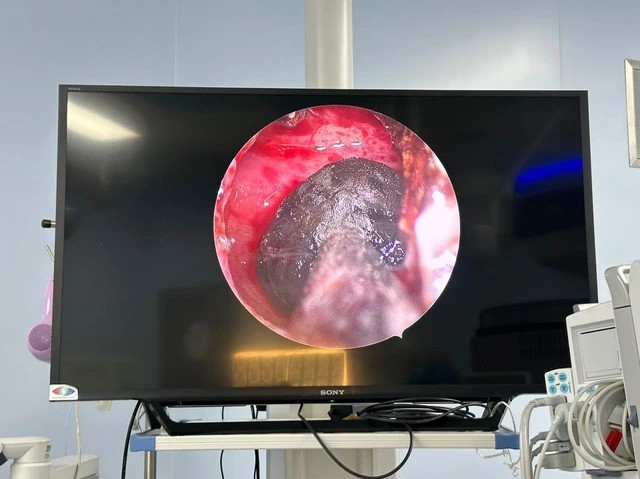
A 53-year-old female patient was admitted to the hospital with a persistent dull headache, without nasal congestion or runny nose. She occasionally noticed a faint foul odor in her nose. Prior to this, she had sought medical attention multiple times, taken medication, and even been hospitalized for treatment, but her condition had not improved.
The CT scan revealed that the left sphenoid sinus was filled with fluid and suspected fungal tissue, with characteristic radiopaque spots. Nasal endoscopy revealed an abnormality in the left upper hiatus. Despite being very anxious about surgery, after repeated explanations from the doctor, the patient agreed to the operation.
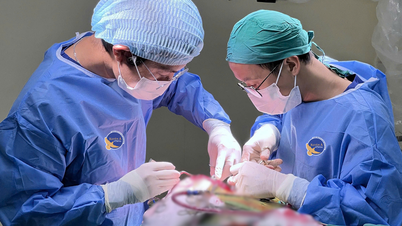
The surgery was performed by Dr. Tran Ngoc Quyen, a specialist in Otolaryngology at 22-12 Hospital ( Khanh Hoa ), using endoscopic sinus surgery. The doctors widened the sphenoid sinus opening, removed the fungal tissue, and irrigated the sinuses. The surgery lasted approximately 30 minutes, was minimally invasive, and did not require post-operative packing. After the surgery, the patient experienced no more headaches and felt relieved. Pathology results confirmed the infection was caused by Aspergillus fungus.
Experts warn that fungal sphenoid sinusitis is a rare condition that often progresses silently with atypical symptoms. Patients may only experience deep headaches in the parietal region or behind the eye sockets, which are persistent and unresponsive to painkillers. In some cases, the fungus can cause reduced or lost vision, and even affect cranial nerves.
In particular, the sphenoid sinus is located close to important structures such as the optic nerve, internal carotid artery, pituitary gland, and optic chiasm. If not detected and treated promptly, fungal infections can cause serious complications, even life-threatening ones, especially in invasive forms in immunocompromised patients.
According to doctors, diagnosis is based on nasal and sinus endoscopy, CT scans, or MRI, with CT scans showing a hazy mass in the sinuses with characteristic calcification. Treatment mainly involves endoscopic surgery to remove the fungal tissue, combined with antifungal medication in cases of suspected invasion or in immunocompromised patients.
The case of this 53-year-old patient clearly demonstrates the importance of accurate diagnosis and timely intervention. Individuals experiencing persistent headaches of unknown origin, decreased vision, or cranial nerve symptoms should seek early medical attention for fungal sinus screening to avoid the risk of dangerous complications.
Source: https://baolaocai.vn/phat-hien-nam-xoang-buom-sau-nhieu-thang-dau-dau-am-i-post880099.html


![[Photo] Prime Minister Pham Minh Chinh holds a phone call with the CEO of Russia's Rosatom Corporation.](/_next/image?url=https%3A%2F%2Fvphoto.vietnam.vn%2Fthumb%2F1200x675%2Fvietnam%2Fresource%2FIMAGE%2F2025%2F12%2F11%2F1765464552365_dsc-5295-jpg.webp&w=3840&q=75)




































































Comment (0)