

In May 1976, following the central government's policy of merging provincial and district-level administrative units, the three provinces of Quang Binh , Quang Tri, and Thua Thien Hue, along with the Vinh Linh area, merged to form Binh Tri Thien province. After the merger, on March 5, 1977, the Binh Tri Thien Provincial Party Committee issued Resolution No. 02 on merging districts within the province, with Trieu Phong and Hai Lang districts becoming Trieu Hai district. This period marked significant milestones in flood control, the development of irrigation systems, and the expansion of irrigation canals, laying the foundation for the agricultural development of Hai Lang district to this day.
Rising from the land and water.
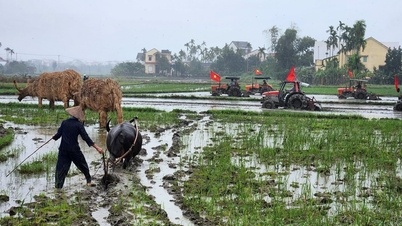
Three years after emerging from a devastating war that left devastating consequences, the people of Hai Lang focused on rebuilding their homeland. In agricultural production, the primary task was to actively reclaim and cultivate land, expand cultivated areas, improve fields, and prioritize the development of technical infrastructure to support intensive rice cultivation. Irrigation was considered the top priority, and the movement to build irrigation systems was vigorously promoted throughout the region.
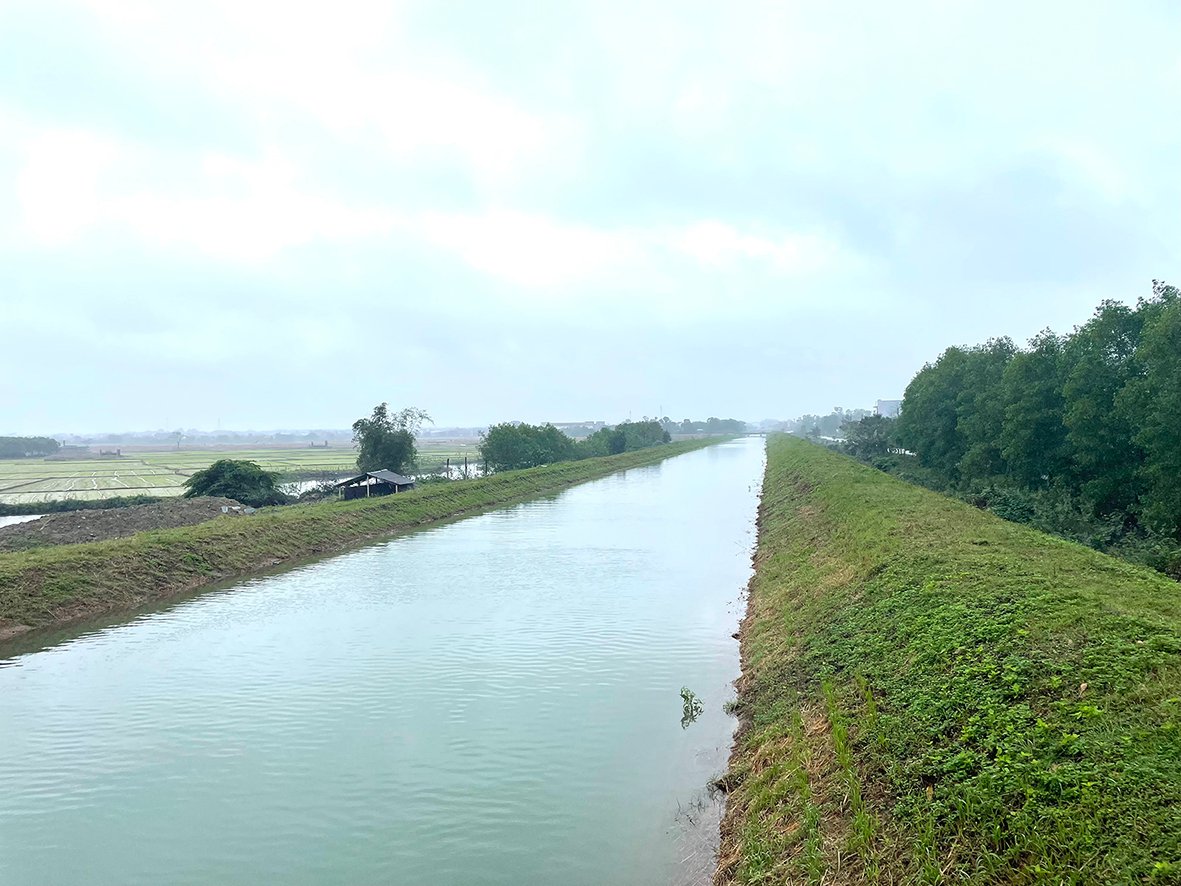
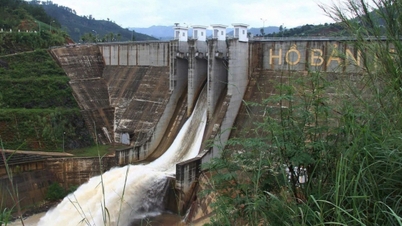
Water from the Nam Thach Han project contributes to providing irrigation water for agricultural production in Hai Lang - Photo: D.T.
In particular, thanks to the attention of the central and provincial governments, and the support and assistance of the people of Binh Tri Thien province, the Nam Thach Han large-scale irrigation project was started in March 1978 and put into operation in June 1979, providing irrigation water to many communes in Hai Lang district. On average, by 1984-1985, it irrigated 7,000-7,500 hectares of farmland per year. In addition, the district invested 14 million dong and 1.5 million man-days of labor from cooperatives to build 68 medium and small-scale irrigation works to serve irrigation and drainage.
In the hilly areas, five medium-sized reservoirs and several smaller ones have been constructed, holding a total of 11 million cubic meters of water. These include reservoirs in the communes of Hai Chanh, Hai Son, Hai Lam, Hai Phu, etc. Thanks to the additional irrigation water and the promotion of intensive farming, rice yields have increased significantly.
In 1981, 17 cooperatives in Hai Lang district intensively cultivated rice on an area of 2,000 hectares, increasing productivity from 50 quintals/hectare/year to 82 quintals/hectare/year. Three cooperatives achieved productivity exceeding 70 quintals/hectare/year. In 1982, 23 cooperatives achieved productivity exceeding 50 quintals/hectare/year, and four cooperatives achieved over 75 quintals/hectare/year – leading the province in rice productivity. Among them, Long Hung Cooperative (Hai Phu) became a leading example in Binh Tri Thien province's agricultural development.
It is noteworthy that by 1983, the total rice production of the entire district reached over 62,100 tons, with an average yield of 51.04 quintals/hectare per hectare for two crops, and the Long Hung Cooperative alone achieved over 100 quintals/hectare. In 1984, the total food production of the district reached 62,540 tons, marking the highest production year for Trieu Hai district since its merger.
The irrigation system is becoming increasingly sophisticated.
In the process of developing agricultural production, Hai Lang district has always focused on maintaining, repairing, and expanding the irrigation system to ensure timely and effective irrigation. Statistics show that in 2024, the total irrigated area of annual crops in the district was 18,304.64 hectares, of which the total irrigated area of rice was over 13,600 hectares.
Of the 13,600 hectares of irrigated rice fields, farmers used gravity-fed water for 4,617.14 hectares, electric pumps for over 9,000 hectares, and diesel pumps for 73 hectares. The localities with the largest irrigated areas compared to other communes in the district are: Hai Phong (2,410.27 ha), Hai Duong (2,112.8 ha), Hai Dinh (1,870.82 ha), Hai Hung (1,824.5 ha), Hai Ba (1,136.2 ha)...
Currently, the total length of canals and ditches in Hai Lang district is nearly 360 km, of which 178.78 km have been reinforced, reaching a rate of nearly 50%. Among these, the rate of reinforced canals and ditches is quite high in some communes such as Hai Phu (92.08%), Hai Lam (85.07%), Hai Que (68.38%), Hai Ba (66.49%)...
In addition to water from the gravity-fed irrigation system, to ensure readiness for irrigating rice fields during the planting season and to proactively prevent flooding in low-lying areas, Hai Lang district has also arranged a system of irrigation pumping stations, drainage pumping stations, and combined irrigation and drainage pumping stations.
The entire district currently has 55 irrigation pumping stations with a total designed flow rate of 51,800 m³ /h; 5 drainage pumping stations with a total designed flow rate of 28,300 m³ /h; and 26 combined irrigation and drainage pumping stations with a total designed irrigation flow rate of 45,700 m³ /h and a total designed drainage flow rate of 45,700 m³ /h. Localities with a large number of pumping stations for irrigation and drainage include the communes of Hai Phong (10 stations), Hai Chanh (8 stations), Hai Dinh (7 stations), Hai Hung (7 stations), etc.
Hai Lang District has also utilized 26 existing dams and reservoirs in the area to supply water for agricultural production, with a total designed capacity of 16.635 million m³ of water, distributed across the communes of Hai Chanh, Hai Son, Hai Truong, Hai Lam, Hai Thuong, Hai Dinh, Hai Phu, etc. Water resources from reservoirs such as Kieu Ngu (Hai Phu), Tram Khang (Hai Truong), Khe Che (Dien Sanh town); and dams such as Ho Phan (Hai Thuong), Bau Suu (Hai Lam), Truong Xuan, Tram Vung (Hai Truong), Tan Trung, Ruong Cay (Hai Chanh); Tram Tra Loc (Hai Hung)... are being used to irrigate fields, especially during dry periods.
Thanks to these efforts, Hai Lang district is now one of the leading localities in rice production in Quang Tri province, with a total rice cultivation area of over 13,600 hectares for the whole year (2024). The average yield for the entire district reached its highest level ever, at 64.67 quintals/hectare. Rice production reached 88,188.4 tons. The production value per unit area reached 126 million VND/hectare.
Dan Tam
Source: https://baoquangtri.vn/phat-trien-he-thong-thuy-loi-noi-vung-dong-hai-lang-191462.htm

![[Photo] Prime Minister Pham Minh Chinh receives the Governor of Tochigi Province (Japan)](/_next/image?url=https%3A%2F%2Fvphoto.vietnam.vn%2Fthumb%2F1200x675%2Fvietnam%2Fresource%2FIMAGE%2F2025%2F12%2F16%2F1765892133176_dsc-8082-6425-jpg.webp&w=3840&q=75)

![[Photo] Prime Minister Pham Minh Chinh receives Lao Minister of Education and Sports Thongsalith Mangnormek](/_next/image?url=https%3A%2F%2Fvphoto.vietnam.vn%2Fthumb%2F1200x675%2Fvietnam%2Fresource%2FIMAGE%2F2025%2F12%2F16%2F1765876834721_dsc-7519-jpg.webp&w=3840&q=75)
![[Live] 2025 Community Action Awards Gala](/_next/image?url=https%3A%2F%2Fvphoto.vietnam.vn%2Fthumb%2F1200x675%2Fvietnam%2Fresource%2FIMAGE%2F2025%2F12%2F16%2F1765899631650_ndo_tr_z7334013144784-9f9fe10a6d63584c85aff40f2957c250-jpg.webp&w=3840&q=75)
![[Image] Leaked images ahead of the 2025 Community Action Awards gala.](/_next/image?url=https%3A%2F%2Fvphoto.vietnam.vn%2Fthumb%2F1200x675%2Fvietnam%2Fresource%2FIMAGE%2F2025%2F12%2F16%2F1765882828720_ndo_br_thiet-ke-chua-co-ten-45-png.webp&w=3840&q=75)




























































Comment (0)