

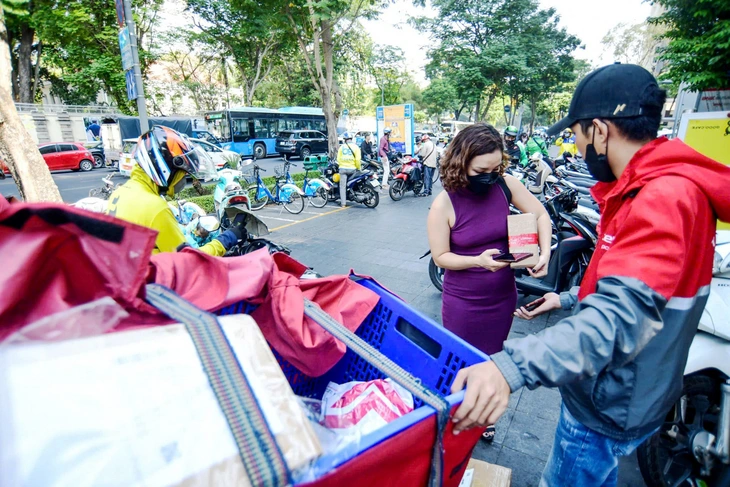
E-commerce platforms are constantly increasing fees, putting pressure on sellers - Photo: QUANG DINH
Starting October 27th, the TikTok Shop e-commerce platform will implement a new fee called "order processing fee" at 3,000 VND per order (including tax) for all orders, regardless of value or quantity.
Previously, the platform had also increased its commission fees for standard sellers by up to 300%. This new policy further exacerbates the "fee basket," eroding profits and increasing business risks for online sellers.
Markets are raising fees ahead of the peak season.
As the peak of the year-end shopping season and the start of the 2026 Lunar New Year season approaches, Hai Nam (Ho Chi Minh City), who sells sportswear on TikTok Shop, is fed up with the news that the platform is adding another new fee.
He said that small business owners like himself already have to bear a series of costs from platform fees such as commission fees, extra vouchers (promotional policies where sellers share the cost of discounts offered to customers with the platform)... In total, these expenses account for about 23-30% of the revenue per order.
In October alone, the platform introduced several new policies, including a processing fee of 3,000 VND per order and a shipping refund fee of approximately 1,620 VND per order, further eroding sellers' profits, while their profit margins were already very thin.
With a product generating revenue of around 500,000 VND, Mr. Nam estimates he has to spend nearly 155,000 VND on platform fees, not including a host of other costs to maintain the business such as operations (packaging, staff, utilities...), advertising, affiliate marketing... Meanwhile, import prices are not decreasing but are trending upwards, causing profit margins to shrink and business risks to increase.
Ms. Bich Chi, a household goods businesswoman residing in Ho Chi Minh City, believes that maintaining a low-price sales model in the near future is almost "impossible," especially during the end of the year and leading up to Tet 2026.
This small business owner calculated that, even though the platform increased fees for sellers, raising prices for customers wouldn't be easy. Raising prices would risk losing customers and being restricted from participating in the platform's promotional programs. "It's very difficult for small-scale traders to survive on the platform now. It's even harder to compete with low-value goods," Ms. Chi commented.
This is especially true now that many Chinese sellers have opened stores on TikTok Shop, directly competing with Vietnamese small businesses right in their own backyard.
"The problem is that exchanges tend to watch each other raise prices; if one exchange raises prices first, another will follow a few months later. If sellers aren't careful, they might lose a lot of money," Ms. Bich Chi shared.
Not only TikTok Shop, but from July 2025, Shopee and Lazada platforms are also attracting attention with adjustments to their tax and fee policies.
Online sellers need to adapt.
According to Tuoi Tre 's research, the end of the year is typically a major sales season, but the sudden increase in platform fees creates several risks: if sellers raise prices to compensate for costs, it could affect purchasing power; if they maintain prices, their profit margins will shrink.
For small business owners, profit margins are already low, and the added cost is a significant burden. The fee increase gives larger brands, which can more easily justify their costs, an advantage – forcing small businesses to find alternative solutions or abandon the platform. On the other hand, it forces some small businesses to reconsider their business models while also creating opportunities for those who adapt more quickly and effectively.
Speaking to Tuổi Trẻ newspaper , Ms. Nguyen Thi Anh Hong, Director of E-commerce at the 24hStore retail system, said that sellers, especially small business owners, should not "bet" on only one channel, the e-commerce platform, but should expand to include: their own website, Facebook/Instagram sales, Zalo, their own livestream channel, or cooperation with smaller platforms. Multi-channel marketing helps reduce dependence on platforms that increase fees.
Also, consider offline channels (pop-ups, physical stores, markets, year-end fairs) if possible – when online sales are tightened, offline channels can compensate.
"Small businesses can apply value-added strategies to offset costs by upgrading the customer experience, such as: more attractive packaging, better after-sales service, special promotional combos, etc., to encourage customers to accept slightly higher prices. At the same time, they should choose products with higher profit margins instead of trying to compete on price (for example, exclusive products, products with clear USPs (unique selling propositions), or import small quantities for testing beforehand)," Ms. Hong suggested.
Specifically, according to this entrepreneur, in the context of e-commerce platforms constantly increasing fees, sellers should proactively focus on building their own brand instead of just being a "platform store." When customers clearly remember a brand, they will seek it out even outside the platform, and that is the leverage to switch to their own channel.
In addition, sellers should also focus on using content marketing, livestreaming, and social media to create a loyal customer "community," reducing their complete dependence on customers from e-commerce platforms.
"Sellers can focus on products with low return rates, easy-to-sell items, or trending products at the end of the year, instead of spreading themselves thin across hundreds of small product lines. Additionally, they can try a 'pre-order' model to reduce inventory and risk if they find platform fees and operating costs too high," Ms. Hong shared.

Small business owners learn professional livestreaming skills in the "Professional Livestreaming Sales Skills" program at E2E Studio (Ho Chi Minh City) - Photo: QUANG DINH
We need to reduce our dependence on the exchange.
Given this reality, many sellers are looking to diversify their distribution channels to avoid complete dependence on e-commerce platforms, but this shift requires a sustainable strategy.
According to Huynh Ho Dai Nghia, a Master of Public Policy, considering the operating principles of the digital economy , the addition of new fees by e-commerce platforms is inevitable and a common trend worldwide . It's noteworthy that these platforms have a high degree of autonomy, but it's important to emphasize that this doesn't mean they can operate in a "grey area."
There is a need for mechanisms to publicly disclose fee structures, consult with the seller community (especially small traders) before implementing policies, and issue a code of conduct to protect both sellers and consumers. Simultaneously, a legal framework is needed to recognize and protect online small traders.
He also suggested that e-commerce platforms should tier fees based on order value, product category, or seller size, as well as ensure transparency in fee usage and create a public feedback channel on policies.
From the perspective of small business owners, it is necessary to collaborate within industry groups, share costs, and diversify channels to reduce dependence on a single platform.
" E-commerce is entering a mature phase," Mr. Nghia emphasized. Success is measured not only by growth and total transaction value, but also by the quality of the ecosystem and fairness among participating parties.
Launch promotions to attract customers to buy off-platform.
According to observations, recently many vendors have started attracting customers from the floor to social media channels such as Facebook, Instagram, Zalo, or back to shop directly at the store.
By launching special promotions and offers for customers buying off-platform, online sellers aim to further incentivize consumers to change their purchasing habits.
Nguyen Thao Van (22 years old), a student at Van Lang University, said she recently bought a set of watercolors for nearly 350,000 VND through a brand's Facebook fanpage, and received a free paintbrush and stickers.
"If you buy online, the price is higher, and you don't get any free gifts," Van shared. She approached the seller through Facebook, but still trusted them because the page had a verified badge (blue tick), a clear brand, and her friends and she herself had bought from them many times.
Simultaneously, many brands are also directing customers to their own websites with more flexible pricing and a wider variety of products. Others are reinvesting in physical stores to enhance the in-person customer experience.
Source: https://tuoitre.vn/san-tang-phi-truc-mua-cao-diem-nguoi-ban-hang-online-lo-sot-vo-2025102608272575.htm






























































































Comment (0)