

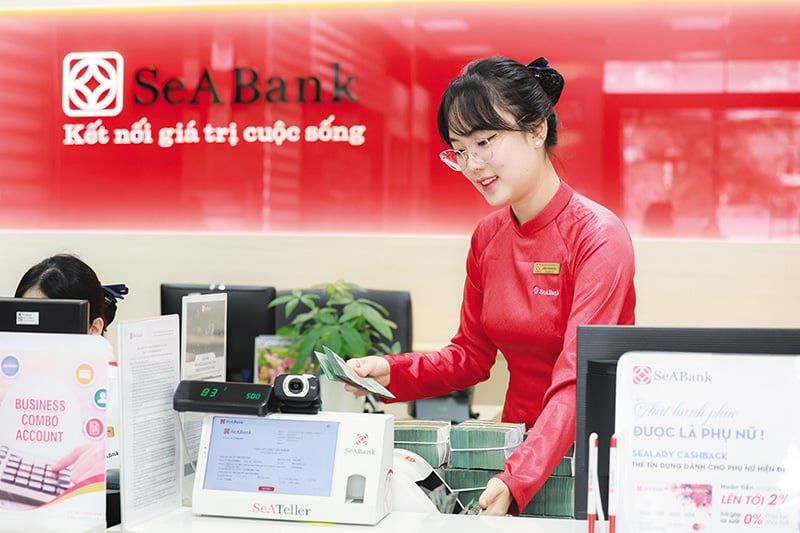
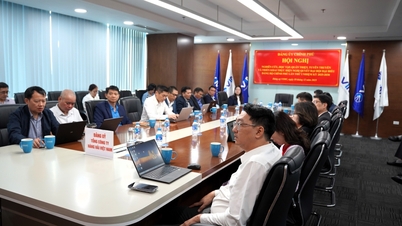
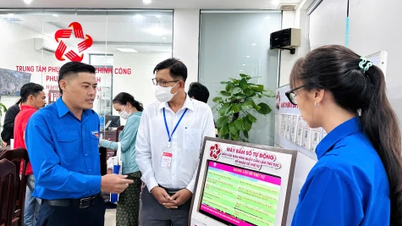
Working at a SeABank branch.
Comprehensive Risk Management According to International Standards: To maximize support for business objectives and build a solid foundation for sustainable development, SeABank continuously improves its comprehensive risk assessment methods according to international standards and practices, while flexibly adjusting policies according to market fluctuations, ensuring the maintenance of asset quality, stable liquidity, and a robust buffer. To strengthen its capital reserves for risks, SeABank completed all three pillars of Basel II ahead of schedule. SeABank is also one of the few pioneering banks to implement and apply Basel III from May 2022 with stringent requirements for meeting the Capital Adequacy Ratio (CAR), core capital components, reserve buffer components, and liquidity risk management indicators. After two years of implementation, SeABank has continuously improved its indicators for ensuring safe operating capital reserves and strengthening its liquidity resilience against unforeseen events. Accordingly, the Bank applies the Internal Models Approach (IMA) to measure liquidity resilience, assess capital risk against market risks, and fully implements the Internal Capital Adequacy Assessment Process (ICAAP) to be prepared for all scenarios. As a result, the Bank consistently maintains a CAR ratio at a safe level higher than the minimum requirement of the State Bank of Vietnam (SBV), with a consolidated CAR ratio of 13.61% as of December 31, 2023. SeABank also adopted International Financial Reporting Standards (IFRS) early, alongside Vietnamese Accounting Standards, in preparing and presenting financial statements. Through this, the Bank strengthens risk management and control by improving the ability to measure and manage business results, creating a basis for rational resource allocation to increase capital efficiency. Managing Environmental and Social Risks and Promoting Responsible Credit: In addition to managing inherent key risks, SeABank proactively develops and implements an Environmental and Social Risk Management System (ESMS) and promotes green credit, aiming to combat climate change and realize the Government's goal of transitioning to a net carbon-zero emission economy . Since 2022, SeABank has comprehensively implemented environmental and social risk management in its credit operations. Accordingly, 100% of credit transactions are screened, classified, and assessed for environmental and social risks, thereby identifying appropriate environmental and social risk management measures based on the identified risk levels, while rejecting transactions with serious and irreparable impacts on the environment and society. To enhance efficiency and promote responsible credit projects, SeABank continuously seeks financial and professional support from reputable international partners such as IFC, DFC, and ADB. Through this, the Bank confidently provides green and social finance products to maximally support small and medium-sized enterprises (SMEs) and women-led businesses, fostering their development towards a green and circular economy, meeting stringent global production standards, and improving resource and energy efficiency. Risk management on a technology and digital platform: To strengthen its risk management foundation and create momentum for business development, SeABank continuously promotes its "Digital Convergence" strategy, focusing on investing in systems and applying advanced technologies to enhance control, prevention, and early detection of risks, thereby maintaining safe and continuous operations. SeABank has invested in applying advanced technology to improve the efficiency of risk management, control, and early detection, and risk prevention in many aspects, such as leveraging Big Data to gain a comprehensive and timely view of issues arising in transactions and building tools to identify suspicious transactions; applying AI, Machine Learning, and Data Analytics to build models to improve the quality of risk assessment; developing data centers… In particular, SeABank prioritizes resources to prevent risks related to technological security and customer information security during the digital transformation period through investment in data loss prevention systems; risk management projects and enhanced card security such as the Digital Authentication Framework and Mastercard Proactive Scanning; Upgrading eKYC technology, ensuring the integration of national population data and the verification of chip-embedded citizen identification cards enhances transaction security… As a result, SeABank has been certified to meet the highest standards of information security according to ISO 27001, and has become the first organization in Vietnam to be awarded PCI DSS 3.2 certification for security of payment card systems. For many consecutive years, SeABank has been rated B1 in baseline creditworthiness (BCA) by Moody's. Notably, in 2023, this organization rated SeABank at Ba3 for several key categories with a Stable outlook. Moody's also highly appreciated the improvements in asset quality management, high capital adequacy, lending operations, and stable liquidity. Source: https://baodautu.vn/seabank-phat-develop-sustainably-on-a-solid-risk-management-platform-d228677.html


























![[Video] The craft of making Dong Ho folk paintings has been inscribed by UNESCO on the List of Crafts in Need of Urgent Safeguarding.](https://vphoto.vietnam.vn/thumb/402x226/vietnam/resource/IMAGE/2025/12/10/1765350246533_tranh-dong-ho-734-jpg.webp)































































Comment (0)