

Jordan: The necklace consists of multiple strands and is made from over 2,500 stones and pieces of seashell, suggesting the child in the tomb had a high social status.
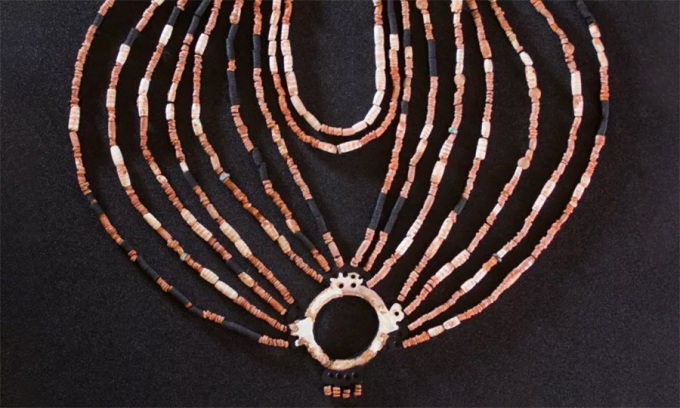
A physical reconstruction of the 9,000-year-old necklace is on display at the Petra Museum in Jordan. Photo: Alarashi/PLOS One
European researchers have reconstructed an exquisite necklace buried with an 8-year-old child in a tomb in the village of Ba'ja, Jordan, dating from approximately 7400-6800 BC, the Neolithic period. The Neolithic period is an archaeological era that began in the Middle East at least from around the 10th millennium BC. The reconstruction process is described in a new study published in the journal PLOS One on August 2nd.
Ba'ja is one of the most important and well-studied villages in the Southern Levant region during the Neolithic period. Since 1997, archaeological research at Ba'ja has revealed large, deep, and complex structures.
The tomb, discovered in 2018, contained the remains of a child in a fetal position, along with over 2,500 colorful stones and seashell fragments on its chest and neck, a perforated stone pendant, and an intricately carved mother-of-pearl ring.
Through analysis of the composition, manufacturing methods, and distribution of the artifacts, the research team concluded that they belonged to a necklace consisting of multiple strings of beads. "Based on various pieces of evidence, we believe the necklace was made in Ba'ja, although the important parts made from shells and stones came from elsewhere, including fossilized amber," the research team wrote.
According to the research team, the necklace indicates that the tomb's owner held an important social status. "The ornamentation, with its large number of beads – over 2,500 – is unprecedented in Neolithic villages in the Levant," the research team stated.
The research team recreated a physical version of the original necklace, now on display at the Petra Museum in Jordan. Because the necklace's parts were no longer in their original positions when discovered, the recreation relied on in-depth analysis and a series of estimates based on logical predictions.
"The reconstruction exceeded our expectations, revealing an impressive multi-strand necklace with a complex structure and eye-catching design," the research team shared. This is one of the oldest and most impressive examples of Neolithic ornamentation, and sheds light on burial customs for people of high social status.
According to experts, the newly discovered necklace is unlike any known Neolithic Levant decorative tradition to date. Its large size, intricate structure, symmetry, harmony, the beauty of the objects, and the colors are reminiscent of the sophisticated ornaments of later Egyptian and Mesopotamian societies.
The crafting of the necklace required skillful workmanship and the importation of some exotic materials from other regions. This highlights the high level of connection between the ancient Ba'ja people and the wider world .
Thu Thao (According to Newsweek )
Source link


![[Photo] Prime Minister Pham Minh Chinh holds a phone call with the CEO of Russia's Rosatom Corporation.](/_next/image?url=https%3A%2F%2Fvphoto.vietnam.vn%2Fthumb%2F1200x675%2Fvietnam%2Fresource%2FIMAGE%2F2025%2F12%2F11%2F1765464552365_dsc-5295-jpg.webp&w=3840&q=75)

























































































Comment (0)