

(NLĐO) - A radio observatory operating in the Western Australian desert has detected a very strange signal from a location 4,000 light-years from Earth.
According to Science Alert , a mysterious event occurred at the Murchison Widefield Array (MWA) – a radio astronomical observatory in the Western Australian desert. It was a flickering signal like a pulsar, but between the extremely long pulses there was an extremely long interval.
The incident happened several years ago, but at the time, no scientist could explain the source of the signal.
They only knew that it must be some kind of world never before known.
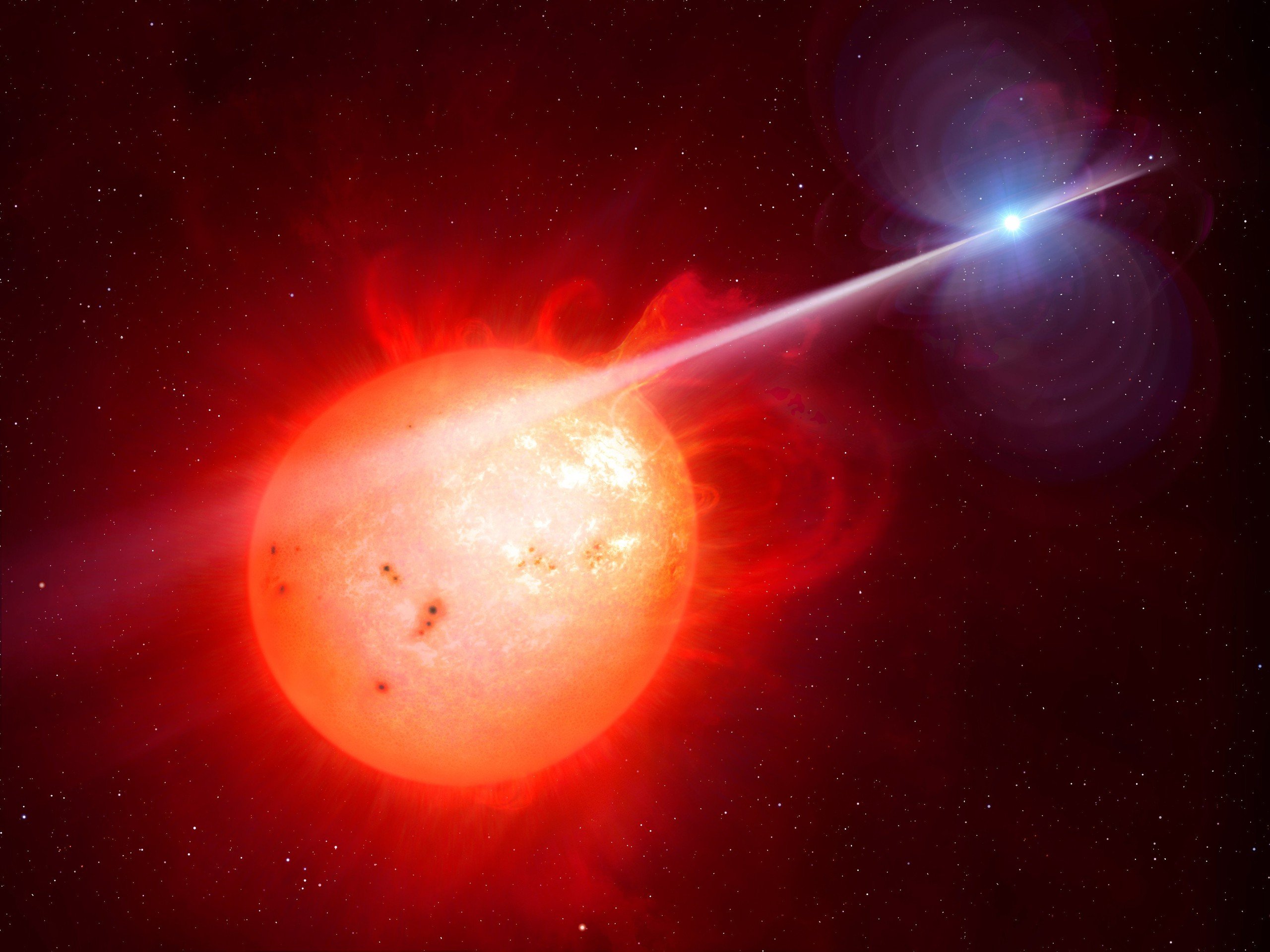
A pair of red dwarf and white dwarf stars in a pulsar system may emit mysterious radio signals - Graphic: ESO
Named GLEAM-X J162759.5−523504.3, the mysterious source was described as emitting radio waves for 30 to 60 seconds, every 18.18 minutes, until March 2018 when it stopped.
But then a series of equally strange signals reached the MWA in 2023, from a different region of the sky, a place crowded with celestial objects.
The second mysterious source emits radio waves lasting 5 minutes every 22 minutes. Examination of archived data reveals it has been active since at least 1988.
This second mysterious source is known as GPM J1839-10.
Scientists tried to find matching data in the observatory's archives, and they found a third signal.
Named GLEAM-X J0704-37, the third mysterious source emits signals lasting 30-60 seconds, occurring every 2.9 hours. This source is located in the outer reaches of the Milky Way galaxy, which contains Earth, in the constellation Carnauba in the South.
This third signal is easier to observe than the two similar signals mentioned.
Therefore, a research team led by astrophysicist Natasha Hurley-Walker from the International Centre for Radio Astronomy Research (ICRAR) at Curtin University (Australia) decided to focus on this third mysterious source.
They used the MeerKAT radio telescope array in South Africa to zoom in on the sky where the signal originated and found only a faint star that matched that location.
Spectroscopic analysis of the star revealed its identity: an M-type red dwarf.
However, red dwarfs are very common in the Milky Way, and other red dwarfs do not produce such signals.
The research team searched for something that could explain the anomaly and found that it was most likely a white dwarf, the remaining core of a collapsed Sun-like star.
According to a paper published in The Astrophysical Journal Letters , this binary star system may consist of a red dwarf with a mass of about 0.32 times that of the Sun and a white dwarf with a mass of 0.8 times that of the Sun.
But because they are highly compressed objects, white dwarf stars are much smaller in size.
If the two are orbiting close enough, the white dwarf could be accumulating matter from the red dwarf, resulting in continuous bursts of radiation from the white dwarf's poles.
Therefore, this white dwarf is actually GLEAM-X J0704-37, the entity that emitted the strange signal.
This also makes it a pulsar, a type of white dwarf with pulsar capabilities, which are typically more powerful neutron stars.
It is also one of the rarest types of stars in the Milky Way. GLEAM-X J162759.5−523504.3 and GPM J1839-10 may be two of the rare remaining examples of this type of star that are known to mankind.
Source: https://nld.com.vn/theo-tin-hieu-radio-la-dai-thien-van-uc-tim-ra-dieu-khong-tuong-196241216091943456.htm

![[Photo] Closing Ceremony of the 10th Session of the 15th National Assembly](/_next/image?url=https%3A%2F%2Fvphoto.vietnam.vn%2Fthumb%2F1200x675%2Fvietnam%2Fresource%2FIMAGE%2F2025%2F12%2F11%2F1765448959967_image-1437-jpg.webp&w=3840&q=75)


![[Photo] Prime Minister Pham Minh Chinh holds a phone call with the CEO of Russia's Rosatom Corporation.](/_next/image?url=https%3A%2F%2Fvphoto.vietnam.vn%2Fthumb%2F1200x675%2Fvietnam%2Fresource%2FIMAGE%2F2025%2F12%2F11%2F1765464552365_dsc-5295-jpg.webp&w=3840&q=75)















































![[OFFICIAL] MISA GROUP ANNOUNCES ITS PIONEERING BRAND POSITIONING IN BUILDING AGENTIC AI FOR BUSINESSES, HOUSEHOLDS, AND THE GOVERNMENT](https://vphoto.vietnam.vn/thumb/402x226/vietnam/resource/IMAGE/2025/12/11/1765444754256_agentic-ai_postfb-scaled.png)









































Comment (0)