


Blue-chip stocks all fell sharply.
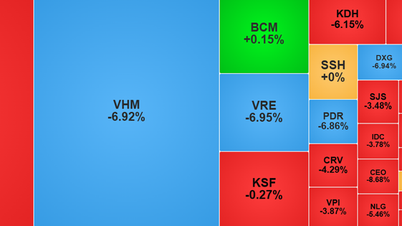
According to Mr. Do Bao Ngoc, Deputy General Director of Vietnam Construction Securities Joint Stock Company (CSI), the sharp decline at the end of the week mainly stemmed from large-cap stocks, especially those in the Vingroup ecosystem. Selling pressure from this group quickly spread to other sectors such as real estate, securities, and banking, causing many leading stocks to fall sharply, creating a negative psychological effect and dragging the market down.
The past weekend's trading session was typical of emotional selling, as the market had experienced a prolonged period of sideways movement with low liquidity and weakening cash flow. Although many stocks had fallen to low price levels, selling pressure continued, reflecting cautious sentiment and a defensive stance among investors, Mr. Ngoc observed.
In terms of macroeconomic information, the expert believes that there are almost no new negative factors emerging. The US Federal Reserve (FED) has just cut interest rates – a factor considered positive for the global financial market. Domestically, economic data has not shown any significant adverse signals.
However, the biggest bottleneck currently lies in market liquidity. Interbank liquidity is strained, interbank interest rates remain high, and institutional demand for cash is increasing towards the end of the year. These factors are not new, but in the context of weakening liquidity, the market becomes more sensitive and prone to "amplifying" reactions to negative developments in large-cap stocks.
Technically, the market has been trading sideways for about two weeks, but there hasn't been enough positive news, and cautious investors are staying on the sidelines. Smart money hasn't returned either, which isn't enough to sustain an upward trend.
After a period of sideways movement, the market often experiences a clear shift – rising if there is supporting news, or falling if the news is not strong enough. The weekend trading session showed the second scenario, with selling pressure increasing towards the end of the session, leading to widespread selling.
Notably, the Vingroup group of stocks officially broke its upward trend. For the past two months, while the VN-Index hovered around 1,600-1,800 points, this group of stocks played a significant role in supporting the index. If Vingroup were excluded, the actual VN-Index level would only be around 1,500 points. With the weakening of these leading stocks, coupled with a prolonged sideways movement and a lack of supporting information, increased anxiety triggered strong selling pressure.
In addition, foreign investors continued to sell heavily, focusing on large-cap stocks, further exacerbating the already fragile sentiment of domestic investors.
Furthermore, the market witnessed significant selling pressure, evidenced by strong selling orders concentrated towards the end of the session, high trading volume, and many stocks hitting their lower limit. This is believed to be not the action of individual retail investors, but rather from institutions or large-scale investors.
According to statistics from Construction Securities (CSI), the VN-Index started mid-December with positive sentiment, approaching its previous peak around 1,760 points thanks to concentrated demand in Vingroup-related stocks. However, the first session with a sharp drop quickly appeared and was followed by bearish candlesticks.
In just the last 30 minutes of the weekend trading session, a massive sell-off caused the VN-Index to plummet by 56 points from its intraday high. Numerous stocks hit their lower limit, mostly in highly speculative sectors like real estate.
At the end of the trading week from December 8th to 12th, 2025, the VN-Index closed at 1,646.89 points, down 94.43 points. Trading volume on the HOSE reached 778 million shares, equivalent to a value of VND 22,448 billion, 37.8% lower than the 20-week average.
This week saw 20 out of 21 sectors close in the red. Plastics stocks were the only group to gain, rising 2.78%, while retail, real estate, and port sectors experienced the strongest downward pressure, falling 7.74%, 6.28%, and 5.74%.
Foreign investors resumed net selling with a value of VND 5,791 billion. On the net buying side, HPG,FPT , and MBB were the top three stocks; conversely, VPL, VIC, and STB faced the strongest net selling pressure.
Analysts believe the market may continue to face downward pressure in the next few sessions due to margin calls (brokerage firms requiring investors to deposit more money or sell shares when the margin ratio falls below a safe threshold) following sharp declines at the end of trading sessions. Some investors are forced to sell off their positions due to a lack of funds to make additional deposits, creating further technical downward pressure.
However, this correction does not stem from macroeconomic risks, nor does it reflect internal problems of the businesses or the economy, but mainly from technical and psychological factors. As the selling pressure from forced liquidations gradually subsides, the downward trend is expected to weaken.
For investors holding stocks with strong fundamentals, experts advise against selling at any cost at this time. Over the past 2-3 weeks, most stocks have fallen by 5-30%, resulting in losses for the majority of investors.
Conversely, investors holding cash can take advantage of the opportunity to select good stocks that have been deeply discounted – previously inaccessible price levels. Restructuring the portfolio, eliminating underperforming stocks and shifting to stocks with strong fundamentals, high profit margins, or unique stories is considered a suitable strategy.
According to Rong Viet Securities Joint Stock Company (VDSC), the VN-Index is forming a Bearish Engulfing candlestick pattern (a bearish reversal candlestick pattern where the bearish candle completely engulfs the preceding bullish candle, indicating that selling pressure prevails) on the weekly chart, reflecting cautious sentiment around the historical peak. The market is likely to enter a state of equilibrium after the supply pressure is absorbed, with support near 1,600 points and resistance near 1,660 - 1,670 points.
In the current context, the main strategy remains cautious, maintaining a reasonable proportion of stocks, avoiding leverage, and prioritizing a medium- to long-term outlook on leading stocks with growth prospects in the 2025-2026 period, VDSC recommends.
The correction in the domestic stock market also occurred against the backdrop of international financial markets reversing their upward trend and falling at the end of the week, as profit-taking pressure increased after a period of strong gains.
US and European stocks reversed course and fell.
Specifically, US and European stocks fell across the board on December 12th, as profit-taking pressure narrowed the gains made following the Federal Reserve's decision to cut interest rates.
Although Wall Street's major indexes reached all-time highs mid-week, concerns about the high valuations of technology stocks, coupled with less-than-positive employment data, led to a market correction towards the end of the week.
At the close of trading, the Nasdaq Composite index fell 1.7% to 23,195.17 points, the S&P 500 fell 1.1% to 6,827.41 points, and the Dow Jones fell 0.5% to 48,458.05 points.
In Europe, markets were also affected by the shift in sentiment in New York. London's FTSE 100 fell 0.6% to 9,649.03 points amid data showing an unexpected contraction in the UK economy in October 2025. Frankfurt's DAX 30 fell 0.5% to 24,186.49 points, while Paris's CAC 40 dropped 0.2% to 8,068.62 points.
With both domestic and international factors lacking short-term support, the Vietnamese stock market is projected to continue fluctuating cautiously, with a clear divergence among different stock groups.
Technical correction pressure may still exist, but in the medium and long term, a stable macroeconomic foundation and the growth prospects of businesses are expected to help the market gradually rebalance as cash flow becomes more stable.
Source: https://baotintuc.vn/thi-truong-tien-te/thi-truong-chung-khoan-co-tuan-dieu-chinh-manh-nhat-tu-dau-quy-iv-20251214171418489.htm































































































Comment (0)