

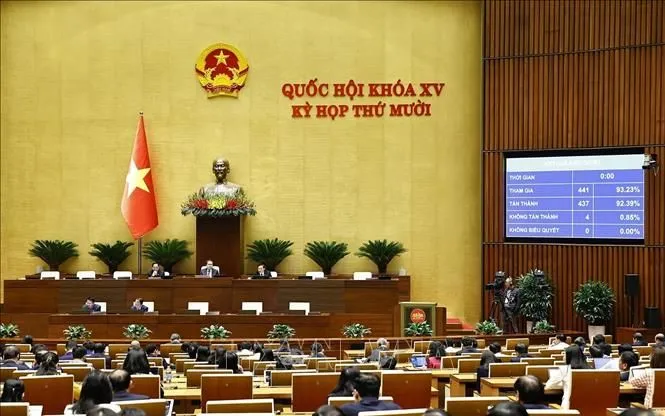
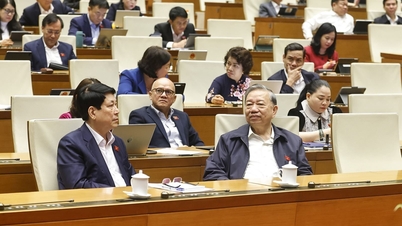
The National Assembly voted to pass the Law amending and supplementing a number of articles of the Law on Judicial Records. Photo: Doan Tan/VNA
Before voting, the National Assembly listened to General Luong Tam Quang, Minister of Public Security, authorized by the Prime Minister, present a Summary Report on the acceptance, revision and explanation of the draft Law amending and supplementing a number of articles of the Law on Judicial Records. Accordingly, at the discussion session in groups and the hall, the majority of National Assembly deputies agreed with the content of the draft law. The draft law has institutionalized the policy of streamlining the organizational apparatus, transferring the task of state management of judicial records, and many policies stated in the draft law clearly demonstrate a strong innovative mindset, aiming to promote administrative procedure reform, digital transformation, and innovation in state management methods of judicial records.
Regarding the purpose of managing criminal records information, the Government accepts and revises the draft law in the direction of: the purpose of managing criminal records information, criminal records, to help citizens know about their criminal records information to resolve personal administrative procedures. At the same time, clearly stipulate the purpose of supporting the management of cadres, civil servants, and public employees, minimizing the situation of requiring criminal records in personnel management.
Regarding the request for issuance of criminal records, provision of criminal records information, use of criminal records, and criminal records information, the Government accepts and revises the draft law in the direction of stipulating that agencies, organizations, and individuals are not allowed to request individuals to provide criminal records information or criminal records, and are only allowed to request form No. 01 in cases where the law, resolution of the National Assembly, ordinance, resolution of the National Assembly Standing Committee, or decree, resolution of the Government stipulates.
At the same time, the draft law has amended and supplemented regulations on agencies and organizations that, when requested to use personal criminal records, can exploit and use them through connecting and sharing data from the criminal records database and the national population database, without requiring individuals to provide criminal records.
Regarding criminal record forms No. 01, No. 02 and electronic criminal record forms, the Government accepts and revises the draft law in the direction of continuing to maintain criminal record forms No. 01 and No. 02. The forms are issued in electronic or paper form with the same legal value. In case the electronic criminal record form has been issued, the citizen's criminal record information updated and displayed on VNeID is considered an available information field, similar to full name, date of birth, and year of birth. Criminal record information displayed on VNeID has the same legal value as a criminal record form. Individuals do not need to request a criminal record form when needed.
Regarding the procedures for issuing criminal records and the time limit for issuing them, the Government has accepted and revised the draft law in the direction of regulating the procedures for issuing criminal records online to institutionalize the policy on developing the application of science, technology, innovation and digital transformation. Only a few cases of foreigners, people who do not have electronic identification, can request to be issued a certificate directly or via postal service. Individuals can authorize others to carry out the procedures for requesting a certificate for both types of certificates. The time limit for issuing a certificate is shortened to 5 working days.
Through the Law on Civil Judgment Enforcement (amended)
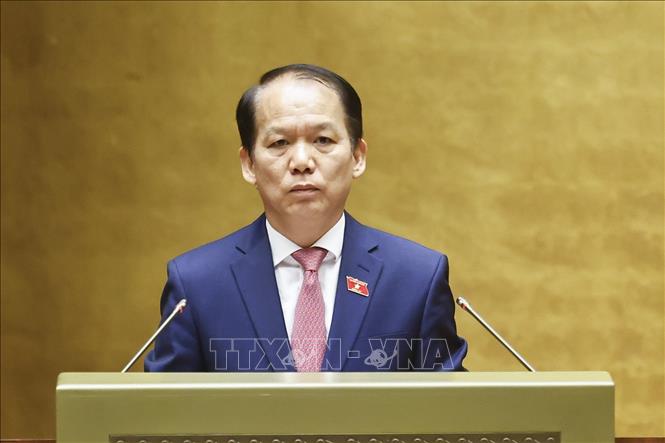
Chairman of the National Assembly's Committee on Law and Justice Hoang Thanh Tung speaks. Photo: Doan Tan/VNA
Also on the afternoon of December 5, the National Assembly voted to pass the Law on Civil Judgment Enforcement (amended) with 91.54% of delegates voting in favor.
Before voting, Chairman of the Law and Justice Committee Hoang Thanh Tung, authorized by the National Assembly Standing Committee, presented a report explaining, accepting and revising the draft Law. The National Assembly Standing Committee received a maximum of 79 comments from National Assembly deputies and many written comments, focusing on 116 important contents related to the model of enforcement organization, digital transformation, enforcement authority and reform of enforcement procedures. After revision, the draft submitted to the National Assembly consists of 5 chapters and 116 articles, fully institutionalizing the Party's policies and meeting the requirements of judicial reform in the context of strong digital transformation.
The content of socialized enforcement of judgments was also discussed in depth, many opinions wished to expand the enforcement authority for the Office of Enforcement of Judgments and Enforcement Officers to improve the effectiveness of socialization. However, the Standing Committee of the National Assembly affirmed that enforcement of judgments is an activity of state power, directly affecting the basic rights of citizens such as property and residence. If assigned to non-public organizations, it could cause great risks to security and order. Therefore, the draft Law has not yet given comprehensive enforcement authority to the Office of Enforcement of Judgments; Enforcement Officers are only entitled to request competent authorities to freeze accounts, assets or suspend transactions to prevent the dissipation of assets. This approach both ensures legal safety and creates room for socialization within the scope of control.
Another important group of issues is to shorten the duration of many execution procedures to reduce time and costs for people, in line with the spirit of Resolution 27-NQ/TW on legal policy reform.
Through the Law on Judicial Expertise (amended)
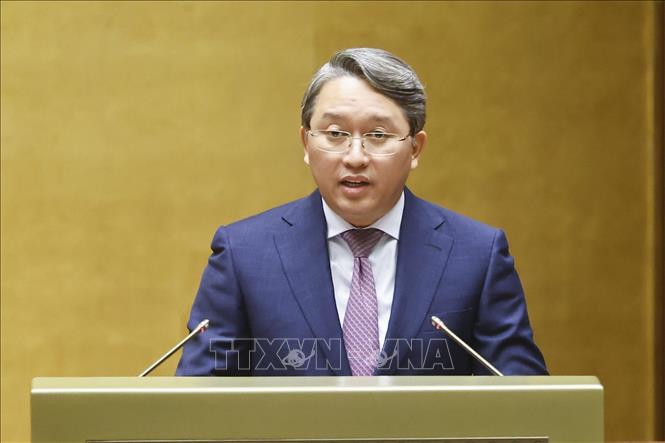
Minister of Justice Nguyen Hai Ninh speaks. Photo: Doan Tan/VNA
Also at the session, the National Assembly voted to pass the Law on Judicial Expertise (amended) with the majority of delegates in favor (92.81%).
Before voting, the National Assembly listened to Minister of Justice Nguyen Hai Ninh, authorized by the Prime Minister, present a summary report on a number of major issues of the draft Law on Judicial Expertise (amended).
Minister Nguyen Hai Ninh said that regarding the scope of establishment and operation of judicial appraisal offices, some National Assembly deputies agreed with the provisions of the draft Law on expanding the scope of establishment of judicial appraisal offices. In addition, some opinions suggested considering further expansion according to practical needs such as: information and communication, science and technology, pharmaceuticals, cosmetics, food safety, agriculture, forestry and fisheries, wildlife, precious and rare animals, environment, traffic and serving criminal proceedings, social needs to contribute to reducing pressure on current appraisal agencies and units. In addition, some opinions suggested that the Law not stipulate the establishment of judicial appraisal offices but consider assigning the Government to make specific regulations for flexibility.
Regarding this content, Minister of Justice Nguyen Hai Ninh stated that recently, the Party has issued instructions on continuing to improve the mechanism for mobilizing resources to socialize and develop the field of judicial appraisal, amending the Law on Judicial Appraisal in the direction of expanding the scope of establishing judicial appraisal offices in a number of fields and specialized appraisals with great and regular demand, ensuring compliance with practical requirements. In particular, Directive No. 54-CT/TW dated November 30, 2025 of the Politburo on strengthening the Party's leadership over judicial appraisal work has directed: "Promoting the socialization of a number of appraisal fields to meet the requirements of litigation activities, especially civil and administrative proceedings; encouraging and creating conditions for the development of non-public judicial appraisal organizations with a roadmap suitable to practical requirements, while at the same time having measures to ensure and strictly control the quality of appraisals".
Therefore, in order to institutionalize the above-mentioned policies and directions of the Party, the draft Law stipulates in the direction of expanding the scope of establishing judicial appraisal offices in a number of fields and specialties, in which the specialized fields of DNA, document, digital and electronic, and fingerprint identification are only performed for civil and administrative proceedings. Based on this basic principle of the Law, the Government will continue to specify the procedures for establishing, registering, and controlling the quality of operations of judicial appraisal offices.
Although there are some fields and specialized fields of expertise that have requests for expertise (environment, information and communication, science and technology...), there are not really large and frequent requests for expertise, so for now, the scope of establishing judicial expertise offices will not be expanded to these fields and specialized fields.
For the above reasons, the Government proposes to maintain the provisions on expanding the scope of establishment and operation of judicial appraisal offices as in the draft Law; in the fields of DNA, document appraisal, digital and electronic techniques, and fingerprints, judicial appraisal offices can only perform in civil and administrative proceedings, while public appraisal agencies perform in criminal proceedings.
Source: https://vtv.vn/thong-tin-ly-lich-tu-phap-tren-vneid-co-gia-tri-nhu-phieu-ly-lich-tu-phap-100251205195116364.htm
![[Photo] 60th Anniversary of the Founding of the Vietnam Association of Photographic Artists](/_next/image?url=https%3A%2F%2Fvphoto.vietnam.vn%2Fthumb%2F1200x675%2Fvietnam%2Fresource%2FIMAGE%2F2025%2F12%2F05%2F1764935864512_a1-bnd-0841-9740-jpg.webp&w=3840&q=75)


![[Photo] Cat Ba - Green island paradise](/_next/image?url=https%3A%2F%2Fvphoto.vietnam.vn%2Fthumb%2F1200x675%2Fvietnam%2Fresource%2FIMAGE%2F2025%2F12%2F04%2F1764821844074_ndo_br_1-dcbthienduongxanh638-jpg.webp&w=3840&q=75)






























































































Comment (0)