

Immediately after the election results on November 6th, US President-elect Donald Trump announced a series of cabinet nominees for his new term, which will begin in January 2025. These included key positions such as the White House Chief of Staff, and the heads of the Departments of State , Justice, Defense, Homeland Security, Health and Human Services, the National Security Agency, and the Central Intelligence Agency (CIA).
However, Trump's efforts to appoint loyalists to his cabinet are creating the first major test for the Republican majority in the U.S. Senate. Their leader must now decide how far they are willing to go to support or oppose cabinet nominations.
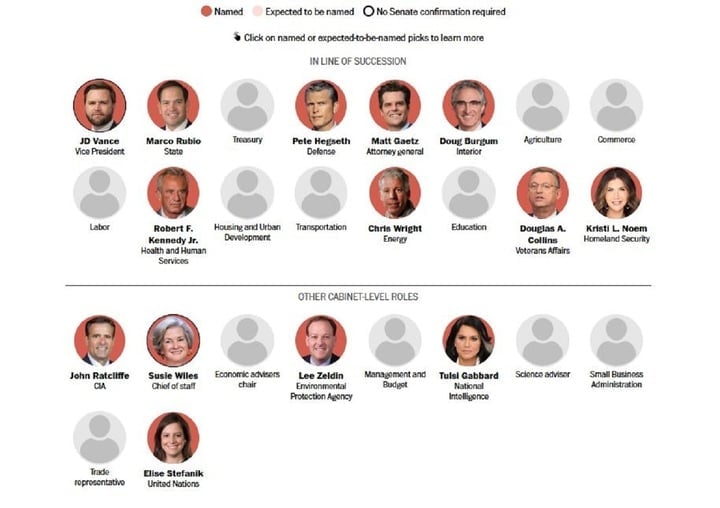
Some potential candidates for a second term for Mr. Trump. (Graphic: Washington Post)
The US Senate decides on the cabinet.
The U.S. Constitution stipulates that the U.S. Senate has the role of reviewing and approving members of the government appointed by the President, including ministers, U.S. ambassadors to foreign countries, and federal judges. This provision aims to control presidential power and help ensure that incompetent or corrupt individuals are not selected.
The Senate begins the confirmation process by holding hearings. These hearings take place before a 'committee with authority over the agency to which the nominee is to lead.'
The hearings can last for hours. Committee members ask candidates questions, often about their backgrounds, policy views, and future leadership plans.
For example, in 2021, the US Senate Foreign Relations Committee held hearings to confirm Antony Blinken, President Joe Biden's nominee for Secretary of State. The Senate Finance Committee confirmed Janet Yellen as Secretary of the Treasury.
This process will conclude with a committee vote, followed by a vote in the full Senate. A candidate needs the support of a majority of participating senators to be confirmed.
It should also be noted that not only the U.S. Senate but also other security agencies are involved in the vetting process, such as the Federal Bureau of Investigation (FBI). The FBI's role is even larger as it is tasked with vetting the backgrounds of over 1,000 candidates for positions in the new government; the results and files of each candidate are sent to the office of the President-elect and the U.S. Congress .
The new US Senate will begin its work on January 3, 2025, and the vetting process for nominated cabinet members will follow.
For Trump, the Republican majority in the Senate is a major advantage. However, not all candidates for his cabinet are popular with lawmakers.
A prime example is Pete Hegseth, a former Fox News host and nominee for Attorney General, and Florida Congressman Matt Gaetz.
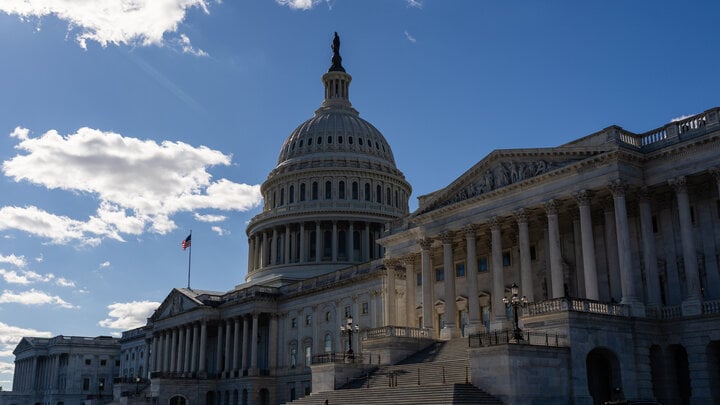
According to the U.S. Constitution, the President can appoint cabinet members while Congress is in recess. (Photo: New York Times)
Trump is trying to "bypass" the US Senate.
US President-elect Donald Trump said he wants to use the recess in Congress to appoint cabinet members, a move that could bypass Senate confirmation for some of the most important positions in the US government.
This move is expected to limit the remaining power of the Democratic Party in obstructing the new administration, but it could potentially strip the U.S. Senate of its role in confirming or rejecting presidential nominations.
According to the U.S. Constitution, the President can also appoint cabinet members while Congress is in recess.
Congress can adjourn for months, and presidents can use the direct appointment provision during this time to avoid leaving a key position vacant for too long.
Historically, many U.S. presidents have used their authority to appoint personnel without going through lawmakers in the Senate. President Bill Clinton made 139 appointments and President George W. Bush made 171, but neither of them used this process for high-level cabinet positions, according to the Congressional Research Service.
President Barack Obama attempted to continue that practice, making 32 appointments, but a 2014 Supreme Court ruling narrowed the president's powers in this regard.
To address this issue, the U.S. Senate, even during recess, holds sessions but does not conduct any legislative activity. The House of Representatives also retains certain powers over temporary appointments by refusing to allow the Senate to adjourn its sessions.
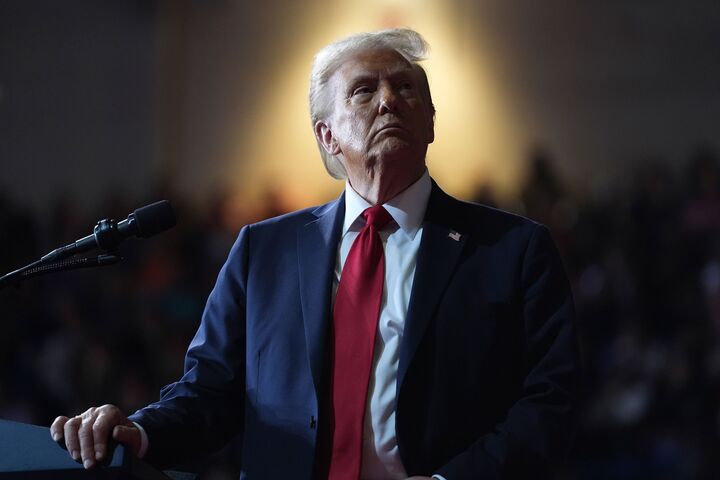
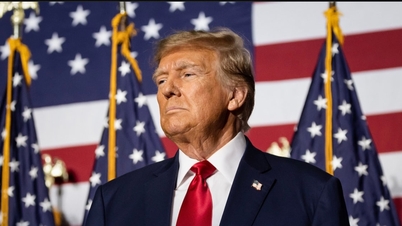
Trump appears to want to be a decisive president with greater authority than any of his predecessors. (Photo: CNN)
Appointing personnel during Congress's recess would significantly reduce the Senate's power. This may be what Trump is trying to achieve as he plans for a second presidential term, one that would be even more impactful than his first.
Trump appears to want to be a decisive president with greater authority than any of his predecessors.
President-elect Trump recently stated that the Senate "must approve" his overstepping of authority, otherwise he wouldn't be able to make timely appointments. He said that during his first term, some of his nominations took years to be approved by the Senate. According to the Presidential Transition Center, during his first term, it took an average of 115 days for those nominated by Trump to be confirmed.
Republican Senator John Thune, who was elected as the Senate Majority Leader for the next term, has pledged to maintain a "tight schedule until Trump's nominations are confirmed." Thune also did not rule out the possibility of allowing Trump to override Senate authority.
However, Democratic senators will do everything they can to block it, and it is unclear whether all Republican senators will support this option. Furthermore, appointments made during recess are only temporary. The appointment decision will expire at the end of the congressional session, for a maximum of one year.
Source: https://vtcnews.vn/thuong-vien-my-thong-qua-noi-cac-cua-ong-trump-the-nao-ar908048.html





























































































Comment (0)