

 |
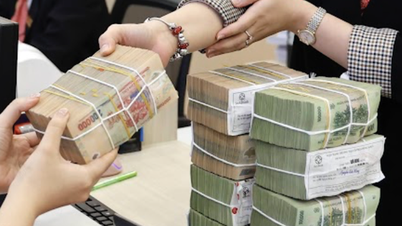
| In November 2025 alone, more than 20 banks increased deposit interest rates. Photo : Duc Thanh |
About to give up room, banks rush to raise capital
By the end of November 2025, credit in the entire banking system is estimated to increase by 16%, which means reaching the credit growth target set by the State Bank for the whole year. The State Bank has not yet announced an increase in credit room for the entire system, but banks are still rushing to increase interest rates to mobilize capital to prepare sources to serve high growth needs next year. The Prime Minister's direction to the State Bank to develop a roadmap to pilot the elimination of credit room next year is also a driving force for banks to "race" to mobilize capital.
According to the State Bank of Vietnam, as of the end of September 2025, capital mobilization is "short" VND 1.6 million billion compared to credit growth. This year, the difference could reach more than VND 2 million billion and could increase more strongly in 2026, when credit must grow higher to serve the economic growth target of 10%.
In the interbank market, overnight lending rates have exceeded 7%/year. Meanwhile, in the residential market, the number of banks joining the race to increase interest rates has not stopped. In November 2025 alone, more than 20 banks increased interest rates. In early December 2025, there were banks continuing to maintain interest rate increases, including banks in the Big 4 group. The banks that announced the latest interest rate increases are MB, BVB, VietinBank ... Up to now, the interest rates for many terms of the private commercial joint stock banks have been nearly twice as high as the interest rates of the Big 4 banks.
In particular, to attract deposits in the context of term deposits under 6 months being controlled by the mobilization ceiling, many banks have launched certificates of deposit with outstandingly high interest rates. Accordingly, the interest rate for 1-month term deposits with certificates of deposit can be up to 5-5.5%/year, twice as high as the normal interest rate.
 Regarding the difficulty in pouring capital into priority areas such as social housing, infrastructure, and digital transformation, if we only stop at stating the cause due to other ministries and branches, it is not really close, correct, and not enough to the role of macro-regulation and the responsibility of proactive policy advice of the State Bank. People and businesses look at the final result of whether capital reaches priority areas and reaches those in need, not just looking at whether the banking sector is "capital ready".
- Delegate Nguyen Thi Viet Nga (Hai Phong)
According to Mr. Ngo Thanh Huan, CEO of FIDT Investment Consulting and Asset Management Joint Stock Company, the fact that banks are rushing to raise interest rates to mobilize capital is due to supply and demand factors, not due to the reversal of monetary policy. This expert also believes that interest rates have been pushed down too low in the recent period, so the current adjustment is understandable.
Although interest rate increases are inevitable, in the context that the Government may remove the credit room in 2026, experts recommend that the State Bank have solutions to closely monitor credit in risky sectors, especially when capital is flowing too strongly into real estate and liquidity in this market is slowing down.
Removing credit room will have to go hand in hand with "capital adjustment"
In the report on the implementation of the resolution on supervision sent to the National Assembly this week, the Government affirmed that in the banking sector, in recent times, the Government has focused on directing and operating monetary policy proactively, flexibly, promptly and effectively; closely and synchronously coordinating with a reasonable, focused and key expansionary fiscal policy, in order to contribute to stabilizing the macro-economy, controlling inflation, promoting growth, and ensuring major balances of the economy. Credit growth of the whole system has been improved, ensuring to meet the credit capital needs of the economy...
However, delegates still have concerns about the credit management mechanism of the State Bank. Delegate Nguyen Thi Viet Nga (Hai Phong) said that Resolution 62/2022/QH15 requested: "Research to limit and eventually eliminate the management mechanism of allocating credit growth targets to each credit institution".
The Government's report shows that the State Bank has made adjustments in the operation of the credit room mechanism, but in reality it continues to maintain this mechanism.
“The State Bank still assigns and adjusts specific targets for each credit institution. The State Bank has not yet completely abandoned this mechanism and has not fully explained why, after many years, the request to 'move towards eliminating quotas' still has no timeline and specific solutions attached,” the Russian delegate suggested, asking the State Bank to have a clearer roadmap for eliminating credit room.
Although the State Bank of Vietnam affirms that it is directing capital flows into priority sectors, in reality, capital is flowing very strongly into the real estate sector.
According to VIS Rating analysts, real estate credit is increasing at a record high. By the end of the third quarter of 2025, outstanding real estate business loans increased by 37% over the same period, making real estate credit account for 23.7% of total credit. The company warned that real estate credit increasing too quickly could negatively affect banks' capital safety indicators. In fact, overdue debt in the home loan group of many banks has increased sharply.
Meanwhile, credit for social housing, infrastructure, digital transformation... is flowing slowly. Delegate Nguyen Thi Viet Nga said that the social housing credit package of 145,000 billion VND and the infrastructure and digital transformation loan package of 500,000 billion VND are being disbursed at a very slow rate, not commensurate with expectations.
According to the delegate, the National Assembly has repeatedly emphasized the need for the banking sector to direct credit flows to production, business, priority sectors, social housing, infrastructure, and digital transformation, but the report shows that there are still "bottlenecks" such as a lack of qualified projects, investment and land procedures, and a lack of project portfolios from ministries and branches. This shows that the Government's coordination role in inter-sectoral coordination is not good and it is recommended that the Government and the State Bank have solutions to "open the way" for capital flows to the right priority sectors.
Source: https://baodautu.vn/tiep-tuc-de-nghi-bo-room-tin-dung-lo-khi-von-chua-chay-vao-linh-vuc-uu-tien-d450716.html

![[Image] Close-up of the newly discovered "sacred road" at My Son Sanctuary](/_next/image?url=https%3A%2F%2Fvphoto.vietnam.vn%2Fthumb%2F1200x675%2Fvietnam%2Fresource%2FIMAGE%2F2025%2F12%2F13%2F1765587881240_ndo_br_ms5-jpg.webp&w=3840&q=75)
































































































Comment (0)